Until being taken over by NASCAR, ARCA was an alternate group to NASCAR, with their own rules, teams, drivers, and fan bases. Many drivers used ARCA to get to NASCAR, and if their NASCAR careers didn’t work, they had the option to return to ARCA.
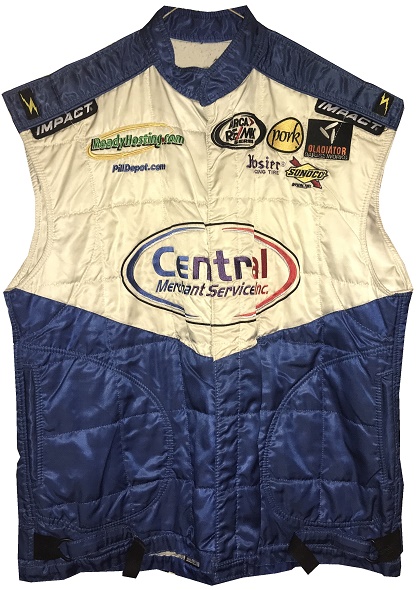
Central Merchant Services, Inc sponsored a few teams in ARCA from 2006 to 2009 for S&H Motorsports and Venturini Racing among others. They had some success on track. During that time, one of the pit crews wore this Impact vest. The vest shows very light use.
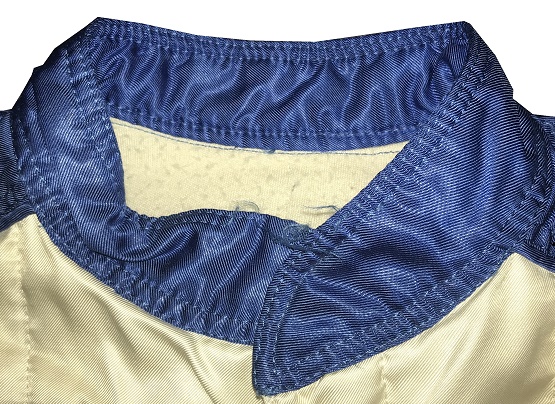
The blue collar is unadorned.
The right chest features READYHOSTING.COM, and PILLDEPOT.COM embroidered into it.
The left chest features ARCA RE/MAX SERIES, PORK, GLADIATOR GARAGE WORKS, HOOSIER RACE TIRE, and SUNOCO logos embroidered into it.
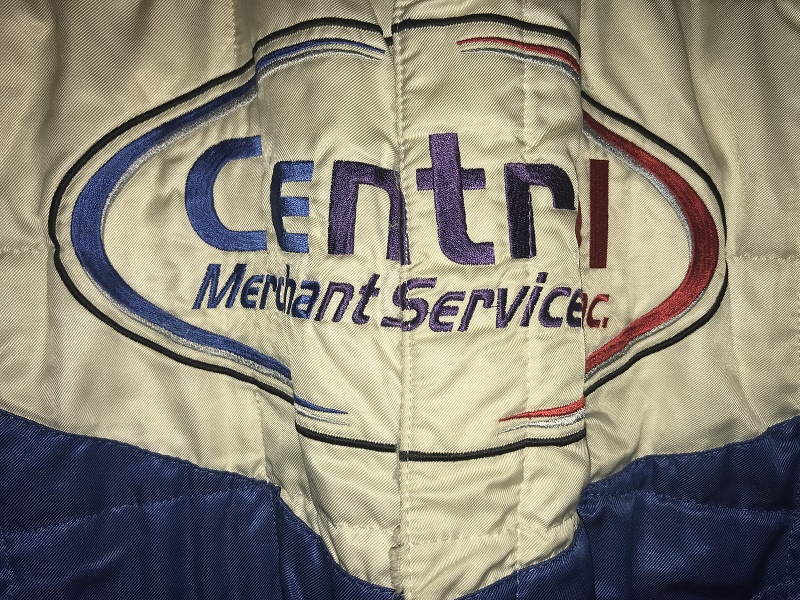
The front torso features a blue CENTRAL MERCHANT SERVICES logo embroidered in the white material. There is blue material below that.
Inside the front zipper is the Impact warranty label.
The corners have Velcro comfort straps attached. The blue shoulder epaulets are unadorned. The vest has standard arm holes present. The back of the vest doesn’t show that much use.
The blue collar is unadorned in the back.
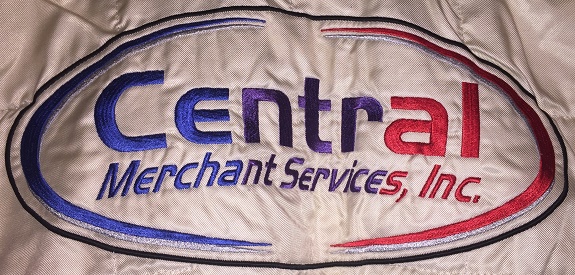
The back torso features a blue CENTRAL MERCHANT SERVICES logo embroidered in the white material.
It’s sad that ARCA, once an independent stock car racing series with its own identity is going to become just another NASCAR developmental series. Guys like Billy Venturini need ARCA to help their careers, and help keep their identity. I hope the ARCA guys are able to find their places after this is all said and done.
Next Friday Feature will feature the final Infinite Hero Challenge column.
Daniel Suarez #99 iFly Chevy Camaro-It’s an ugly, over designed mess. The only reason this is getting a passing grade, is because I like the color scheme. D-
Daniel Suarez #99 K1 Speed Chevy Camaro-It’s an ugly, over designed mess. The only reason this is getting a passing grade, is because I like the color scheme. D-
When it comes to silent comedy teams, you would be more pressed to find a duo more iconic that Laurel and Hardy. With a combination of great chemistry and slapstick, Laurel and Hardy films are fun to watch even in 2021. What makes the duo even better is that they were able to survive the transition into talkies. Their films with audio are just as funny as their silent films.
The first Laurel and Hardy movie was called The Lucky Dog, and it features Laurel being mugged by Hardy. Their next movie together was 45 Minutes From Hollywood, released in 1926. This was after the two had signed with Hal Roach Studios. Roach saw that the two had great comedic chemistry, and the physical differences between the two would make for some great comedy, and thus the legendary duo was fully born.
Stan Laurel and Oliver Hardy had two different careers outside of Laurel and Hardy. One particular short was called “Kid Speed” from 1924, released by Chadwick Pictures, and directed by Larry Semon.
The movie starts with a title card that states:
The tale is told of two men bold
Both loving a maiden fair
To decide the case
They entered a race
The loser to take to the air.
Then a scene starts at the garage, where Dangerous Dan McGraw played by Hardy is preparing his car. Two other men are working on the car, and McGraw slapstick throws them out of the garage. He gets a letter from race organizer Avery DuPoise hinting that the winner will win his daughter Lous’s affectations.
Avery DuPoise is shown with his daughter Lou in a car. It is then revealed that they are sanctioning and promoting a race by the corporation that Avery owns. Avery and Lou pull up to the garage, and McGraw opens the door for both of them. The scene shifts to another garage, where The Speed Kid played by Larry Semon. There was some physical comedy with smoke and grease coating The Kid’s face. This gets the attention of sleepy Sheriff Phil O’Delfa. They have a building to building argument. My complaint about Ford Sterling in The Speed Kings is nullified, as everyone is over the top in this movie, which works very well.
The Kid accidentally backs into The Sherrif’s bed. He then drives away with the bed and Sheriff with some slapstick driving. In a very impressive for the time sequence, he races through a series of different places, and into McGraw’s garage. He sees Lou, who starts flirting, much to the chagrin of McGraw and Avery. This leads to a lengthy slapstick sequence which is very well done, and very ambitious for the time.
This leads to the day of the race, where Avery and Lou watch from the stands, while McGraw and The Kid race. McGraw plots to cause the kid to lose, and the race begins. Like many other movies of the era, the racing schene is filmed using a combination of original footage, and footage of real racing footage, which looks really good, and seamless. One of McGraw’s henchman tries to use a wooden door to stop The Kid’s car, but to no avail. At one point, The Kid drives through a wall of debris, and a bucket get stuck, followed by a white dress, which scares his African-American mechanic. The Kid eventually crashes, and his car gets away from him. He catches up with it, just in time to jump over a bridge, that was blown up. A second explosion crushes McGraw’s car, and The Kid wins the race, and Lou’s hand.
While I did enjoy the movie as a whole, I do have to address one issue. The fact that in a few scenes, there are overtly racist tones. There are at least two instances of blackface, and a KKK referenece mentioned above. While I did enjoy the movie, I felt that these scenes were out of taste, and will dock the grade accordingly. With everything taken into account, I’ll give this a B-
Now as I said a few weeks ago, starting in February, I will only do a Friday Feature every other week, as I don’t have as much free time anymore. So the next Friday Feature will go back to The Vest Project.
Long before Disney took the concept of needless sequels to the level it is today, there were other examples. Sometimes these sequels were great, other times they serve no real purpose. This is especially true if the movie in question can be considered to have a “They lived happily ever after” ending. Today’s movie is one such example.
The Roaring Road ended in “and they lived happily ever after.” However, the writer of The Roaring Road, Byron Morgan decided to write The Bear Trap in 1920. This story would evolve into Excuse My Dust, a sequel to The Roaring Road in 1920. All the main cast members return for this sequel. As with the last movie, this is somewhat difficult to follow without sound.
The movie starts with a decent explanation of the events of The Roaring Road, then sets up the movie stating that ‘Toodles’ Walton has retired from racing, has Dorothy as his wife, and Toodles Jr. as a son, played by Wallace Reid Jr., It also explains that Toodles is now a high ranking member in Darco Automobiles. Wallace, Dorothy, and Toodles are a happy family, with Toodles Sr. giving Toodles Jr. his own play car. Dorothy chides Toodles Sr. for teaching Jr. how to speed, and Jr. almost rides into the street.
The scene then shifts to a top secret room in Darco, where J. D. “The Bear” Ward, and Tom Darby develop a brand new, more powerful stock motor for a car. Max Henderson, a salesman described as “A six-cylinder man with a one-cylinder conscience” is introduced. Darby and The Bear don’t trust Henderson, but Toodles likes him.
We are then introduced to The Fargot Bunch, representing Fargot, who is the chief rival to Darco. They have plans as well. Leading the bunch is President Mutcher, who has questionable ethics. It’s revealed that Henderson is in fact working for Fargot, and trying to steal the secret engine. The come to the conclusion that Toodles is testing the new engine, and decided to get him to race, and get a peek at the motor, not realizing he has left the speed game.
Ritz, Mutcher’s stooge, scouts Toodles’ route, and tries to get him to race, with his wife holding his infant son. The cops pull them over, and take him to the station. In court, Toodles waits for the judge, and his wife calls The Bear, asking for help. As The Bear arrives for court, he catches Ritz trying to spy on the engine, which isn’t on the car that Toodles was driving. Ritz dejectedly walks away.
Back in court, The Bear and the judge have a talk, and Toodles thinks he is getting off easy, but the judge suspends his license for six months. The Bear then proceeds to place signs in all Darco offices stating that any employee caught speeding will be promptly fired. Toodles argues with The Bear, but not only does he get nowhere, The Bear reveals that he is selling all three of their race cars. Dorothy talks Toodles down.
Fargot learns that Darco is selling their race cars. They set up a plan for a dummy company to buy their cars. This plan is successful, and within a week, Fargot has all of Darco’s race cars. That, coupled with his probation, takes a toll on him. The Bear becomes enraged when he sees a Darco add talking about their racing cars, which was pitched by the spy Henderson. Thus the trap is set.
The scene shifts to an automobile show, where all the manufacturers show off their latest models. At the show, a clipping is given to Toodles, claiming that Darco has no real racing prowess left. This sends The Bear into a rage, and a Darco/Fargot race from LA to San Francisco is set. This is not a race for just road cars, but full on race cars are in this race. Because of his probation, Toodles isn’t allowed to drive officially. However, through Henderson, his old race car is sold aback to him. In testing, he nearly hits his own son and nanny, which enrages his wife.
Toodles and his mechanic Griggs work on Toodles’ car. While the car is being worked on, Toodles goes home to make things right with Dorothy. He runs into his eternally cigar smoking father in law, who give him a note. Dorothy won’t see Toodles until he gives up speeding forever. The Bear sides with his daughter. Griggs reluctantly agrees to race, and Henderson tries to find out more about the Darco engine.
Henderson mentions to Toodles that he thinks the new engine is in the car Toodles is going to drive, and calls Fargot. Toodles, realizing what is going on, tells Henderson that the new engine is, in fact, in Toodles’ car, and alerts The Bear. When the night of the race comes, all are ready, but Toodles gets a telegram asking him to come to San Francisco, because his baby is sick. Toodles decided to replace Griggs in the race. Mutcher tells his driver to wreck Toodles, and The Bear replaces his driver in his car to protect his son-in-law. The race then begins.
The night racing shots are really well done, as it’s actually shot at night. Daytime comes, and Toodles is in the lead. The Bear has to pull over for a pit stop, and realizes that Toodles is still in the lead. The course is changed by a bridge out sign. In trying to catch up with Toodles, The Bear drives over a railroad bridge, narrowly missing a train. Ritz catches up to Toodles, and they wreck. Ritz inspects the car, and realizes they have been duped. A fight ensues, and Fargot’s second driver vows to chase down The Bear. He finds out that Fargot bought all of Darco’s racing cars.
The Bear is now unknowingly in the lead. Thinking he is in third, he actually wins the race. It’s announced that Toodles and Ritz were in a wreck, and as The Bear tries to figure out what happens, Toodles and Oldham, Fargot’s driver, come in second. Toodles reveals that the car is a Darco car in disguise, and he leaves to check on his child, which turns out to be a false alarm. Relieved, The Bear gives the $10,000($134,833.68 in 2020), Dorothy forgives Toodles, and the movie ends.
The movie was a little too complex, given the technical restrictions. Also, without sound, it’s really hard to tell who is who sometimes. This could have been an original movie, but it’s a sequel for no real reason. Still, it is well shot, the racing is good, and there was a lot of effort put into it. So I’ll give it a C.
Next Week, a silent movie from 1924 featuring another silent film comedy legend.





 DGF2099-Main Page