To say oil is critical to auto racing is like saying that water is the key to life. Without oil, auto racing couldn’t exist as it does today. Crude oil is refined into gasoline, and also into motor oil, which keeps the engine lubricated.
In recent years, NASCAR has started a green program to help their image. This includes recycling, clean energy, and oil recycling. Not long ago, it was discovered that used motor oil can be re-refined into almost anything that crude oil can be refined into. Interestingly, sometimes oil was sold to collectors, as is evidenced by this display of oil from Kyle Busch’s #18 Toyota Camry when he won the 2009 Shelby 427 at Las Vegas.The package is about 5 inches long by 3 inches wide, and contains a card, an ounce of thick motor oil, a COA, and a card. This is one of only 504 ever made.Inside the box is the display which is slightly smaller than the box. It has a small oil drum with a small amount of motor oil. The oil has a thick viscosity, which is needed because of the wear that Cup engines produce during a race.The COA comes in the box, and states that this is #359 of 504.This is an interesting little piece of memorabilia, something that I’ve never seen offered before or since. With NASCAR going green, it seems unlikely that something like this will be offered up again. Since I know that this week’s column was a little thin, so I’m switching gears, and offering up…
Tailgating Time!
NASCAR fans love red meat. That has never been disputed by anybody. While most people simply grill steak, I thought it would be good to make something a little more complex…and tasty. With that, I present:
Steak and Mushrooms
8 Servings
Ingredients:
8 steaks
4 packages pre-sliced baby bella mushrooms
4 cups red wine
2 sticks unsalted butter
16 sprigs of thyme
Kosher salt and pepper
Vegetable oil
Instructions:
1. Place a large saute pan on the stove top over medium-high heat.
2. Salt and pepper both sides of your steaks, and then add them to the hot pan.
3. Sear 4-5 minutes until browned, then repeat on the other side.
4. Just before you remove the steaks from the pan, add the thyme springs and butter in there. Let it melt, then take a spoon and baste the tops of the steaks continuously with it.
5. Set the steaks aside on a plate to rest.
6. Put another drizzle of oil in your hot pan and add the mushrooms.
7. Season them with salt and pepper and cook them, tossing occasionally, until they release their water and start to take on some color, about 8 minutes.
8. Add the wine, and let the liquid cook down until thickened.
9. Plate your steaks on top of the crispy green beans, and add mushrooms on top of steak with sauce.
Founded in 1995, Ultra Motorsports went through different drivers and manufacturers until 2002, when they settled on Dodge. In 2002, they acquired Sirius Satellite Radio as a sponsor, and raced the full season. This sponsorship continued until the end of 2003, during which time, the team fielded a second car. After the 2003 season, they lost the sponsorship, and only raced in 2 races in 2004. The team would get sold to Robby Gordon in 2005.
In 2002, Ultra Motorsports raced a full season with Casey Atwood as the driver. The team didn’t do much that season, and Atwood was replaced with Jason Leffler for the last two races of the season. In 2003, the team raced a full season with Jimmy Spencer for 35 of the 36 races, and Ted Musgrave for a single race. Spencer had 1 top 5 and 4 top 10’s. During that time, one of their crew members wore this Simpson one piece double-layer firesuit.The suit shows decent use, having been worn for two seasons.The collar is a standard collar, with SIRIUS SATELLITE RADIO logos on the sides.Inside the cowl is a standard Simpson warranty tag. There is no flags or other indications of any kind present.The right chest features a NASCAR WINSTON CUP SERIES logo, and a small SIMPSON patch present.The left chest features a DODGE logo embroidered into it.The front torso features a large white SIRIUS SATELLITE RADIO logo, which shows signs of wear, embroidered into it.The black belt features a white GOODYEAR logo embroidered into it.The black legs feature white SIRIUS logos in television position on the sides. The cuffs show damage, including fire discoloration.The right shoulder is missing its epaulet.The right sleeve features a SIMPSON logo, a SOUTHERN PRIDE TRUCKING logo, and a SIRIUS SATELLITE RADIO logo on the top, and SIRIUS at the end of the sleeve in television position.The left shoulder does have its epaulet, and it is embroidered with a SIRIUS logo.The left sleeve features a NASCAR logo, a ULTRA/EVERNHAM MOTORSPORTS logo, and a SIRIUS SATELLITE RADIO logo on the top, and SIRIUS at the end of the sleeve in television position.The back of the suit shows wear on the logos.The back of the neck is unadorned.The Sirius dog is embroidered on the back, and there are a number of stains on the logo.Ultra Motorsports was one of those teams that raced full seasons in the Cup series, with no real tangible results. Their time in the Truck Series was much better, with 36 wins from 1995 to 2004, and the 2004 Driver’s Championship with Ted Musgrave. In total, Ultra Motorsports had 36 wins, 157 top 5’s, and 233 top 10’s. They should have just focused on the Truck Series.
Next week, an aspect that all race cars share, but isn’t sold as memorabilia…for the most part.
As I said last week, the name Andretti is to racing what the names Gretzky, Jordan, Unitas, and Ruth are to hockey, basketball,football, and baseball respectively. It is a name associated with the sport. Mario Andretti is considered to be one of, if not the greatest race car drivers in the world. He has to his record, 33 USAC Champ Car wins, 19 Cart/CCWS wins, 12 Formula One wins, 3 IROC wins, and has also won the 1966 Fuji 500, and won the 1967 Daytona 500.
After his career ended, he opened up his own racing experience, The Mario Andretti Racing Experience, where you can pay to ride in, or even drive an IndyCar. He gives fans a chance to live their dreams. The suits that he uses are simple firesuits that anyone can use, and are designed to be easy to use, such as this one.This Pyrotect SFI 1 rated suit shows a decent amount of wear, with tears and some stains.The collar is unadorned, and is a standard collar.The suit is not Nomex, but is a treated cotton. The Pyrotect tag states that. There is also no warranty label on this suit…which is odd.Both the left and right chests feature small MARIO ANDRETTI RACING EXPERIENCE logos. The front torso features a large MARIO ANDRETTI RACING EXPERIENCE logo.The front of the belt has 1-877-RACELAP embroidered into it. There is a tear in the fabric. The suit doesn’t use a zipper, but oddly uses Velcro.The legs have standard cuffs, and have white and black stripes running up the sides.The shoulders have epaulets, but they are almost torn off of the shoulders.The right sleeve has a MARIO ANDRETTI RACING EXPERIENCE logo embroidered in black on a white background, in television position.The left sleeve has the same MARIO ANDRETTI RACING EXPERIENCE as the right sleeve, but the SFI certification is also present.The back of the suit doesn’t show much wear.The back of the neck is unadorned.The upper back torso features a MARIO ANDRETTI RACING EXPERIENCE logo embroidered into it.The seat area has a little bit of padding added.Mario Andretti joins Rusty Wallace and Richard Petty in opening a racing experience. These have proven to be popular, and I’m wondering if guys like Dale Earnhardt Jr., or Jeff Gordon will start their own experiences. Who wouldn’t want to get racing lessons from guys like these? I certainly would!
Next week, another firesuit, this one worn by a professional.
The name Andretti is to racing what the names Gretzky, Jordan, Unitas, and Ruth are to hockey, basketball,football, and baseball respectively. It is a name associated with the sport. Mario Andretti is considered to be one of, if not the greatest race car drivers in the world. He has to his record, 33 USAC Champ Car wins, 19 Cart/CCWS wins, 12 Formula One wins, 3 IROC wins, and has also won the 1966 Fuji 500, and won the 1967 Daytona 500.
After his career ended, he opened up his own racing experience, The Mario Andretti Racing Experience, where you can pay to ride in, or even drive an IndyCar. He gives fans a chance to live their dreams. The helmets that he uses there are based on his distinctive silver and red helmet, such as this one.This Bell helmet has a lot of scuffs and scratches on it. On the left side, there is a large scratch, and someone has written “2426” on the sides.The front of the helmet has ventilation tabs, a helmet stripe with 1-877-ANDRETTI printed, some wear on the interior material, and some scratches.The right side features a large scratch, and several small scuff marks present.The huge red stripe that extends up the back has a lot of scratches and scuff marks.The top of the helmet features more scuff marks and scratches on the red stripe.The inside of the helmet is heavy damaged, with material loss, and other damage.In racing, you need a helmet and a suit if you are going to ride in a race car. I discussed the helmet, next week I’ll discuss the suit.
Tailgating Time!
Racing fans love good food, and mac and cheese is a great choice. Adding bacon makes it much better. So I present:
Baked Bacon Macaroni and Cheese
6 Servings
1 package macaroni
2 tablespoons butter
2 tablespoons butter
1 3/4 cups milk
1/2 teaspoon salt
1/8 teaspoon pepper
1/2 pound Cheddar cheese diced or grated (2 cups)
1/3 cup bread crumbs
1 1/2 tablespoons melted butter
2 packages real bacon bits
Instructions:
1-Cook macaroni as directed and drain.
2-Melt butter in heavy saucepan; blend in flour.
3-Stir in milk slowly and cook, stirring constantly, until mixture thickens.
4-Add seasonings, bacon bits, and cheese, stir until cheese is melted.
5-Add macaroni and transfer to a buttered 1 quart casserole.
6-Combine bread crumbs and melted butter and sprinkle over macaroni.
Every racing fan wears their favorite driver’s merchandise. This has been done in sports since the early days. Teams, drivers and leagues all try to crack down on phony merchandise since it costs everybody money, and benefits the wrong people. There are ways to tell fake from real merchandise. Sometimes, albeit rarely, there are items that are made by the league, with tagging to match.
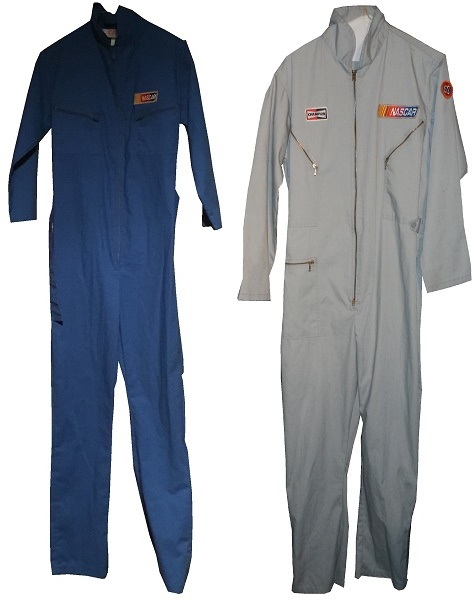
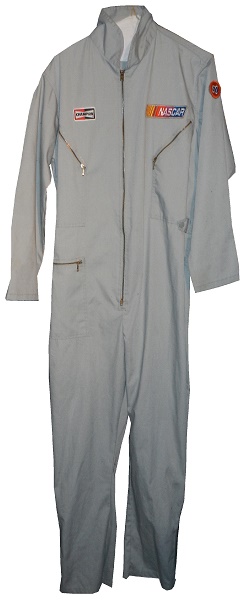
In the 1980’s, NASCAR allowed The Longley MFG Company to make mechanic jumpsuits with official NASCAR branding and tagging. The reasons for making these suits is unclear. However, they were made and still survive to this day.
The gray and blue suits show some light wear, but are in otherwise good condition.The collars are small and are an open design.The blue suit tag has an OFFICIAL NASCAR LICENSE indication, and a small flag indicating 702 SMALL. The gray suit has a similar tag setup.The right chest on the blue suit features a zippered pocket, and is otherwise unadorned. The gray suit features a CHAMPION patch.The left chest on both suits feature a vintage NASCAR logo patch.The front torso on the blue suit features a tie belt, and is unadorned. On the gray suit, the belt is a snap belt.The legs on both suits are unadorned.On both suits, the shoulders are unadorned.On both suits, the right sleeves are unadorned.The blue suit, the left sleeve is unadorned. On the gray suit, there is a small Unocal 76 patch on the upper sleeve.The back of both suits are completely unadorned.These suits are an interesting piece of merchandise. Why they exist is still a mystery. Who bought them, and what did they use them for? Why do they still exist? They are pretty well made, and they look nice, but I still can’t understand why they were made. Maybe that answer will never be known.
Next week, we go back to a fantasy camp for the first of a two part series.
As I discussed last week, I went to St. Louis for a few days, and I spent time at the Budweiser Brewery Experience on one of my days. The second attraction I attended was the St. Louis Cardinals Hall of Fame and Musceum.
While its existence dates back to the original Busch Stadium days, the current St. Louis Cardinals Hall of Fame and Museum was established in 2014, in St. Louis Ballpark Village. It houses 15,000 artifacts, of which only a handful are on display at any given moment. These artifacts give a look into the history and players of the St. Louis Cardinals.
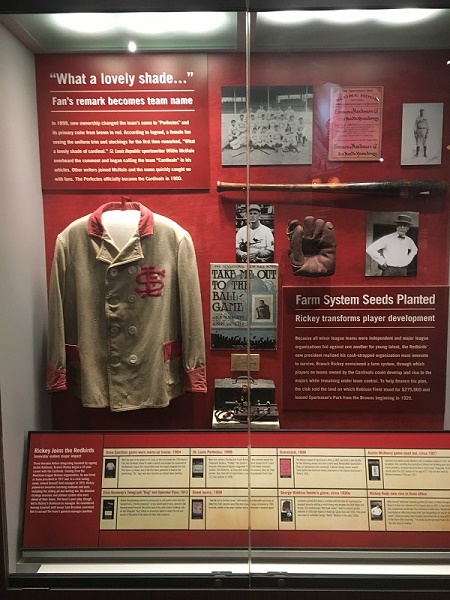
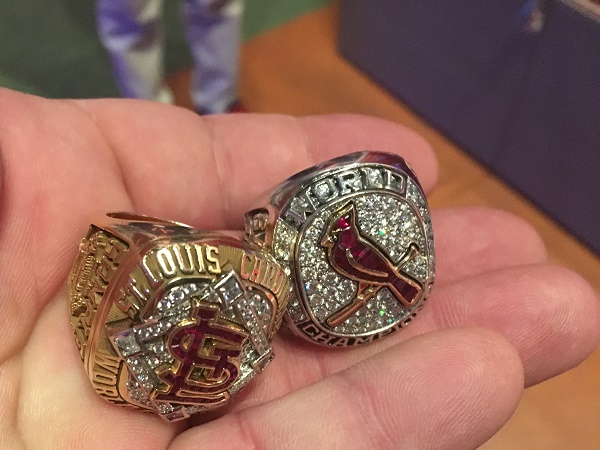
When you walk in, the first thing you see is the Hall of Fame plaques. All 37 members of the Cardinals Hall of Fame have plaques here.The next thing you see is a display with the three 2017 inductees, Pepper Martin, Tim McCarver, and Mark McGwire. Near the elevator, there is a sign showing where Busch stadium was located, and where you are in the stadium, specifically, behind second base.Upon entering the museum, you see a list of the various professional baseball teams in St. Louis, and where in the city they were located, a Sportsman Park banner, and straw hats suspended from the ceiling.The museum starts with the founding of the team in 1882, and there is a display with a number of items, including uniform items.The history moves to 1926, where the Cardinals won their first World Series, and wore special WORLD CHAMPIONS jerseys in 1927.The Cardinals would go on to win 5 pennants in 8 years, 1926, 1928, 1930, 1931, and 1934. The y would win the World Series in 1931 and 1934. This display features some of the artifacts from this era.The Cardinals won the 1942, 1944, and 1946 World Series, and this display represents those wins.The late 1940’s saw Harry Carry used as the Cardinals radio announcer, and while the team had some success, they weren’t able to score another World Series Championship until 1964. This display houses some of the artifacts from this era.There is a large model of Sportsman’s Park near this display, which housed the Cardinals from 1920 until 1966.The 1934 St. Louis Cardinals were known as the Gas House Gang because of their rough tactics. This display pays homage to them.The next display is devoted to the greatest player the St. Louis Cardinals ever had, Stan “The Man” Musial. This display features uniforms and trophies earned by Musial, including one of his Major League Baseball Most Valuable Player Awards. His last major award was the Presidential Medal of Freedom, awarded in 2011 by Barack Obama.The Cardinals are credited with creating the “Knothole Gang” which was designed to give tickets to underprivileged children in 1917. Though the idea dates back to the 1880’s. The team sold stock, and for every $50 in stock($1,064.06 in today’s money) a seat was set aside for a child. This would lead to a group of devoted fans, as this display shows.St. Louis has hosted a number of All-Star Games, and this display shows a series of artifacts from these games.In 1944, the Cardinals played what came to be known as the “Trolley Series”, “Streetcar Series”, or the “St. Louis Showdown.” It was a World Series against the St. Louis Browns. The Cardinals would win the series 4 games to 2, in what was the last World Series featuring two teams from the same city that isn’t New York. This display features a series of artifacts, both Cardinals and Browns from that Series.The next area is the World Series section, which houses various items from the Cardinals World Series Championships. These include a championship ring, tickets, and uniforms. The first one is devoted to the 1926 World Series.The next display is for the 1931 World Series, and the prominent feature is a 1932 Cardinals World Series sweater.The 1934 World Series display features a Leo Durocher jersey, and some awards won by players.The next display features the 1942 World Series, and has a uniform, some programs, tickets, and some other memorabilia.The 1944 World Series is represented by a jersey, pennants, tickets, programs, and a pocket watch.The 1946 Cardinals are represented here by a jersey, some other game used memorabilia, and a team signed baseball.18 years after winning the 1946 World Series, the 1964 Cardinals won the World Series, and has their own display, featuring a jersey, cap, cleats, some awards and programs.In 1967, the Cardinals won the Series, and the trophy is displayed in the team’s World Series display, along with a jersey, and some other game-worn memorabilia.In 1982, the Cardinals won the World Series wearing their powder blue pullovers. They are represented here with a jersey, World Series Trophy, a pair of cleats, and some other memorabilia.The 2006 World Series Champion St. Louis Cardinals are represented by a jersey, the Commissioner’s Trophy, program, scorecard, and champagne bottle.The 2011 World Series, the Cardinal’s most recent to date, is represented by half of David Freese’s jersey, which was torn in half after game 6. Also present is the Co missioner’s trophy, a game-used bat, a score card, and other memorabilia.Not all Cardinal teams that won the pennant won the World Series, and this display is devoted to Cardinal teams that won the pennant, but not the Series. It’s a group of Memorabilia including tickets, baseballs, and a cap, among other things.The next display covers the decade from 1950 to 1960, which wasn’t a great decade. There are three jerseys, and an early batting helmet, as well as a trophy, and other game-used items.The Negro League was represented by the St. Louis Stars, and they are represented by this display, including a 1998 Stars throwback, a 1928 game-used baseball, and a suitcase.St. Louis also had the St. Louis Browns, which moved to St. Louis in 1902, after operating as the Milwaukee Brewers from the late 1800’s to 1901. The Browns played in St. Louis until 1953, when the moved to Baltimore and became the Orioles. This display is devoted to the Browns, including Eddie Gaedel, a little person who played as a pinch hitter for one game under owner Bill Veeck.The next section is devoted to International baseball, primarily Japan, and the first thing you see is a World Baseball Classic Championship trophy.The first display focuses on pre-war Japanese trips by MLB players. Included is a John McGraw jersey, a Moe Berg jacket(Ironic, given that Berg was an Allied spy against the Axis during the war.), a Babe Ruth game-used bat, diaries, scrapbooks, and other memorabilia, including an Ozzie Smith game-used jersey.The next display is focused on Stan Musial’s trip to Japan in 1958. There are a lot of artifacts, including baseball programs and photos, and a number of Japanese souvenirs. A kimono worn by Lillian Musial is hung across from this display.In 1968, the Cardinals took a second baseball trip to Japan. This display features several items from that trip. Including a jacket, an umbrella, autographs, and other various items. The itineraries for the trip are located next to this display.The next part of the international pavilion is devoted to the World Baseball Classic, and features game-used baseballs, game used caps, a gold medal, a game-used base, a game used catcher’s mask, and some other memorabilia.The final display in the international pavilion is devoted to Asian players for the Cardinals, and has some jerseys, both domestic and international, game used bats and balls, and other various international objects.The next section is devoted to the first Busch Stadium era. It is bathed in blue light, and has a large vintage model of Busch Stadium, made prior to the stadium’s construction, when it was know as ” Civic Center Busch Memorial Stadium” though the Civic Center part was rarely, if at all used.The first display features Cardinals items from 1966 to 1976, the first Busch Stadium decade. There are a number of uniforms, awards, hats, a bat, and a helmet and cleats, among other things. The next display is devoted to the period from 1978 to 1983, and features a number of uniforms, several awards, and other game-used memorabilia.The next display is from the Whitey Herzog era, from 1982 to 1987, and it features a number of items including jerseys, trophies, game used memorabilia, and other items.The 1998 home run record chase has its own display. In it is the home plate from Mark McGwire’s 70th home run, several jerseys, game used bats.Next to it is an early 1990’s display, which features a few uniforms, and a baseball.The next section houses an area where you can handle World Series rings and game-used bats. I had the chance to hold two World Series rings, and a Stan Musial bat, which he had broken, and repaired.The last feature of the first Busch Stadium era is devoted to the 2000’s, and includes a base, jerseys, and some other game-used memorabilia.As you exit the Busch Stadium section, there is a section of game-used bats in a display case.Next to the game-used bats is a display which features the inspiration for the Cardinals logo, which was a set of table decorations at a church function in 1921. Branch Rickey was in attendance, and he was so enamored with the designs, he asked Allie May Schmidt to make him some cardboard Cardinals, which became the design still used to this day. These are the original cardboard Cardinals, one of which is inscribed.The biggest display in the museum is a comprehensive history of the Cardinals uniforms and logos, starting at the beginning, and ending with today’s set.The next section is the Manager’s Corner, which features displays from several Cardinal managers, starting with Rogers Hornsby, and includes Billy Southwith, Eddie Stankey, Red Schoendienst, Whitey Herzon, Joe Torre, Tony La Russa, and Mike MAtheny. These displays include uniform items, and other memorabilia.The final section is devoted to the current era, and the current stadium. It starts off with a series of items from non-baseball events at Busch Stadium II, including a soccer jersey, a soccer ball, music tour posters and passes, and a game-used football.The next display starts off the current era, with a display of uniforms, awards, and game-used memorabilia from modern era players.There is a scale model of Busch Stadium II, and behind that, there is a display featuring memorabilia from players currently playing for the Cardinals, which include jerseys, bats, caps, and other memorabilia.The final section is devoted to giveaways, which are separated into baseball cards, bobble heads, and baseballs.I did a video about the museum, and it can be viewed below:
Next week we get back to auto racing, with a couple of mechanic suits.
Last week, I took a trip to St. Louis. I had been wanting to do something for a while. I had been planning this for some time, and it happened, and I had a great time. It was only a four day trip. Days 1 and 4 were spent on the Amtrak Lincoln Service.
The second day was spend at the Budweiser Brewery Experience. I made a video of my experience, here is the transcript, and the video as a whole is posted below:
Introduced in 1876 by Carl Conrad & Co. of St. Louis, Missouri, Budweiser went from a local brewery to a national brewery through a combination of innovations of advertising, and distribution. Under the supervision of Eberhard Anheuser and his son in law Adolphus Busch created Budweiser, which was perfect for the hot summers of St. Louis. Using pasteurization, and refrigerated rail cars, this new brand spread like wildfire, into the international brand we all know today. While Budweiser is brewed all over the world, it will always call St. Louis home.
The Budweiser brewery in St Louis is embracing their history, and status, with a biergarden, museum, and factory tour. Factory tours are disappearing, for the most part. Brewery tours have proven profitable. My day at the brewery started at the biergarden, which is marked with a 20 foot tall B from the old BUDWEISER sign located on the canning plant.
The biergarden is located next to the main lobby. During the winter months, it is encapsulated in a tent, and is well heated. The day I was there, I had some Budweiser-battered chicken strips, and some of the various kinds of beer, including a chocolate stout created by the fire department in the “Research Pilot Brewery” or “RPB.” which is the R&D for the brewery.
Since the brewery is actively making beer, clouds of exhaust periodically drift over the tent, and provide a nice effect.
Next to the biergarden is the lobby, where you check in for your tour. There is a gift shop in the lobby. Off to one side is a display featuring the basics of brewing, their current lineup, and some memorabilia from the history of the company, as well as some paintings, including a Leroy Neiman original Clydesdale painting.
One of the things that the Budweiser Brewery Experience offers is Beer School. Beer School is a 45 minute class on the basics of brewing, the composition and profiles of different beers, and beer/food pairings. It comes with samples, a free flight glass, and a token for a free beer from the biergarden. It takes place in the beer museum…but more on that later.
The best tour to take is the Brewmaster Tour. It costs $35, and covers most of the areas of production in the brewery. It starts in a small area behind the lobby, and starts off at the Beechwood Aging Cellar, where the unfiltered beer is filtered through beechwood for 21 days. We got a sample of the unfiltered beer, which is on par with a small batch micro brew.
The next stop is the beer museum, which is housed in the former corporate office, which itself is a former schoolhouse. Adolphus Busch II turned his third grade classroom into his office. There are paintings, busts, and various drawings, and tiles, and a punch card machine in the main hall.
The Budweiser Museum covers the history of Budweiser from the 1800’s to today. The artifacts housed cover everything from the brewing process, advertising, packaging, and historical documentation of Budweiser. The first section covers the period from the birth of Budweiser to prohibition.
From 1920 to 1933, the United States suffered through Prohibition. Alcohol for consumption was prohibited, and many breweries had to shut down. Anheiser-Busch however changed their business model, and marketed different products, including soda, and diesel engines, among other things. In 1933, prohibition was repealed. Franklin D. Roosevelt gave Budweiser a 30 day exemption, so on the night prohibition was repealed, a massive party took place, where thousands of bottles of beer were consumed. The prohibition section of the museum houses a lot of these artifacts, including Bevo Soda advertising.
The museum shifts to post-Prohibition, where advertising, packaging, stock, and promotional materials are displayed. One of my favorite things on display is the 2 foot tall ® that was part of the 150 BUDWEISER sign located on the canning plant.
The last part of the museum is the beermaster section, where the beer masters are paid tribute. Beermasters make sure that every single Budweiser is the same as every other Budweiser, through a combination of aroma and scent.
As you walk from one building to another, you see some of the classic architecture of the various buildings, some of which have been there since the 1800’s. Red Brick is heavily used, and most of the buildings incorporate it. The Brew House, build in 1891 is the next stop.
The brew house is where the beer is actually brewed. It was built in 1891. Adolphus Busch was a guy who wanted his factories to be beautiful, so there was a lot of effort put into art and architecture. This can be seen in the various sections of the brew house, which has nice architecture and nice art.
The next stop is the canning plant, which started as a canning plant for Bevo the Beverage, which was created during prohibition. It was a near beer. The building was built in the early 1900’s, and the first floor is reminiscent of this design. Going up to the 7th floor, the bottling line can be seen, but when we were there it wasn’t active. Moving down to the 5th floor, we entered the canning plant, which was canning Natural Ice, and is so loud you can’t hear yourself think. A display in the visitor area shows the evolution of how the top of a can is made.
The next stop is the Clydesdale stable, which houses one set of 8 Clydesdales. Budweiser owns over 170 Clydesdales making them one of the biggest purebred collections in the world. The stable dates back to the mid 1800’s. The team was introduced in 1933, after Prohibition was repealed. The team went on a tour of the United States, and became a part of advertising, and pop culture. The dalmatians, which were introduced in the 1950’s, also reside here. They were shy while we were there. The chandelier in the middle of the stable dates to the 1904 World’s Fair, and weighs over 600 pounds.
The last stop on the Budweiser Brewery Tour is the finishing cellar, where we got to take a sample from the finishing tank. The Budweiser i tried had been through the whole process, and had been finished for just under 90 minutes. Afterwards, we went back to the lobby, and finished up the trip. As gifts, we got to keep the glass from the finishing tank, and the Bud Light hat. I also purchased a few things at the gift shop, including the custom labels as seen above.
Here is the video:
The next day, I went to the St. Louis Cardinals Hall of Fame and Museum, which I will discuss next week.
After winning the 1984 Winston Cup Championship by 65 points over Harry Gant, Terry Labonte had established himself as a great driver. By the mid 1990’s, he was a consistent driver, who won a few races, but was never considered as a championship contender. That changed in 1996, where he pulled the biggest upset in Cup Series Championship history, beating Jeff Gordon by 37 points. After that, he was seen as a championship contender, until he retired from full time racing in 2004, though he raced until 2014. That same year, he was elected to the 2015 NASCAR Hall of Fame class.
In 1995, Labonte’s 2nd year with Hendrick, he had a great season, with 3 wins, winning the 1995 Pontiac Excitement 400 at Richmond, the Winston Select 500 at Talladega, and the UAW-GM Teamwork 500 at Pocono. He had a consistent season with 14 top 5’s, and 17 top 10’s. During that season, one of his crew members wore this suit. This suit may have been worn in 1996 as well.
The suit shows use in the form of stains and there is a lot of sun fading, especially in the red.The collar is a standard collar, and has KELLOGG’S logos embroidered.The collar has a standard Simpson warranty label, a small flag indicating the suit was made in “9/95.” The collar has the initials “W.S.” embroidered into it. The inside of the collar doesn’t show the fading the outside of the collar does, as can clearly be seen in this photograph.The right chest features NASCAR WINSTON CUP SERIES and QUAKER STATE logos embroidered into it.The left chest features KELLOGG’S CORN FLAKES, FROSTED FLAKES, RAISIN BRAN, POP TARTS, FRSOTED MINI WHEATS, HENDRICK MOTORSPORTS, AC DELCO, and GMAC logos embroidered into it.The front torso features a giant KELLOGG’S CORN FLAKES logo on a white background.The yellow belt features a CHEVY bow-tie logo and a Goodyear logo embroidered into it.The faded red legs features KELLOGG’S logos in television position.The faded red shoulder epaulets feature KELLOGG’S logos embroidered into them.The right sleeve features a GMAC logo on the top and KELLOGG’S logos in television position on the faded red stripe.The left sleeve features a SLICK 50 logo on the top and KELLOGG’S logos in television position on the faded red stripe.The back of the suit shows some sun fading, and some light wear.The back of the neck is faded and unadorned.The back torso has a large KELLOGG’S CORN FLAKES logo embroidered.Terry Labonte is one of the most underrated drivers in NASCAR history. He was a contender for the 1979 Winston Cup Rookie of the Year, but lost to Dale Earnhardt. He is the second Triple Threat, having won in all 3 national series by 1995. He is also the first to win in all 3 series in the same year. He has also class wins in the Rolex 24, the 12 Hours of Sebring, and IROC. He is a championship winning driver who could win in many different classes. He is enjoying his retirement as a hall of famer. It would be cool if he ran one more race, but sadly, it probably won’t happen.
Next week, a special project, which will be discussed on Tuesday.
I think it’s safe to say that every racing fan wishes they were a race car driver. That could be said for most sports fans. While many of us don’t have the skills to be professional race car drivers, many people are weekend warriors, who race for fun. In recent years, a trend has emerged, race tracks, drivers, and/or sanctioning bodies having fantasy camps, and on-track racing experiences.
In recent years, drivers like Rusty Wallace, Larry Dixon, Richard Petty, and even Mario Andretti have started their own racing experiences, where, for a price, you can climb into a race car, and take a few laps on a real speedway. Even NASCAR now has their own racing experience, the NASCAR Racing Experience. It comes with professional instruction, and, depending on what kind of option you choose, pit stops. Equipment used is often switched out after use, as exampled by this NASCAR Racing Experience Helmet.
The helmet shows some use with scuff marks and some scratches. The left side shows a few scuffs.The front has no visor, and shows a scratch, and some scuffs.The right side has some scuff marks, and a slight scratch.The back has a number of scuffs, a SNELL tag, and a size L tag.The top has a size L tag, and numerous scuffs and scratches.The inside of the helmet has tagging, has no microphone equipment, and is in decent condition.The idea of fantasy camps is not exclusive to racing. There are many sports fantasy camps, some done by leagues, some by individual teams, some by players. While these camps are not cheap, they do give the armchair athletes a chance to live as an athlete, even for only a day or two. Some are better than others, and one should do their research before booking.
Races are won and lost on pit road. The best pit crew helps a driver to victory lane. Pit road is one of the most dangerous places in sports. Cars are driving around, the risk of fire is high, and drivers occasionally hit their crew members by accident. As such, safety on pit road should be top priority.
After an incident on pit road at Richmond in 2015, NASCAR required all crew members to
wear full-face helmets. While most crew members were already wearing them, some crew members were still wearing bicycle style helmets. Impact is a major supplier of helmets for pit crews. This is an example of a pit crew helmet used by NASCAR.
The helmet shows a lot of use, with scratches and chips. The left side shows a lot of scratches and scuffs.The front opening is very wide, and there is no visor present. There are some scratches above and below the face opening.The right side shows a lot of scratches and scuffs.The back shows a lot of wear, in the form of scratches and scuff marks.The top of the helmet has numerous scratches, scuff marks and chips.The interior of the helmet has an Impact warranty label, a small flag tag indicating the size as S, and the microphone equipment is still present.As popular as this type of helmet is, it’s not made by Impact anymore, and now has been replaced with a helmet that looks like a motorcross or BMX helmet. These have become the standard. It’s good to see that the pit crew helmet is evolving. As safety equipment evolves, it gets better.
Tailgating Time:
People love tailgating, cheese, and potatoes, so one thing to bring to a tailgating party would be Homemade Au Gratin Potatoes! It’s a bit complex, but it works very well.
Homemade Au Gratin Potatoes
6 Servings
Ingredients:
3 tablespoons butter
3 tablespoons flour
1 1/4 cup skim milk
1/4 cup shredded Cheddar cheese
1/4 cup finely chopped onion
1 teaspoon salt
1/2 teaspoon minced garlic.
Fresh ground pepper to taste
3 medium russet potatoes, peeled and thinly sliced, about 3 cups.
Instructions:
1-Melt butter in medium saucepan and stir in flour
2-Cook and stir over medium heat for one minute
3-Gradually stir in milk; cook and stir until thick and smooth.
4-Stir in cheese until melted.
5-Stir in onion, salt, garlic and butter.
6-Put potatoes in 2 1/2 quart baking dish or casserole.
7-Pour sauce over potatoes and toss gently to mix
8-Place in 400 degree preheated oven for 45-50 minutes.
We’re going to keep the helmet theme going next week.

 By David G. Firestone


 Inside the box is the display which is slightly smaller than the box. It has a small oil drum with a small amount of motor oil. The oil has a thick viscosity, which is needed because of the wear that Cup engines produce during a race.


 The COA comes in the box, and states that this is #359 of 504.
 This is an interesting little piece of memorabilia, something that I’ve never seen offered before or since. With NASCAR going green, it seems unlikely that something like this will be offered up again. Since I know that this week’s column was a little thin, so I’m switching gears, and offering up…









 DGF2099-Main Page