The Driver Suit Blog-Robby Gordon’s SCORE Pit Crew Suits Part 2

gordon2By David G. Firestone

Last week, I discussed the first of two pit crew suits from Robby Gordon’s pit crew during his 1994-1995 SCORE seasons. This week I will discuss the second version. Last week I discussed Robby Gordon, this week, I’ll discuss the races.

Founded in 1973 by the late great Mickey Thompson, SCORE races take place between two points. The Baja 500 for example is a loop from Ensenada to Ensenada, with the course remaining the same for most years. The Baja 1000 has changed from a Ensenada-Ensenada loop to an Ensenada -La Paz California straight shot. Both races are about 800 miles. The Dakar Rally is similar to SCORE in terms of the basic premise, though The Dakar Rally is overseen by the Amaury Sport Organisation.

One of the more unusual aspects that drivers and teams have to deal with is the possibility of booby traps. Since the routes are well known, fans will arrive prior to the start of the race, and plant booby traps to watch the trucks and motorcycles hit them. While drivers can avoid them, sometimes they hit the traps, and suffer damage or injuries. Should a driver avoid the trap, they will radio the location, and officials will deal with the situation.

This is the second pit crew suit, worn between 1994-1995. Unlike the previous suit, this one is made of Nomex, but isn’t SFI certified.gordon2The front collar is a Velcro design with a FORD logo embroidered into it.gordon2-collarThe cowl tag is a Simpson non Nomex variation, with two flag tags. One is a size tag indicating S, the other is a made on tag indicating it was made in 5/93.gordon2-tagHere is the first indication that this was used in SCORE, The right chest patch features an ULTRA CUSTOM WHEEL patch sewn into it.gordon2-rchestEvidence indicating that these suits date to 1994-1995 is on the left chest. Sewn into the material, which feels rather unusual, almost like a dipped polyester, is a VALVOLINE patch, and a SHILO INN patch. These two logos are clearly visible in all photos of Robby’s CART rides in 1994 and 1995. All of the chest logos are also visible in what few photos I’ve been able to find of Robby’s SCORE rides in 1995.gordon2-lchestThe front torso doesn’t have any logos adorning it, nor does the belt.gordon2-flogo gordon2-beltThe legs are unadorned, and have standard cuffs.gordon2-legsThe shoulders have no adornment, and the sleeves have no adornment at all. The left sleeve has a SIMPSON patch.gordon2-rshoulder gordon2-rsleeve1 gordon2-rsleeve2 gordon2-lshoulder gordon2-lsleeve1 gordon2-lsleeve2The back of the suit shows some light wear.gordon2bThe back of the neck has no adornment at all.gordon2-neckThe back torso has a large FORD blue oval patch sewn into it.gordon2-blogoI discussed why I’m convinced that this is a SCORE pit crew suit, but everything I said has to be reiterated. The lack of customization is a telling piece of evidence. Between photos and videos, I’ve been able to determine that Gordon wore a blue suit in CART. While there is evidence that Gordon at the very least wore a suit with some customization, for a SCORE crew in that era, it doesn’t seem so far fetched that they would wear a cheap suit with some patches while working on the truck. Based on all of the above evidence, I can safely say that this is a SCORE pit crew suit from 1994-1995, more than likely 1995.

Next week, I discuss the NHRA equivalent of the participant award.

The Driver Suit Blog-My Thoughts on the IndyCar Racing Memorabilia Market

By David G. Firestone

I had a thought this last weekend, and I have to ask this question. Does IndyCar know that the race-used memorabilia market exists? Based on the research I’ve done over the past few years, I don’t know it they do. NASCAR, the NHRA, Formula 1, ARCA, and even the SCCA have not only figured out that the market exists, but they’ve embraced it. IndyCar is so far behind, that I’m not sure the league, the teams or the drivers really understand that there is a market for race-used equipment and uniforms.

I wrote about this some time ago, and I wondered then, as I wonder now. What amazes me here is that not only do the teams not seem to understand that fans want race-used memorabilia, they don’t seem to understand that fans want team BRANDED items. HALF of the team websites don’t have store options, and of the ones that do, only one, Team Penske, doesn’t link to IndyCar’s website. Am I missing something here? Why wouldn’t teams want to sell their own merch?

Above and beyond the obvious, one would think that tires, the most expendable part of the race car, would make their way on to eBay. You would think that, but it never happens. I don’t understand this. What happens to all the used tires from IndyCar races? I’m not saying that every tire should be sold, but you would think that one or two might get sold to fans! As of this writing, of the hundreds of race-used tires on eBay, THREE OF THEM are IndyCar tires!

I’d like someone, and I don’t care who to explain this to me! Could someone from IndyCar, one of the teams, or Firestone to get in touch with me, and tell me why the race-used tires don’t get sold as memorabilia to fans. Do NOT try and tell me that you think fans wouldn’t buy them! NASCAR and the NHRA have shown that there is a market for race-used tires! EVEN FORMULA ONE SELLS OFF TIRES!

IndyCar and their teams should be run by smart people, yet whoever is in charge doesn’t seem to understand that there is money to be made from race-used memorabilia. It goes further than just tires. Engine parts, pit crew uniforms, driver uniforms, and damaged body panels all are in demand by fans and collectors, yet little, if anything ever comes to the regular market. Occasionally, teams and/or drivers will donate items to charity auctions and raffles, but a lot of memorabilia never sees the light of day.

This isn’t a situation where teams would lose money either. Race-used memorabilia is in such short supply, and much of the stuff that is on eBay has questionable authentication, if any. Teams could sell used racing parts, and uniforms with good authentication and make a killing! Yet only a few teams take advantage of the market. Do you know how much money you are leaving on the table?

I’m saying this because I’m a racing uniform guy, and a racing memorabilia guy. I would love to have more IndyCar stuff in my collection, but I can’t, because nothing is hitting the market. Every other sport in America has embraced the game-used memorabilia market, yet IndyCar, one of the most technologically advanced forms of motorsports in the United States doesn’t grasp this. If they don’t, it will be just another bad decision from an organization that has made so many over recent years. I really hope someone will wake up…but I’m not betting the farm on it.

The Driver Suit Blog-Robby Gordon’s SCORE Pit Crew Suits Part 1

gordon1By David G. Firestone

Love him or hate him, you can’t disagree with the fact that Robby Gordon LOVES to race. From five SCORE International championships, to three Baja 500 wins, three Baja 1000 wins, two wins in IndyCar, three wins in the Cup Series, and one win in the Xfinity Series, Gordon can win in any series he is in. Gordon also founded the Speed Energy Formula Off-Road series in 2012.

Gordon is the son of Robert “Baja Bob” Gordon, and grew up with off road racing. He got his start in off-road racing, and transitioned into other forms of auto racing. In his early SCORE days, Robby preferred Ford over all others. This continued in to the 1990’s, though he would never be a part of the famed Ford Rough Riders.

I recently acquired two firesuits supposedly worn by Robby Gordon’s pit crew during the early 1990’s. Research on SCORE stats and information isn’t as easy as NASCAR or IndyCar. However, I have reason to believe that these two suits date between 1994 and 1995. I’ll start with the first one, a non Nomex example, which shows some light wear.gordon1 The front collar is a Velcro design with a FORD logo embroidered into it.gordon1-collarThe cowl tag is a Simpson non Nomex variation, with two flag tags. One is a size tag indicating M, the other is a made on tag indicating it was made in 8/91.gordon1-tagHere is the first indication that this was used in SCORE, the right chest patch features an ULTRA CUSTOM WHEEL patch sewn into it.gordon1-rchestEvidence indicating that these suits date to 1994-1995 is on the left chest. Sewn into the material, which feels rather unusual, almost like a dipped polyester, is a VALVOLINE patch, and a SHILO INN patch. These two logos are clearly visible in all photos of Robby’s CART rides in 1994 and 1995. All of the chest logos are also visible in what few photos I’ve been able to find of Robby’s SCORE rides in 1995.gordon1-lchestThe front torso doesn’t have any logos adorning it, nor does the belt.gordon1-flogo gordon1-beltThe legs are unadorned, and have standard cuffs.gordon1-legsThe shoulders have no adornment, and the sleeves have three red stripes on the upper sleeve, and nothing on the lower sleeve. The left sleeve has a SIMPSON patch.gordon1-rshoulder gordon1-rsleeve1 gordon1-rsleeve2 gordon1-lshoulder gordon1-lsleeve1 gordon1-lsleeve2The back of the suit shows some light wear.gordon1bThe back of the neck has no adornment at all.gordon1-neckThe back torso has a large FORD blue oval patch sewn into it.gordon1-blogoI’m fully convinced this is a SCORE suit and not a CART suit. First off, no crew member would be dumb enough not to wear a Nomex suit. Second, the lack of customization is a telling piece of evidence. Between photos and videos, I’ve been able to determine that Gordon wore a blue suit in CART. While there is evidence that Gordon at the very least wore a suit with some customization, for a SCORE crew in that era, it doesn’t seem so far fetched that they would wear a cheap suit with some patches while working on the truck. Based on all of the above evidence, I can safely say that this is a SCORE pit crew suit from 1994-1995, more than likely 1994.

I have a second pit crew suit from Robby Gordon’s SCORE team, possibly from 1995, which we will examine next week.

The Driver Suit Blog-1/4 Mile of Bliss in Tucson

2017-2-8-tucson-dragway-1By David G. Firestone

When you ask which states are auto racing hot beds, certain states automatically come to mind. Anyone who thinks of auto racing associates Indiana, Florida, California, and the southern states, Alabama, Georgia, The Carolinas, Tennessee, Texas, and Kentucky. New York, and Illinois are often thought of as well. There are a lot of states

One state that doesn’t get the respect it deserves as an auto racing state is Arizona. The state has a number of well-known tracks, including the now defunct Manzanita Speedway, and the ill-fated Phoenix street circuit, Phoenix International Speedway, Wild Horse Pass Motorsports Park, and Tucson Raceway Park. The climate in Arizona, especially Tucson is great for car collectors and racers, since the weather isn’t as damaging to cars as it is in many other places in the country.

While Wild Horse Pass Motorsports Park is the most well-known dragway in Arizona, it isn’t the only one. A former dragstrip located in Phoenix was Speedworld Raceway, and Tucson has Tucson Dragway. Drag racing has a long history in Tucson, dating back to the 1960’s. The original Tucson Dragway was built in 1962, and opened in 1964. The dragway operated continually until 1985. Te story goes that apparently, it was discovered that the strip was being used as a landing strip for drug dealer airplanes. After the 1985 AHRA Winternationals on February 17, 1985, the old track closed for good, and is now overgrown on state-owned land.

Drag racing seemed dead in Tucson, but shortly after, a new track, Southwestern International Raceway, a 1/4 mile dragstrip, opened shortly after the closing. Since then, Southwestern International Raceway re-branded to Tucson Dragway has hosted IHRA, and AHRA events, but is currently an NHRA-affiliated track. Located near the Pima County Fairgrounds, it is also one of the most active drag strips in the United States. The 2017 schedule alone has 60 events over the course of the year.

Last week, I discussed my trip to Tucson. I had asked if I could come down to Tucson Dragway, and track manager Matthew DeYoung was kind enough to let me come down and photograph the track. The facility is a nice one.2017-2-8-tucson-dragway-25I started at the starting line, and I photographed the burnout box, 2017-2-8-tucson-dragway-172017-2-8-tucson-dragway-4the maintenance shed, 2017-2-8-tucson-dragway-21and the tower.2017-2-8-tucson-dragway-9I noticed a tumbleweed stuck in the sticky rubber near the beginning of the track.2017-2-8-tucson-dragway-5I noticed all of the track equipment, parked behind the starting line. 2017-2-8-tucson-dragway-22 2017-2-8-tucson-dragway-23Matt was nice enough to let me photograph the Christmas tree, I like the “No U-turns” sign on the tree. 2017-2-8-tucson-dragway-2 2017-2-8-tucson-dragway-18 2017-2-8-tucson-dragway-10I noticed the little shed just in front of the tree, near the starting line, which has some of the basic maintenance items needed for racing events.2017-2-8-tucson-dragway-19I then stared down the dragstrip, and felt serene. The look, and the scent is something that drag racing fans love about a dragstrip.2017-2-8-tucson-dragway-8 2017-2-8-tucson-dragway-6 2017-2-8-tucson-dragway-7I walked down the strip, walking in the racing groove, and out of the racing groove. I noticed that while the track is sticky, the groove isn’t as sticky as the area out of the groove…

As I got to the 1/8th mark, I took photographs of the sensors and the foam blocks that are used to record times. 2017-2-8-tucson-dragway-14 2017-2-8-tucson-dragway-12 2017-2-8-tucson-dragway-13Then I walked to the finish line, indicated by the black line on the wall. 2017-2-8-tucson-dragway-15 2017-2-8-tucson-dragway-16Since Tucson Dragway is close to Davis-Monthan Air Force Base, a C-130 flew over the finish line, and I tested my zoom lens. 2017-2-8-tucson-dragway-26Tucson Dragway is a nice facility, and it’s really close to Tucson Speedway, a 0.375 mile paved oval, one of three in the state of Arizona. They don’t have a partnership, but they do work with each other occasionally. I would like to thank Matthew DeYoung for letting me come down and photograph the track.

Next week, I’m going to shift focus to some off-road stuff.

The Driver Suit Blog-Traveling to Tucson in 2017

2017-2-9-tucson-gem-show-12By David G. Firestone

My annual Tucson trip is now just a memory. It was nice to get out of Chicago for a week, and be able to spend time in warm weather with my family. Every year I try to find some interesting things to do, and this year I had a few good ones, and a special project, but more on that later.

I have a hard core and deep seated fear of flying, so I take Amtrak from Chicago to Tucson and back. I take the Texas Eagle, which takes three days. Here is a video I made of the trip down there. You see a lot of the country over three days.

We have a five hour layover in San Antonio, Texas, and I decided to kill some time and have dinner. I found a Whataburger, and tried it, and I thought it was really good.

I also tried a “Homestyle Quarter Pounder” whch is a McDonald’s Quarter Pounder which is, to my knowledge, exclusive to Texas. It’s a Quarter Pounder with, lettuce, tomato, onions, pickles “homestyle burger sauce.” It was also really good.

While I was on the final leg of the trip, I watched The Super Bowl on my phone, using the Verizon NFL app, and I’ll have more to say about that next Monday.

Once I got to my parent’s condo, I spent Monday puttering around. I needed to get my sleep patterns back to normal. I had a quiet day, aside from going to Brushfire for dinner. Tucson has some great barbecue, and Brushfire is my favorite place in Tucson for barbecue. Their fried pork bellies RULE!

Tuesday was spent checking out sports card stores in Tucson. I ended up buying a Lenny Moore signed jersey,moore-1 moore-2 and a Derrick Rose game used swatch card.rose-1 rose-2 I then went to Sentinel Peak Brewing Company, and tried some samples.

I then tried the “Overhaul Spicy Chili Beer” which is made with six chili peppers, roasted Jalapeno, Habanero, Serrano, Annaheim, Poblano, and Ghost Chilies. It was not great.

That night, we went back to El Corral, and, as always, the food was great.

Thursday was one of my two big things I had planned for the trip. My family and I went to the 63rd Annual Tucson Gem and Mineral Show, which is in the Tucson Convention Center. There was a lot of interesting stuff there.2017-2-9-tucson-gem-show-1 2017-2-9-tucson-gem-show-16 2017-2-9-tucson-gem-show-17 2017-2-9-tucson-gem-show-10 2017-2-9-tucson-gem-show-13 2017-2-9-tucson-gem-show-5 2017-2-9-tucson-gem-show-6 2017-2-9-tucson-gem-show-7 2017-2-9-tucson-gem-show-4 2017-2-9-tucson-gem-show-3 2017-2-9-tucson-gem-show-12 2017-2-9-tucson-gem-show-15 2017-2-9-tucson-gem-show-8I’m not as interested in the gems themselves, but the mining aspect interests me. I wound up buying a check from the Bodie Bank, which was in the mining boom town of Bodie California. I also got some other stuff, including:img_1583a small vial of diamond cut quartz,quartz-1 quartz-2some gold leaf in a container with water,goldleaf-1 goldleaf-2a sample of the bluestone used to make Stonehenge,stonehengeand a .07 gram gold nugget.goldnugget-1 goldnugget-2That night, we went to Ha Long Bay, and I had Vietnamese food for the first time. If you haven’t had pho yet, I would suggest you get some, it’s really good.2017-2-9-phoFriday was more or less spent getting ready for the train ride back home, and for dinner we went to Rigo’s Mexican Restaurant. The buffet is great there, and the prices are good too!

Then on Saturday, I got back on the Texas Eagle and headed home. I had fun, and I am looking forward to coming back next year. You may have noticed, I left Wednesday out. Well that was intentional, because on Wednesday, I worked on a project, which I will discuss next week.

The Driver Suit Blog-Breakfast Sausage Is a Form Of Bliss

30-blissBy David G. Firestone

Before I get to today’s Friday Feature, I have something to discuss. As many of you read this, I’ll be on a train from Tuscon back home to Chicago. I’m doing this column in advance. I have two articles based on my trip. One of them may or may not happen. If I can make this happen, it will be fun. If it doesn’t, I have a backup plan ready. As of this writing, I’m not sure the project will happen. I will try, but I’ll have more on that later. Now, on to the article.

While he was a singer, a radio star, a television host, and a movie actor, the name Jimmy Dean will always be known for one thing…breakfast sausage. Jimmy and his brother Don founded the brand in 1969, with Jimmy Dean doing the commercials. The commercials did the trick, and the Jimmy Dean brand became a success. In 1984, the brand was sold to the Sara Lee company, and eventually found its way into NASCAR.

Hailing from Milwaukie, Oregon, birthplace of the bing cherry, Mike Bliss has had a long career. He won the USAC Silver Crown Series in 1993, joining Mario Andretti, AJ Foyt, Jeff Gordon, Tony Stewart, and Ryan Newman. He would make his NASCAR National Series debut in 1995, driving a part time schedule in the Camping World Truck Series.

He would win the 1995 Lowe’s 150 at North Wilksboro, and along with 5 top 5’s, and 12 top 10’s would earn him an 8th place finish in the season. In 1996, he ran the full schedule, and with 2 wins at Milwaukee and Louisville, 9 top 5’s and 11 top 10’s. While he would go on to win the 2002 Camping World Truck Series Championship, his ventures into the other NASCAR National Series weren’t as successful.

Mike bliss would try a couple of races for Bahari Racing in the 1999 Winston Cup Series, racing in the 1999 NAPA AutoCare 500 at Martinsville, and the 1999 Pop Secret Microwave Popcorn 400 at Rockingham. Neither race was that good, with him starting 19th, and finishing 32 at Martinsville, and starting 43rd, running 2/3 of the race, and blowing his engine. For the race at Martinsville, he donned this Jimmy Dean Simpson driver suit.30-blissThe suit doesn’t show much use, not shocking for a suit that was only used for two events at most.

The collar is a Velcro-shut design, with a Jimmy Dean boot logo on the front.30-bliss-collarThe cowl has the standard Simpson warranty label sewn into it.30-bliss-tagThe right chest features a NASCAR WINSTON CUP SERIES logo and a GOODYEAR logo, as well as a Simpson patch.30-bliss-rchestThe left chest features a BAHARI RACING logo and a PONTIAC logo.30-bliss-lchestThe front torso features a Jimmy Dean logo. The off-center yellow stripe is present here as well.30-bliss-flogoMIKE BLISS is sewn in white lettering on the yellow background of the belt.30-bliss-beltThe yellow legs have black and red stripes with JIMMY DEAN logos in television position.30-bliss-legsThe shoulders have black epaulets with white JIMMY DEAN logos embroidered into them.30-bliss-rshoulder 30-bliss-lshoulderThe right sleeve features a STATE FAIR CORN DOGS logo on the upper black part. There are no logos in television position. There is a small Simpson logo at the end of the cuff.30-bliss-rsleeve1 30-bliss-rsleeve2The left sleeve features a Simpson patch at the top, a BRYAN logo and a JIMMY DEAN logo embroidered into it. There are no logos in television position present.30-bliss-lsleeve1 30-bliss-lsleeve2The back of the suit doesn’t show any wear to speak of.30-blissbThe back of the neck is unadorned.30-bliss-neckThe back torso has a large Jimmy Dean logo embroidered into the list.30-bliss-blogoI’m traveling by train home, and next week, things will be back to normal. See you then!

The Driver Suit Blog-A Couple of Little Things For the Big Game

ravenscoin-4-copyBy David G. Firestone

As you read this, I will be riding from Chicago to Tucson via Amtrak. I will be enjoying myself on the trip, as I often do, and I have something planned for Tucson that will work for a future article. I will not watch the Super Bowl live, though I will be watching it on the DVR. But I’ve been wanting to do a special for the big game, and I’ve got a few items that we are going to examine today.

As has been discussed on The Driver Suit Blog before, I’m a fan of game-used toss coins. I have a collection of them from different events, and this week, we are going to look at a pinkwashing coin from 2011. 2011 was a great year to be a Ravens fan. With a solid 12-4 record, it looked as though the Ravens would be the Super Bowl champions, but in the AFC Championship, they lost in a shocker to the New England Patriots, who would win the championship.

One team that looked decent, but didn’t make the playoffs were the New York Jets. With an 8-8 record, they missed the playoffs for the first time since 2008. The two teams would meet at M&T Bank Stadium in Baltimore on October 2, 2011. This special coin was used for the coin toss, which New York won, and deferred.

The Franklin Mint made coin doesn’t really show use, and is number 0001. It comes with PSA/DNA NFL Auction authentication.ravenscoin-2 ravenscoin-3 ravenscoin-4 ravenscoin-1 ravenscoin-5 ravenscoin-6 ravenscoin-7 ravenscoin-8The other thing I wanted to display for my big game special is from another aspect of the sports memorabilia industry that I’ve wanted to discuss for a while. With a 5-11 record, the Jacksonville Jaguars season in 2015 is one the team would rather forget. Blake Bortles had a mediocre season, and the Jaguars were near the bottom in all key stats. The Jaguars were never close to making the playoffs in 2015.

On December 20, 2015, the Jaguars played host to the Atlanta Falcons at EverBank Field in Jacksonville. The Jaguars had a strong first half, but the Falcons had a strong second half, and wound up winning 23-17. During that game, this pylon was near one of the endzones.jagsendzonepylon-1Made by Gilman, CT based Gilman Gear,it measures in at 17.5″ by 17.5″ by 3.7″ this pylon is weighted at the bottom. “17 R:B4C 17 JAG L:17D” is written in Sharpie on the bottom. It comes with Steiner authentication.jagsendzonepylon-1 jagsendzonepylon-2 jagsendzonepylon-3 jagsendzonepylon-4 jagsendzonepylon-5 jagsendzonepylon-6With the end of the NFL season comes the beginning of the racing season. We already had the 24 Hours of Daytona, and next weekend, the NHRA starts back up with the Winternationals. I will also start back with racing stuff, with a driver suit worn by a former Truck Series Champion.

The Driver Suit Blog-NASCAR Book Reviews-The NASCAR Family Album

1By David G. Firestone

There have been dozens of books written about NASCAR. These books cover everything from NASCAR history, drivers, races, personalities, cars, equipment, and many other subject. One of the most unusual books was published in 2007, The NASCAR Family Album. This book covers the history of some of the most well known families in NASCAR. That by itself is an interesting subject. There have been many interesting families in the history of NASCAR.1What makes this book so interesting is that the book includes replica memorabilia from those families. These items, made very faithfully to the originals, are replicas of racing items from those families. Reading these items is a fun experience.

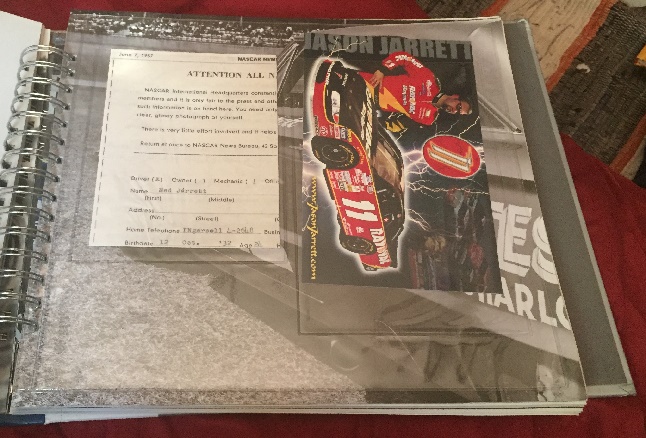
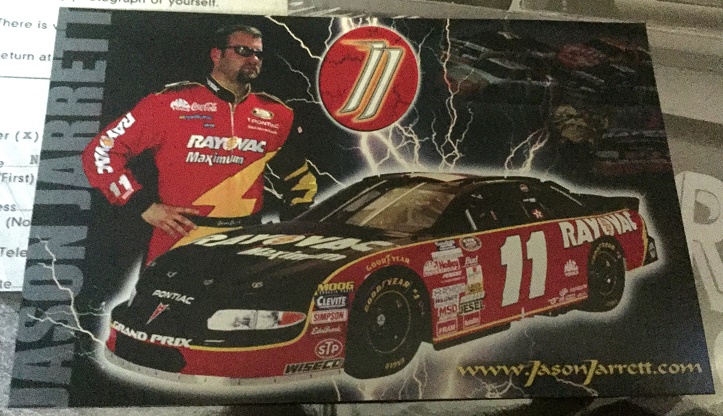
The first family to be featured is the France family. NASCAR was founded in February of 1948 by Big Bill France Sr. who ran it until 1972, when his son Bill France Jr. took over. Bill Sr. died in 1992. Bill France Jr. ran NASCAR from 1972 to 2000, when he was diagnosed with cancer. He turned the reigns over to Mike Helton, and remained on the board of directors until he picked Brian France as his replacement in 2003. He w died from lung cancer in 2007. Brian France is the current owner of NASCAR, having run the sport since 2003.2 3The replica memorabilia for the France Family is Bill France’s business card,4A hand-written note from Bill France Sr. to a stock holder,5Three pages from the Bill France Sr. Testimonial Dinner from 1955,6 8 7and a conceptual sketch of Daytona Motor Speedway from 1959.9The second chapter focuses on the Jarretts. Ned Jarrett is a two-time Sprint Cup champion who raced from 1953 to 1966. His son Dale Jarrett raced from 1984 to 2008 with 32 race wins and the 1999 Sprint Cup Championship. Both are on the list of the 50 Greatest Drivers of All Time.10 12The memorabilia included here includes a replica of Ned Jarrett’s 1957 NASCAR Information Sheet,13and a Jason Jarrett post card.1415If we take a look at the replica, and compare it to the original, its a very faithfully executed replica, only smaller, and with the word REPRODUCTION on the bottom right corner.16 17Chapter 3 focuses on the Flock Brothers, Tim, Fonty, Ethyl, and Bob. The Youngest of the group, Tim was the most well-known of the brothers, having won 39 races and two championships. Tim was banned after the 1961 World 500 for having too much solder on his carburetor screw, but it was most likely retaliation for wanting to found a drivers’ union. He was reinstated as a driver in 1966, but never raced in NASCAR again. Like Ned and Dale Jarrett, he was enshrined into the NASCAR Hall of Fame, and was one of the 50 Greatest Drivers of All Time.18 19
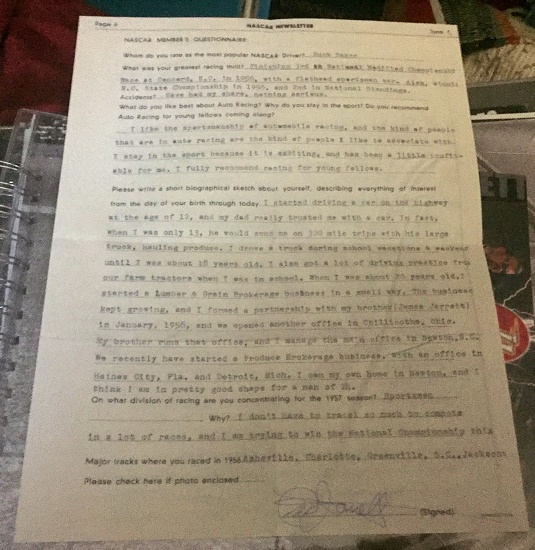
The oldest of the family, Ethyl, was tied as the second female driver to race in, NASCAR,with Louise Smith and after Sara Christian. She had a career high of 11th. The next oldest was Bob, who had 4 wins in his own right, and once got into a police chase IN THE MIDDLE OF A RACE! Fonty was the third oldest, and second most successful of the brothers, having 19 wins and finishing second in 1951. The memorabilia for the Flock family consists of the first two pages of Tim’s 1956 NASCAR profile sheet,20 21A hand-written account of Tim racing with his monkey Jocko,22and a 1948 detailing a race where the Flock brothers finished first, second, and fourth.23 24Next we move on to the Labonte Brothers. Older brother Terry won two Sprint Cup championships, 12 years apart from each other. He won the 1984 championship while driving for Hagan Racing, and the 1996 championship upset driving for Hendrick Motorsports. He has 22 race wins, and is one of the few drivers who has won in the Cup, Xfinity, and Truck Series. Another one of the 50 Greatest Drivers of All Time.25 26

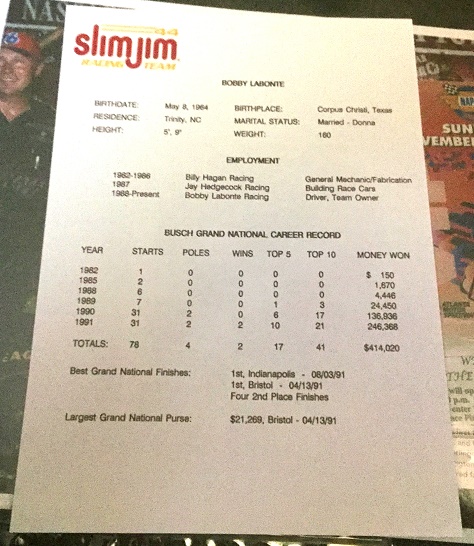
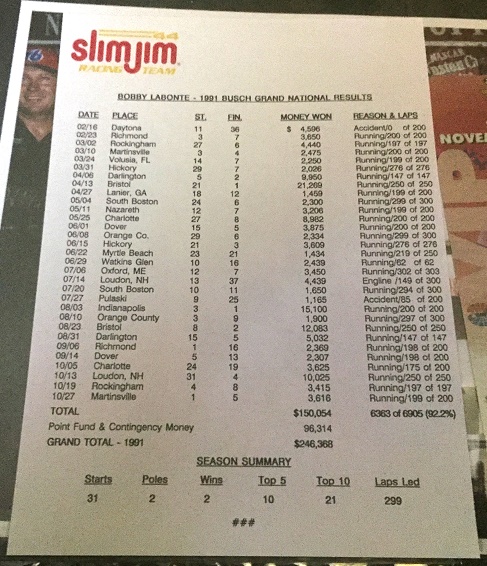
Bobby Labonte won the 2000 Winston Cup Championship, and has 22 races to his credit. He is also the first driver to win Sprint Cup and Xfinity Championships. Like Terry, he is one of a select few drivers to win in the Cup, Xfinity, and Truck series. Justin Labonte is also discussed here, but his career never really lived up to that of his father’s. The memorabilia included here includes a Bobby Labonte press kit from 1992,27 28 29 30 31 32and a ticket to the 1997 NAPA 500 at Atlanta motor speedway, where Bobby won.33 34Darrell and Michael Watrip are the next family featured Darrell is a three-time Sprint Cup champion, who has 84 race wins to his credit. He is one of the few drivers to win the career Grand Slam, including winning the 1989 Daytona 500. He was named one of the 50 Greatest Drivers of All Time.35 36

Younger brother Michael has 4 Sprint Cup wins, including two Daytona 500’s to his name. He also has 11 Xfinity Series wins, and a Truck Series win, making him a Triple Threat. Michael is also a former All-Star race winner as well.

The memorabilia features the 1982 NASCAR Awards Banquet program, commemorating his second Championship,37 38 39 40 41 42and a Michel Waltrip postcard from the 1990’s.43The Earnhardts, my favorite NASCAR family is featured next.44 45The patriarch of the family, Ralph raced in NASCAR’s Sportsman Division, winning the championship in 1951. He then made it to what is now the Sprint Cup Series, but didn’t score a win. He was also a builder of cars, and helped many young drivers including Bobby Issac a shot at racing.

His third son Dale Earnhardt Sr. started racing after Ralph’s death in 1973. He started what was his rookie full time season in 1979, impressing people at the Daytona 500, and eventually winning Rookie of the Year. From there, the only way to go was up, which is what he did. He won 7 championships, a career grand slam, 76 races, and was named one of NASCAR’s 50 Greatest Drivers of All Time. He is also credited with winning the first race in what is now the Xfinity Series. Dale was killed in the final lap of the 2001 Daytona 500, which helped change the safety culture of auto racing.

Dale Sr.’s son Dale Earnhardt Jr. followed in his father’s footsteps. He started racing at age 17, and eventually made it to the Xfinity Series where he won the Championship in 1998 and 1999. He has 24 Xfinity series win to his credit. His debut in the Sprint Cup took place in 1999 at the Coca Cola 600, where he would go on to win 22 races, including 2 Daytona 500’s.

The memorabilia from the Earnhardt family includes a copy of Dale’s 1979 Rookie NASCAR contract,46 A 1956 Telefax that depicts Ralph’s lone Winston Cup Pole in Hickory,49and the first two pages of Ralph’s 1965 NASCAR info sheet.47 48David and Larry Pearson are next featured. 50 51David “The Silver Fox” Pearson raced from 1960 to 1986. He has 105 Sprint Cup wins, three Sprint Cup championships, he won the 1976 Daytona 500, and has won the Grand Slam. He was one of the 50 Greatest Drivers of All Time, and was elected to the Inaugural Class in the NASCAR Hall of Fame. He is second only to Richard Petty in terms of race wins, Petty has 200, Pearson has 105.

His son Larry Pearson’s Xfinity career was actually very good, with Pearson winning two Xfinity Series championships, one in 1986, the other in 1986, as well as 15 race wins. He left NASCAR after 1999. He suffered a serious crash at Bristol in 2010, which has more or less derailed any chance he had of getting his career restarted.

The memorabilia from the Pearson section is a color postcard featuring Larry and David together,52 53and a vintage decal from David Pearson’s racing team in the early 1980’s.54The next chapter features the most important racing family in NASCAR history, the Pettys.55 56Lee Petty was the first of the Petty drivers, first racing in 1949, Petty won an astounding 54 races, three Sprint Cup Championships, and the first Daytona 500. His sons Richard and Maurice had NASCAR careers, Maurice as a crew chief and engine builder. Richard Petty would go on to win just about everything there is to win in NASCAR, including 200 wins, 7 championships, a place on the list of the 50 Greatest Drivers of All Time, and election into almost every racing hall of fame that exists.

The family talent was passed down to Kyle Petty, who has 8 Sprint Cup wins, including the 1987 Coca Cola 600. Kyle’s son Adam had a chance at a racing career, and had some hints of success, before dying in a crash at New Hampshire, a little over a month after Lee Petty died in 2000.

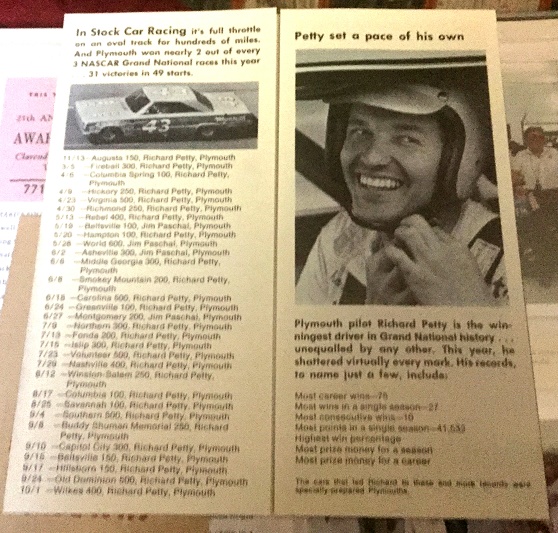
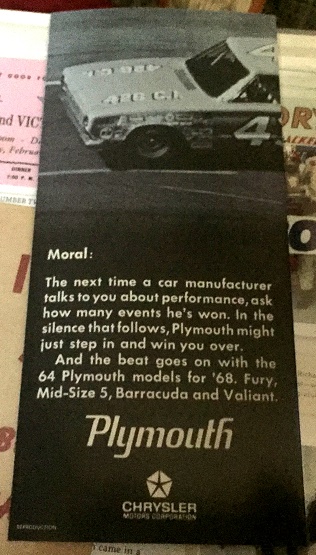
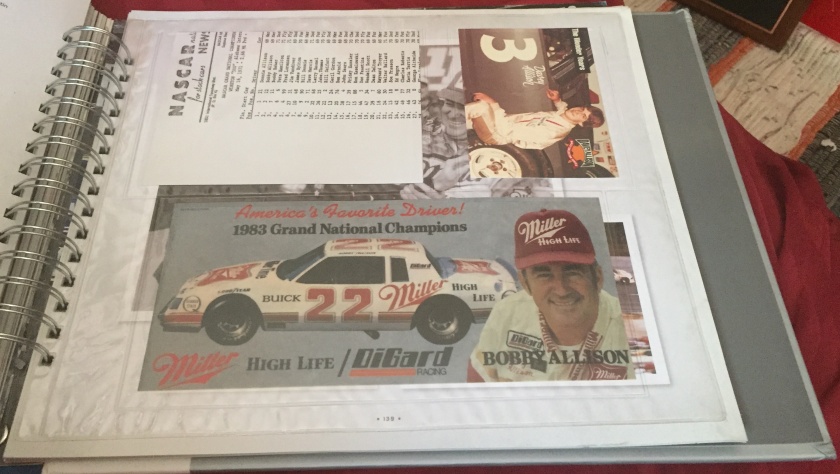
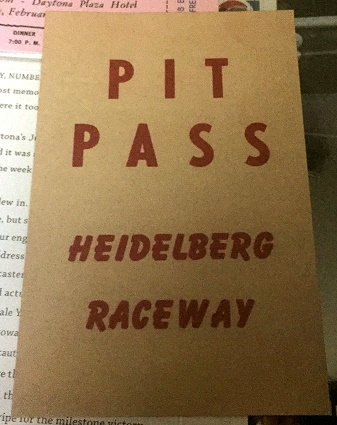
The memorabilia for the Petty family features a ticket to the 1974 NASCAR award banquet,57A Plymouth brochure from 1967, Petty’s most successful year,63 59 60 61 62and a pit pass from Heidelberg Speedway in Pennsylvania, where Lee Petty got his first win in 1949.58The Alabama Gang, made up of the Allison family are the next one featured. 64 65Bobby is the most well-known of the Allison drivers. Officially, Bobby has 84 wins, though the number could be as high as 86, and the 1983 Cup championship. Allison also has 15 wins in the Xfinity Series as well. Bobby is one of the 50 Greatest Drivers of All Time, and has a place in the NASCAR Hall of Fame.
Younger brother Donnie has 10 wins in the Cup Series, but will forever be known for his fight with Cale Yarborough at the end of the 1979 Daytona 500. Considered the most important race in NASCAR history, the 1979 Daytona was the first NASCAR race televised flag to flag, took place during an East coast blizzard, and ended with Richard Petty winning the race, after Cale Yarborough and Donnie crashed into each other. As Petty celebrated his win, Donnie and Cale began to fight on the infield. A photo made the front cover of the sports section of the New York Times, and NASCAR’s rise to the top had begun.

Two of Bobby’s children, Davey and Clifford both started their racing careers in more recent years. Clifford started racing in Xfinity Series in 1990, but was killed in a wreck in 1992 at Michigan International Speedway. Davey Allison, Clifford’s older brother, won the 1991 Coca Cola 600, the 1992 Daytona 500, almost won the 1992 Winston Cup championship, and has 17 other race wins to his credit. He was killed in a helicopter crash in July of 1993.

The memorabilia from the Allison section includes a NASCAR newsletter from 1971 discussing the Allison brothers finishing first and second at Talladega,66A Davey Allison trading card from 1993,68 69and a Bobby Allison 1983 Championship bumper sticker.67The second to last chapter is about the Wallace Brothers, Rusty, Mike, Steve, and Kenny.70 71The most well-known of the brothers is Rusty. With 55 wins, and the 1989 Sprint Cup championship, and a place on the 50 Greatest Drivers of All Time list, and a place in the NASCAR Hall of Fame, Rusty has earned a place in the hearts of many NASCAR fans.

Kenny and Mike, Rusty’s brothers, haven’t had any success in the Cup Series, but both have had success in the Xfinity Series, Kenny having 9 wins, and a 2nd place points finish in 1991, and Mike has 4 wins, and an 8th place points finish in 2008. Rusty’s son Steve is currently working on his racing career, though he hasn’t scored a win in any of NASCAR’s biggest series.

The memorabilia representing the Wallace family features Rusty’s 1982 NASCAR Rookie of the Year eligibility form,72and a postcard from the Rusty’s 1982 season.73 74The final chapter doesn’t have any memorabilia, but discusses a number of other NASCAR families.  75These families include:

The Andrettis-Mario and John,

The Bakers-Buddy and Buck,

The Bodines-Geoff, Todd and Brett,

The Bouchards-Ken and Ron,

The Burtons-Jeff and Ward,

The Busches-Kurt and Kyle,

The Elliots-Bill, Dan, and Ernie,

The Foyts-AJ, and Larry,

The Greens-David and Jeff,

The Hamiltons-Bobby Sr. and Bobby Jr.

The Marlins-Coo Coo, Sterling, and Stedman,

The Parrotts-Buddy, Todd, and Brad,

The Parsons-Benny and Phil,

The Pembertons-Ryan, Roman, Randy, and Robin,

The Sadlers-Hermie and Elliott,

The Scotts-Wendell Sr., Wendell Jr, and Franklin

The Thomas-Herb, and Donald,

The Thompsons-Alfred, and Jimmy,

and The Wood Brothers-Glen and Leonard.

The book itself, even without the memorabilia is a great read too. The book is very well written, and very well done. If you can find a copy, pick it up, and read it. I promise it is worth it. I’d like to take this opportunity to thank John, a friend and coworker for giving me my copy of this book. Thanks John!

Ok, next week, I’ve got a special surprise for the big game…

The Driver Suit Blog-Wheel Reviews-9 Days in Summer

By David G. Firestone

9 Days in Summer is a documentary produced by Ford showing the development of the Cosworth DFV and Lotus 49. These two cars would only go on to race in 9 of the 11 races in 1967. Although it is produced by Ford, and isn’t as neutral as documentaries should be, this one is really interesting when compared to the way things are done now in auto racing.

The film shows designer Keith Duckworth silently working on his board, mixed with video of racing cars, and stylized guages. Then the film shows a 1966 meeting of four people, Duckworth, Fred Hayes, Colin Chapman and Harley Copp in Ford’s Design and Engineering Center in Essex, discussing the development of a new race car. After this discussion has proceeded for a while, the film jumps to the 1967 Belgian Grand Prix, where both of Ford’s new cars drivern by Graham Hill and Jim Clark, retire. This provides some of the most unintentionally hilarious scenes I have ever seen, because the film will show footage of racing mixed with random shots of farm animals. The editing is a little schizophrenic.

The scene then sifts back to the DEC, and Ford building the first series of engines. The various issues including size and weight are discussed, and the engines are machined using a series of automated machines, which were revolutionary in 1967 are obsolete in 2017.

The movie cuts to the LeMans Forumla One circuit. The track is described as “a Mickey Mouse track.” Both cars suffer engine problems, and fail to finish. After the race, Ford goes back to the shop, and tries to figure out what the problem is. The size of the engine, a 3L 90 degree V8 is designed to work with the chassis. It’s a new experiment, designing the engine and car specifically for each other. In fact, the engine makes up part of the chassis.

The British Grand Prix at Silverstone is the next event, Ford brings both their cars to the event with a lot of confidence. The power of the car is clear, but the reliability is dubious. Despite this, Graham Hill does an interview where he praises the new car design. Afterwards, other aspects of the car design are worked on by the team.

A new engine design is delivered to Lotus, and the engineers proceed to mount the engine to the rest of the chassis. After this is done, Graham Hill wrecks at practice for The Grand Prix of Germany at the Nürburgring. The jumps cause a series of suspension problems, and both Lotus cars retire. Hill spins at the begining of the race, and is at the back of the pack. I also love the total lack of safety gear at the track, no walls, no fences, and sharp cliff drop-offs.

Next is shown footage of Lotus testing the new car setup. This time at Snetterton. Graham Hill is testing, and says that, among other things, “It’s got some poke, not a bad old tool.” This part shows some obviously staged shots of the testing, and the short montage and then cuts to the rainy Canadian Grand Prix. There are a number of double-exposed shots of the cars racing in the rain, and the cars seem like they have got the problems fixed. Rain derails Clark’s race, plauging the electrical system. Hill keeps going, but rain causes him to finish fourth.

Graham Hill is shown relaxing with his family before the Italian Grand Prix at Monza. This bit of fun and merrient seems sad when looking back. Damon Hill, who would go on to have his own racing career is featured in this scene. The two drivers featured, Graham Hill and Jack Clark wouldn’t be around for much longer. Jack Clark would die in 1968 in a plane crash, and Graham Hill would die in 1974 in a racing accident. Once the relaxing is done, the work begins anew at Monza.

At Monza, Clark shows some speed initially, and jumps to the front. Graham Hill looked decent, but yet another engine failure plagues him. Clark blows a tire, makes a lap back, and loses the race in a photo finish. The camera shows the closeness of the finish. It’s a badly-needed boost for the new engine design.

The next scene is Jim Clark examined a rainy and empty Watkins Glen. He kicks a rock, and walks into a car. Suddenly it’s race day. Clark and Hill start at the front, and have a great start to the race. This time however is different, as Clark and Hill finish first and second respectivly.

The final race in the Formula One season is Mexico, which had Clark and Hill battle each other for the lead. It’s obvious that, like the Lotus testing, some shots were clearly staged. Hill breaks a universal joint, and his race and season are over. Jim Clark goes on to win his second race of the season. The film ends with a model of the car on a desk, with some trophies in the background.

Again, it’s more of a promotional film than a documentary, but it did something that wouldn’t be done today, take a viewer into the whole design process of an engine and chassis design. The secrecy that Formula One, and other racing teams is such that often, teams don’t want cameras around their engines. This film takes the veiwer into the engine design process, to a degree that’s uneard of.

The editing is pointless artsy sometimes. Also, the farm animals, the double-exposure, and the obviously staged shots take away from the whole feel of the documentary. Still, it’s worth a watch, if you are a racing fan, but there are a lot of better documentaries out there.

The Driver Suit Blog-NASCAR Book Club-NASCAR: A Complete History

1By David G. Firestone

Many NASCAR fans are NASCAR historians, as am I. I love learning about the history of auto racing, and the history of automobiles. I also love being able to access information about the history of NASCAR. For those who love NASCAR, one of the best books is NASCAR The Complete History. I have the 2013 edition, which covers up to the end of the 2013 season.1The book is a heavy-duty leather covered book with a stock car depiction on it. Inside, each season is given a few pages, in which the story of the season, photos and statistics are present. There is a bit of generalization involved with the seasons review, but it’s forgivable because a lot of details about the season, the drivers, and the racing that is really good. It’s a long read, but a good read.2 3 4 7 8 9 As a reference material, it’s great because it contains a lot of things that can’t really be found in other books, especially about the early seasons of NASCAR, and some of the early drivers. It’s easy to lose track of time while reading this book, there are so many good stories, and good information. As a book, its a great read that could be read over the course of a weekend. The writing is great, and interestingly, there are times where you take an interest where it wouldn’t seem that interesting.

Each year, a new edition is published, in order to add the previous season’s information into the book. I find that the new editions aren’t as interesting, because much of the new information is stuff we’ve just seen, and I like the older, more obscure things the books discusses.

My final assessment is that this book is a must-have for NASCAR fans and I would go so far as to say that it should be in the possession of all racing fans. It’s a great reference, and a great read.