
Powerboat racing takes center stage this week, as we examine a Forest Barber driver suit from his days at Drambue Racing in 1999.
The Driver Suit Blog-Two Great Pieces of Advice for Anyone With A Hobby
By David G. Firestone
If I could give a new collector two pieces of advice, they would be 1: In this hobby, when you stop learning, it stops being fun and 2: Research, research, research. Research is critical in any hobby, and that is, for the most part, why The Driver Suit Blog exists. I put a lot of research into this hobby, and I will give some pointers to help my fellow collectors.
First, always get a picture of the item you are going to buy beforehand. This is useful for a number of reasons. First, you can photo match the item. If you are not able to find an exact photo of the suit, helmet or accessory, you can “style match” the item. Style matching is finding evidence that the driver or crew member wore a design similar to the item in question. Drivers wear multiple versions of the same suit for a number of reasons. Nomex is a great material, however, if the suit catches fire, the Nomex will change color, and will not protect the area of the burn after the fire. So if a driver gets into a fiery crash in practice, and the suit gets damaged on the arm. The suit will have to be replaced for the race, because it is very possible that a similar crash could occur during the race, and wearing the damaged suit would wind up burning the driver.
Figuring out WHEN the suit was worn can be tricky, but in addition to photo matching, you can do a driver search on Racing Reference. Racing Reference is a site devoted entirely to racing stats, and for every race they list, they have driver, owner and sponsor information. So for example, let’s take this Stevie Reeves suit:
The primary sponsor is Big A Auto Parts, and is a Busch Series suit. So you go to his driver page:
and clicking the races in his Nationwide Series Statistics section, you can look at each of his sponsors. In this case, he was only sponsored by Big A Auto Parts in 1997. So it can be concluded that the suit was worn in 1997.
In some cases, you will not be able to find a photo of the driver wearing the suit, that is just the law of the land. When searching for a photo, I use Getty Images, Google, YouTube, and eBay. It might seem strange that I use eBay but it works quite well and I have had a lot of success. People sell photos, press kits, hero cards and other such things on eBay, and this is a gold mine. In some cases, I have no luck in searching for photos, and I will take a break, get something to eat, play with the cat, take the dog for a walk, and I will have a moment when I realize I should change a parameter of the search. Sometimes it works, other times it does not.
When it comes to learning, when you stop, the hobby stops being fun. I’ve been collecting sports memorabilia since I was 5, and I’m constantly learning new things about it all the time. Never stop learning, because every hobby is constantly changing, and new information can be very useful.
I also have to cover this story. I gave Swan Racing a lot of bad reviews for paint schemes last year, and I said this year, they stand a good chance of winning the Schemie for most improved paint scheme set. Well, it looks as though they will have to shut down due to a lack of sponsorship. As it stands right now, the team is shutting down and Cole Whitt does not have a ride for Richmond. I will update the story as I learn more information.
Now we move on to…
PAINT SCHEME REVIEWS
Brad Keselowski #2 Detroit Genuine Parts Ford Fusion Great design, great color scheme, I like the black B post, A+
Kevin Harvick #4 Budweiser Chevy SS The Coca Cola 600 is held as the July 4th race, and as such, NASCAR teams like to run patriotic schemes. The scheme as a whole is good, and red, white and blue is a great color scheme. I give it an A. Something else to note: Notice that the name on the windshield is in a patriotic design, as opposed to white lettering on a black background. Is this going to be run by all teams? Stay Tuned!
Kasey Kahne #5 Farmers/Thank A Million Teachers Chevy SS I really hate the huge FARMERS lettering on the side of the car, and I’m guessing that the design on the lettering is a photo mosiac. The color scheme is not good, and there are a number of dark designs on the black background which are almost impossible to see. I support the idea of Thank a Million Teachers, but this scheme looks awful, and earns an F
Tony Stewart #14 Bass Pro Shops/Ducks Unlimited Chevy SS Sadly this is the best Bass Pro Shops scheme I have seen in 2014, and it is a C+ design so that isn’t saying much. Why can’t we go back to this?
Greg Biffle #16 Scotch Ford Fusion Greg’s paint scheme downward spiral continues, with this horrid scheme! The green and plaid doesn’t work with the Biffle template, and it just looks like a mangled mess that earns an F grade!
Paul Menard #27 Menard’s/Certainteed Chevy SS This scheme works! I love the color scheme, and the design is really good. A+
Paul Menard #27 Menard’s/Pittsburgh Paints Chevy SS I love this scheme! The color works well, the design is original. It stands out, and it just plain works! A+
David Stremme #33 Newton Building Supplies Chevy SS Red and white is a good color combination, and if the side did not have the small rectangle just behind the front wheel, I would give it an A, but it takes it down to a B+
Kyle Larson #42 Target 25th Anniversary Chevy SS Really simple design, and a good color scheme. I will tentatively give this scheme an A until I see the real scheme.
Kyle Larson #42 Axe Peace Chevy SS Decent color scheme, but much too overdesigned. Too much visual noise, and i just don’t like it. The green number look awful as well. D-
Ryan Truex #83 VooDoo BBQ Toyota Camry color scheme is not great, and the car in general is way too overdesigned. I can’t give this scheme anything less than a D-
Carl Edwards #99 Fordalwaysracing.com Ford Fusion See Brad Keselowski Above…A+
Also, NASCAR.com has come up with their staff picks for the best paint schemes in the Sprint Cup, Nationwide Series, and Camping World Truck Series. I can’t say I disagree with most of their choices in this respect!
DGF2099 Productions-Introduction to Sports Memorabilia-NASCAR Race-Used Gloves and Shows
This week, we look at two lesser-known but critical aspects of racing uniforms, the gloves and shoes. Specifically, a pair of Scott Riggs race-worn and autographed shoes circa 2004-2007, and a pair of Hut Stricklin race-worn and autographed gloves circa 2000-2001
The Driver Suit Blog-2014 Driver Uniform Chart
By David G. Firestone
I wanted to wait until all 3 racing seasons got underway to do this chart because by this time, more photos are accessable and it makes my job much easier. This is the 2014 driver uniform chart. I am fully aware this list is incomplete, but if I can’t find photographic or video evidence of what kind of suit the drive wears. We start with the…
===2014 NASCAR Sprint Cup Series===
Alex Bowman-Oakley
Ryan Truex-Oakley
Brian Keselowski-Simpson
Kyle Larson-Impact
Jamie McMurray-Impact
Timmy Hill-Simpson
Landon Cassill-Impact
Eric McClure-Simpson
Blake Koch-Simpson
David Ragan-Simpson
David Reutimann-Simpson
Martin Truex Jr.-Oakley
Travis Kvapil-Simpson
Terry Labonte-Simpson
Dale Earnhardt Jr.-Alpine Stars
Jeff Gordon-Alpine Stars
Jimmie Johnson-Alpine Stars
Kasey Kahne-Alpine Stars
Justin Allgaier-Simpson
Bobby Labonte-Sparco
Joe Nemecek-Simpson
AJ Allmendinger-Sparco
Kyle Busch-Alpine Stars
Denny Hamlin-Nike
Matt Kenseth-Sparco
Michael McDowell-Sparco
Cliny Bowyer-Oakley
Jeff Burton-Oakley
Brian Vickers-Oakley
Michael Waltrip-Oakley
Brad Keselowski-Puma
Joey Logano-Puma
Josh Wise-Simpson
**Randy Humphrey Racing
Dave Blaney-Impact
Austin Dillon-Sparco
Paul Menard-Sparco
Ryan Newman-Sparco
Aric Almirola-Sparco
Marcos Ambrose-Simpson
Greg Biffle-Simpson
Carl Edwards-Simpson
Ricky Stenhouse Jr.-Oakley
Kevin Harvick-Sparco
Danica Patrick-Alpine Stars
Tony Stewart-Simpson
Cole Whitt-Impact
Parker Kligerman-Sparco
Michael Annett
Reed Sorenson-Impact
Trevor Bayne-Simpson
===2014 Verizon IndyCar Series===
Takuma Sato-Sparco
Marco Andretti-OMP
James Hinchcliffe-Sparco
Ryan Hunter-Reay-OMP
Carlos Muñoz-Sparco
Jack Hawksworth-Sparco
Ryan Briscoe-Impact
Scott Dixon-Impact
Tony Kanaan-Impact
Charlie Kimball-Impact
Carlos Huertas-Alpine Stars
Justin Wilson-Oakley
Ed Carpenter-Oakley
Mike Conway-Oakley
Sébastien Bourdais-Sparco
Sebastián Saavedra-Sparco
**Rahal Letterman Lanigan Racing
Graham Rahal-Sparco
Josef Newgarden-Oakley
**Schmidt Peterson Hamilton Motorsports
Mikhail Aleshin-Sparco
Simon Pagenaud-Sparco
Juan Pablo Montoya-Puma
Hélio Castroneves-Puma
Will Power-Puma
===2014 FIA Formula One World Championship===
Marcus Ericsson-Sparco
Kamui Kobayashi-Sparco
Sebastian Vettel-Alpine Stars
Daniel Ricciardo-Alpine Stars
Romain Grosjean-Alpine Stars
Pastor Maldonado-Alpine Stars
Max Chilton-Sparco
Jules Bianchi-Sparco
Kevin Magnussen-Sparco
Jenson Button-Sparco
**Mercedes AMG Petronas F1 Team
Nico Rosberg-Puma
Lewis Hamilton-Puma
Kimi Räikkönen-Puma
Fernando Alonso-Puma
Sergio Pérez-Alpine Stars
Nico Hülkenberg-Alpine Stars
Esteban Gutiérrez-OMP
Adrian Sutil-OMP
Jean-Éric Vergne-OMP
Daniil Kvyat-OMP
Felipe Massa-Puma
Valtteri Bottas-Puma
More Albie Pearson and Washington Senators Research
 By David G. Firestone
I can hear many of you saying “why are you still covering this Dave?” and this will be my last Washington Senators article for a while. When I started this project, I had no idea it would balloon the way that it did. I’ve found more layers to this story than I ever could have predicted. This article was a direct result of these layers. I’ve developed a theory of why they were designed they way that they were, and their design origins…but more on that later.
I was recently contacted by a seller who was able to get the numeral off Albie Pearson’s road uniform from his 1958 rookie season. As you can see, it looks like a generic two-tone number used by the Cardinals or Braves. The home number is an intricately designed number, with aspects never seen before or since. Whereas the road numeral looks like something that one would be able to buy for a little league, or softball uniform.
This was something I could not understand in terms of design. Normally, when a uniform is designed, the home and road numbers are similar to each other. In this case, they are the polar opposite of each other. When compared side by side, they look like they are from two different uniforms.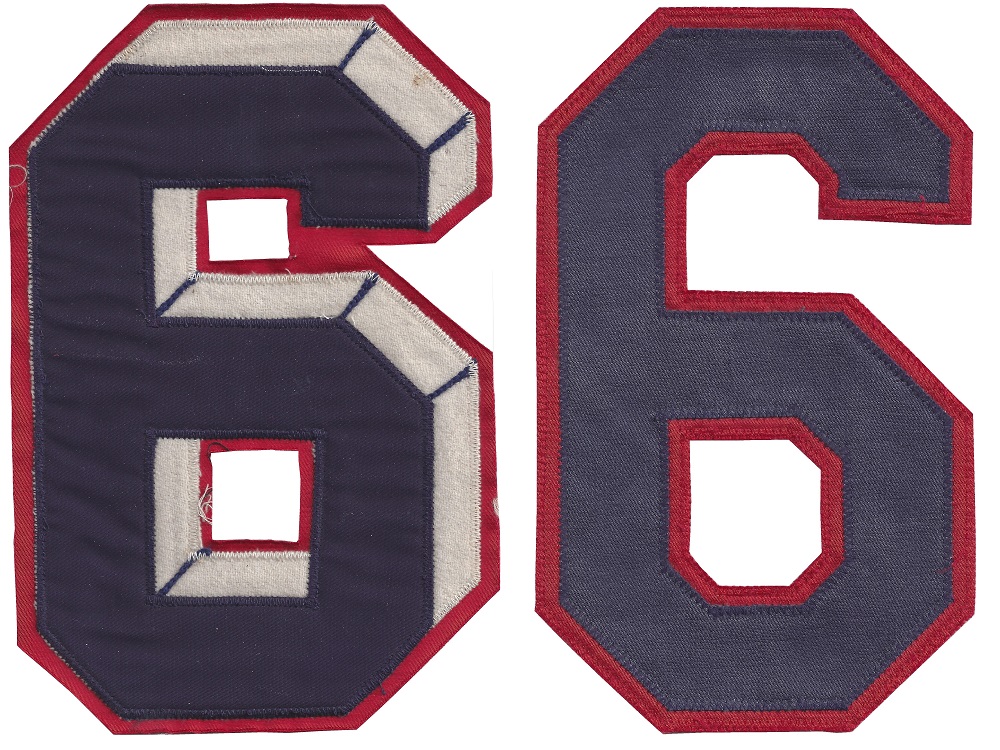
I took the Eddie Yost number, and made a mock up of the design with the gray multi-colored flannel design.
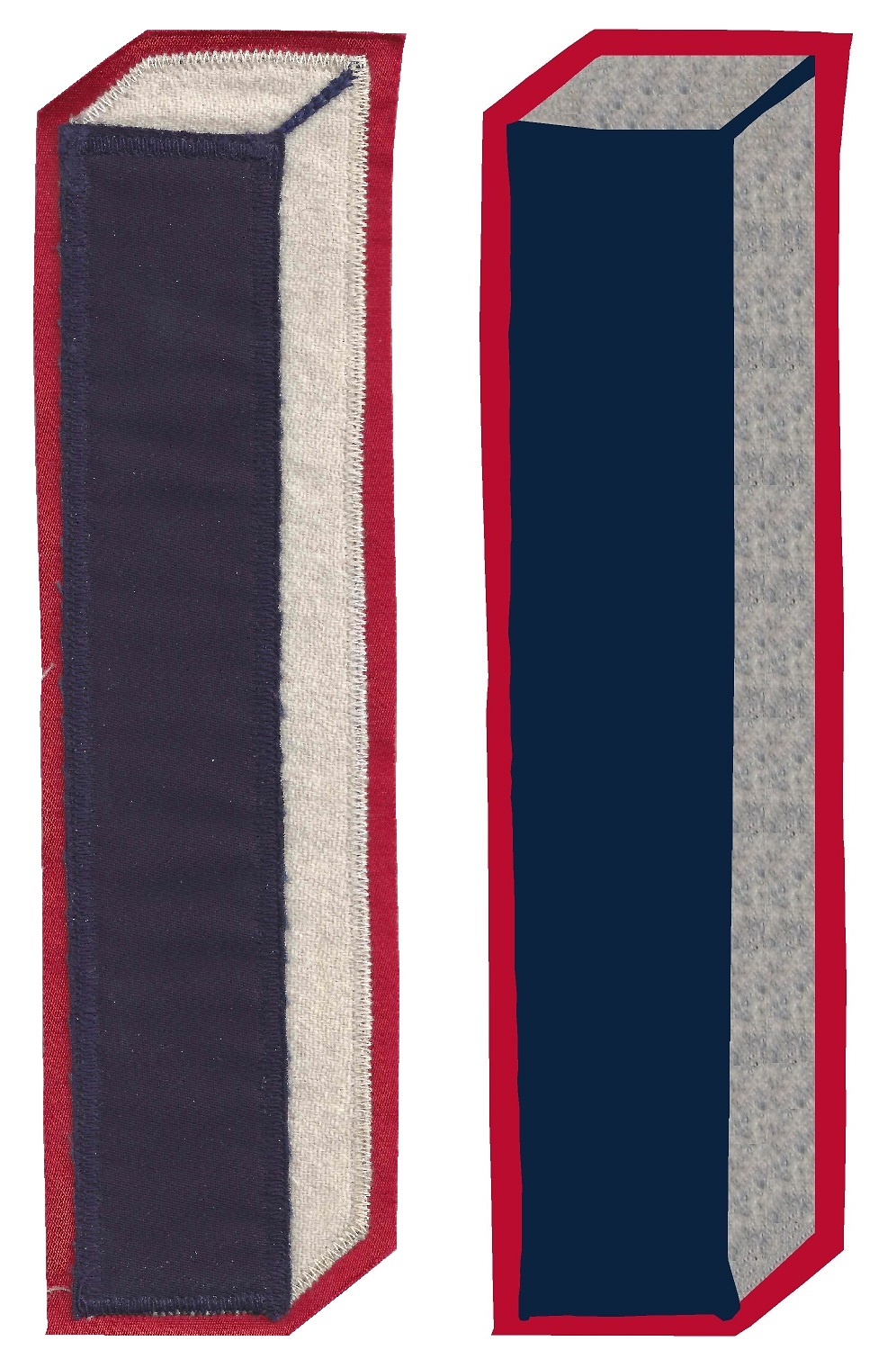
Not a bad looking number, but why would there be a revolutionary design like that on a home uniform, and nothing new for the road uniform. The road uniform they were wearing at the time was created in 1955, a year before the 3D uniforms were introduced. It makes sense, why would you redesign a uniform that was already recently redesigned? But it also does not explain why no effort was made to add some design to the road uniforms.
I was trying to figure this out, and something dawned on me. Maybe this design wasn’t supposed to be a primary uniform, but instead meant to be an alternate uniform. The more I think about it, the more sense it makes. The 3D was meant to be worn at home for certain games, and then for other games, they would wear their regular uniforms. Back in the 50’s, the merch machine was not as in production as it is today, and alternates were not as common as they are today, but not unheard of. Fans were buying merchandise, but didn’t buy jerseys they way they do today. So it wasn’t made to sell replica jerseys, so we can eliminate that as a reason.
The Washington Senators had some alternates in their history. They had home alternates in 1910, 1924, and 1942. While alternate uniforms were used, they were not common in the 1950’s. Calvin Griffith, then owner of the Senators had just taken over from his father Clark, and it can be argued that Calvin was dealing with new competition. The St. Louis Browns had moved to Baltimore in 1954, and attendance at Senators games was down. Griffith Stadium in Washington was old, the Senators were, for the most part, a spent force, and the team had a negative image. Clark Griffith was a segregationist, and the Jim Crow laws applied to Griffith Stadium. Toward the end of the 1950’s, this was more of a liability than an asset.
My theory is that Clark had to find a way to boost attendance, and he wanted the Senators to have new uniforms to help that. He took an alternate design for a home uniform, made it into the primary home design, to give the Senators a futuristic look. The first era of 3D films was nearing its end, and Clark must have seen that they brought people in. It didn’t last long, only 3 seasons, and in 1959, it became clear that the Senators were heading for greener pastures, this pasture being in Minnesota, where they have remained ever since.
This is one of the most attractive uniform designs ever created, and the fact that it died less than 3 seasons after it was unleashed is a tragedy. The fact that this design isn’t seen as much on replica designs, or throwbacks is even more of a tragedy. This research project has been a labor of love, but for the time being, I have to move on to other projects. I don’t think that this will be the last I do on the subject, but it is for now.
DGF2099 Productions-Vintage Box Break-1994 Finish Line Gold Part 3
We crack open another 1994 Finish Line Gold box on Vintage Box Breaks.
DGF2099 Productions-Introduction to Sports Memorabilia-Tracy Leslie Race Worn Helmet
To accommodate the beginning of Passover, I decided to upload this week’s episode of ITSM a day early. We look at Another old school NASCAR helmet, this one worn by Tracy Leslie, will be examined.
Why I Chose To De-Wahoo My Indians Jersey
 By David G. Firestone
I am a uniform enthusiast. That has never been in question. I have always loved sports uniforms, and have a large number of them in my personal collection. I happen to have a 1976 Dennis Eckersley throwback jersey. I made a decision concerning this jersey that even a few people who know me might not understand. I decided to remove the Chief Wahoo patch from the left sleeve.
This is in response to a recent discussion concerning Native American team names. Do we keep the Native American name and imagery despite the fact that many people find them offensive, or do we change the Native American name and imagery and change the tradition of the teams? Basically I have decided to “de-Wahoo” my jersey for a number of reasons. Obviously since it is a racial issue, it was an easy decision, but this is a bit more personal for me.
I went to DePaul University in Chicago, and during my spring breaks, I went on what are referrred to as “service immersions.” We would travel to a specific location, live with a group, and work with the local residents to make life better for people. I did everything from building decks, to tutoring New York City students. But the first two trips I went on helped me made this decision
The first trip I went on was to Brainered Minnesota in March 2001, where we, in conjunction with Habitat For Humanity worked on houses for a week on the Mille Lacs Reservation. We got to know the locals, we conversed, and I had a great time and grew as a person. That was the first of what turned out to be many trips.
Established in 1855, the Mille Lacs Reservation is located about 100 miles north of Minneapolis–Saint Paul, at the at the southern end of Mille Lacs Lake and composes about 60,975 acres. It is home to many of the Mille Lacs Band of Ojibwe as well as the Mississippi River Band of Chippewa Indians.
My second trip took place in November 2001, two months after the 9/11 Attacks. We flew during my winter break to San Carlos Arizona, and spent two weeks in the San Carlos Apache reservation. It was supposed to be that each of us would spend one week working in the classroom at St. Charles School, where we were also staying, and one week working on fixing a house. As fate would have it, I had messed up my ankle before we left, and I was unable to work on the house. I spent two weeks working in the 2nd grade class at St. Charles. It was, without a doubt, the most meaningful thing in my life.
The reservation is located in southeastern Arizona, was established by President Grant in 1872, is on 2,910.7 square miles. It is bigger than the state of Rhode Island, which has 1544.89 square miles. It is located in a remote desert area, surrounded by a ring of mountains. There are areas of the reservation where non-Native Americans are not allowed to go, and then there are areas where no humans are allowed to go. The area is very economically poor, with many people barely able to make ends meet.
Initially I was nervous, having no experience in working with 2nd graders, but those fears would be unfounded, as I worked with the kids well. There were bout 20 kids in the class, some more rambunctious than others. I worked with them, helped out in the classroom, and got to know them, and their culture. I was able to accompany a group of dancers to a show in a shopping mall, and for many of these kids, this was the first time they had ever been to a mall. They had never been on an escalator before, and it took a bit of coaxing to get them to use it. Those children were a perfect example of the human spirit. These kids came from little money, but they were proud of who they were and had hope for the future. Two weeks went by and we had to go back to Chicago, but I still carry part of San Carlos and Brainered in my heart.
That is why I decided to de-Wahoo my jersey. My experiences in Minnesota and Arizona were so influential, and I have too much respect for the Native American to keep an image like that on a uniform. I have also made the decision to no longer wear my Chicago Blackhawks jerseys for the same reason.
The Driver Suit Blog-F1 and NASCAR Discussions
By David G. Firestone
Gonna be a bit of a long entry today, but I have a few things that I really need to discuss, that I haven’t been able to get to until today. I typically write a DSB article a few weeks in advance, and work on it over the weeks before it runs, but given the circumstances, I needed to write a fresh article for this week. Now while the site focuses mainly on NASCAR, I watch other forms of racing, including F1. The F1 race at Bahrain on Sunday was one of the best F1 races I have ever seen. That said, F1 is dealing with a controversy this season, that I need to address
F1 implemented in 2014, a series of regulations designed at making the sport more eco-friendly, or so they say. Engines are also now supercharged, and a redesign of the bodywork has that regulates that the nose of the car is much lower. Since during the off season teams were not able to observe each other, each team showed up to the Australian Grand Prix with a different nose design. These new regulations also had the effect of making the engine sound somewhat quieter. This change in engine noise did not go unnoticed, and many fans complained. There was even discussion of a lawsuit for failing to deliver what was promised by the promoters.
I’m a racing fan, and I understand that the sound of the engines is a huge part of the ambiance of the event. I get it. But at the same time, engine changes are going to happen. Engines will evolve. In fact, if you were to take an F1 engine from 2004, and put it in a current chassis, the car would not be competitive. I get what engine noise means, but sometimes you have to take the bad with the good. The racing has been better this season, and I personally will take the lower engine volume for the better racing.
One other rule new to the 2014 F1 season is a new mandate that the last race of the F1 season, the Abu Dhabi Grand Prix will have double points, to keep the championship points battle alive. What I’d like to see, is for the last TWO races, The Brazillian Grand Prix and the Abu Dhabi Grand Prix to have double points. I think that the last two races having double points would have a major impact on the championship, and would bring more spectators, both live and on television to the event.
A few more things from F1, first the United States Grand Prix in Austin Texas has been moved from November 9 to November 2 to accommodate a Texas A&M football game. What this does also is to move the race away from the season finale of the Sprint Cup Series season. This will give it more visibility in the United States, since it does not have to compete as much with NASCAR for attention. My favorite change in 2014 is that Williams F1 switched to Mercedes engines, and got Martini as a sponsor. They have utilized a very attractive vintage scheme. God that is a beautiful scheme!
The next topic here is something that has been bugging me for a while this year. I watch NASCAR at every given opportunity, I love the broadcast team on Fox, I love Darrell and Michael Waltrip, but I really, REALLY wish they would just shut up about this rookie class. I really do. I get rookies, I get rookie phenoms, but I do not want to hear anymore about this “amazing rookie class.”
I get that in recent years that rookie classes have been lackluster. I get that. Rookie classes can be legendary, like 1979 with Dale Earnhardt Sr., Terry Labonte and Harry Gant, or embarrassing, like 1990, with, Rob Moroso, Jack Pennington, Jerry O’Neil, and Jeff Purvis. I also get that there hasn’t been a decent rookie class since 2006. That said, this rookie class, is not as good as the broadcasters like to talk about.
Darrel said on numerous occasions that this is the largest rookie class since 1994. Ok, I get that, but let’s look at who was in that class, Steve Grissom, Joe Nemechek, Loy Allen, Jr., John Andretti, Jeremy Mayfield, Mike Wallace, Ward Burton, Rich Bickle, Billy Standridge, Rodney Orr, and Jeff Burton who won the Rookie of the Year. Loy Allen Jr. Mike Wallace, Steve Grissom, Rich and Billy Standridge were all busts. Orr was tragically killed before the Daytona 500. Andretti has two wins, Ward Burton has 5 wins, including the 2002 Daytona 500, ONLY BECAUSE STERLING MARLIN ILLEGALLY REPAIRED HIS CAR UNDER A RED FLAG, Joe Nemechek has 4 wins. Jeff Burton was the best of the lot with 21 wins. But the fact is that what it had in driver numbers, it lacked in talent. I’m seeing this same thing with this rookie class
Let’s look at each driver individually, and try to understand why they are in the Sprint Cup Series. Gonna do this in no particualr order, and we will start with Parker Kligerman. He was decent in the Truck Series, with 25 top 10’s in 50 races, with 1 win. He finished in the top 10 in HALF of the races he started in! Ok, so he moves to the Nationwide Series, and falls to 18 top 10’s in 51 races. Ok, still not bad, but he does not have a win. He has raced since 2009, so he raced in 51 races in 4 years. Um…you think he needs some more padding? He has some talent, but it needs to be developed. Unlike some of the other drivers he has some potential.
Cole Whitt is next. Not one win in any of the Big 3 Series. Like Kligerman, he has 18 top 10’s in 51 races. Unlike Kligerman, he was bland in the Truck Series. He’s an underwhelming driver in an overwhelming series. To top that off, he signs with Swan Racing! Swan Racing is to NASCAR as the New York Mets are to baseball…a total embarrassment. No top 10’s, and they have led 5 LAPS IN 3 YEARS! 5 LAPS IN 56 RACES! THEY AVERAGE A LEAD LAP EVERY 11 RACES! They are a total embarrassment to auto racing!
Michael Annett is one of the more underrated drivers, in my mind, in this rookie class. He has a lot of potential, and I think that with the right team, he might win a few races, but I don’t think he will do much more than that. Again, no races won in any of the big series.
BK Racing made the perplexing decision to fire two veteran drivers and replace them with rookies. I don’t disagree with hiring rookies, but Alex Bowman, and Ryan Truex don’t have the results to warrant the move. Again, why do teams insist on moving inexperienced rookies with minimal exposure to the schedule to the Sprint Cup?
Now Kyle Larson on the other hand, is a contender. He has a Truck Series win, and a Nationwide Series win, and in 10 Sprint Cup starts, he has two top 10’s, including a 2nd place finish. He was one bad restart away from winning the race. I think this kid is a contender for the championship. Even when he doesn’t win, he is strong behind the wheel, and I think he is one of two contenders for the Rookie of the Year.
The other contender is Austin Dillon. In 55 races, he has 5 wins, 34 top 10’s and won the Truck Series Championship in 2011. When he moved to the Nationwide Series, he had, in 77 races he has two wins, 53 top 10’s, and won the championship in 2013, without winning a race. In 19 Sprint Cup races, he has a top 10, and I think he is the front runner for the Sprint Cup Rookie of the Year.
So of the 7 contenders for Rookie of the Year, we really only have two contenders. I get it. I really do not want to hear any more about the rookies, so guys, please, stop talking about them!
Now on a positive note…
Paint Scheme Reviews!
Jamie McMurray #1 Beechcraft Chevy SS Great color scheme, great design, great scheme A+
Austin Dillon #3 Bass Pro Shop Chevy SS Camo and orange never work, and this is the worst example I have seen yet. Why can’t the #3 Bass Pro Shop car look like this? This is an F scheme, and I’m being polite!
Denny Hamlin #11 SportClips Toyota Camry Good color scheme, but much too overdesigned. D-
Alex Bowman #23 Dr. Pepper Toyota Camry Like the silver, and the design scheme is very good. A
David Gilliland #38 A&W Ford Fusion Front Row Racing uses a really good template and the color scheme works very well. A
Aric Almirola #43 Fresh From Florida Ford Fusion(try saying that 3 times fast!) Aric has had some great schemes this year, but this is awful. Bad color scheme, much too overdesigned, and it just looks awful. F
Justin Allgaier #51 AWX Performance Plus Chevy SS Great color scheme and a great design scheme earn an A grade.
Brian Vickers # 55 Aaron’s/Florida State Toyota Camry Good design, great color scheme, an A scheme all around
Carl Edwards #99 Ford EcoBoost Ford Fusion It looks like the designer had a stroke while designing the car. The color scheme is good, and that is the only good thing I can say about this scheme. It has earned an F
DGF2099 Productions-Introduction to Sports Memorabilia-Richard Lastaer Race Worn Helmet
This week, on Introduction to Sports Memorabilia, we examine a helmet worn by former NASCAR driver Richard Lasater, worn during his horrific crash at Talladega in 1993. The helmet did its job and he was able to walk away.
 DGF2099-Main Page