NHRA driver TJ Zizzo is featured this week, with a video devoted to his memorabilia.
Category: Videos
DGF2099 Productions-Introduction to Sports Memorabilia-Pac West Racing 1995 Pit Crew Suit
Pac West Racing was sponsored by Bank Of America in 1995, and the pit crew wore this suit while changing tires.
DGF2099 Productions-Introduction to Sports Memorabilia-Bob Kernodle 1995 Pit Crew Suit
Dick Simon Racing, with Dean Hall raced in a number of events in 1995, and crew member Bob Kernodle wore this suit while working on his car.
My Thoughts on A Rape On Campus
Dear Jann Wenner, Sabrina Erdely, and the other editors and writers for Rolling Stone Magazine,
As you continue to deal with the fallout from A Rape On Campus, which was published in your December 2014 issue, you are obviously busy, and concerned, but I have something I need to say. As you know, The Columbia University report released shows that the report of a horrific gang rape on the University of Virginia campus, and the events which followed that rape were a total fabrication, and the most basic principles of journalism were not followed. I would like to say on behalf of the American public…this is why we don’t trust the media.
Mrs. Erdely, you are a University of Pennsylvania School of Journalism graduate, and after this whole debacle, I’m thinking that the University of Pennsylvania wants they diploma they issued to you back. You frequently write about rape and bullying, and your methods are more suited to an online message board, than to a legitimate news organization.
There was a warning sign that your style could be toxic, specifically in 2011. You wrote about a man named “Billy Doe,” his name changed to protect his identity. He had been an altar boy in the St. Francis Roman Catholic Church in Philadelphia, and came forward to say that he had been sexually assaulted by a priest. You then allege that there was a “high level conspiracy” within the church.
It was a great article…provided you ignore some facts. Ralph Cipriano wrote in Newsweek that “Erdely didn’t know or bother to find out … that Billy had already told his story to the archdiocese, police, and a grand jury, and would subsequently retell it to two different juries in two criminal cases. And every time he told his story, the details kept changing.” The story changed every single time he told it to the authorities, and the fact that he was arrested six times before he told his “story” to you. It should also be noted that your husband was criminal prosecutor for the District Attorney of Philadelphia which was overseeing the case. While Rolling Stone stated it wasn’t a case of conflict of interest, anyone with a brain could see otherwise.
In December 2014, history repeated itself. You wrote an article about a woman named “Jackie” who had supposedly been gang raped by 7 members of the Phi Kappa Psi fraternity at the University of Virginia. Her story was she went to a party with her date “Drew,” and during the party, Drew and six other members of Phi Kappa Psi brutally raped her. You then go on to allege that the university did nothing to fix the situation, and their response was insufficient. It was an article that made national headlines. UVA suspended all fraternities, and cancelled the charter for Phi Kappa Psi. The members of Phi Kappa Psi had to go into hiding after their building was vandalized. But like Billy Doe, your methods did you in.
Like the Billy Doe story, there is no evidence that you did any investigation to find the truth, you just took Jackie’s story at face value, along with an assistant editor, who did no more fact checking that talking to Jackie. Had she followed the rules of journalism, she would have learned that “Drew” was a figment of Jackie’s imagination. His “real name” was Haven Monahan but that name was a combination of two students from high school who hadn’t talked to Jackie after she left. You had a bias against men, and had a theory that none of the males involved would tell you the truth. To borrow a quote from the Wall Street Journal, in your article, there was no attempt to “construct a story based on facts, but went looking for facts to fit [your] theory”
When your story hit the press, people began to talk, specifically about the inconsistencies in Jackie’s story. The Washington Post, ABC News, and The Washington Times all found some form of inconsistency, but these were done using legitimate journalism methods. As these inconsistencies mounted, your story began to fall apart. UVA asked Columbia University to investigate your article, and they concluded that your article was everything we thought it was.
Earlier this week, in the wake of the report being released, you issued an “apology” and I use quotes because you DIDN’T apologize. Here is the text, as quoted from The New York Times:
“The past few months, since my Rolling Stone article “A Rape on Campus” was first called into question, have been among the most painful of my life. Reading the Columbia account of the mistakes and misjudgments in my reporting was a brutal and humbling experience. I want to offer my deepest apologies: to Rolling Stone’s readers, to my Rolling Stone editors and colleagues, to the U.V.A. community, and to any victims of sexual assault who may feel fearful as a result of my article.
Over my 20 years of working as an investigative journalist — including at Rolling Stone, a magazine I grew up loving and am honored to work for — I have often dealt with sensitive topics and sources. In writing each of these stories I must weigh my compassion against my journalistic duty to find the truth. However, in the case of Jackie and her account of her traumatic rape, I did not go far enough to verify her story. I allowed my concern for Jackie’s well-being, my fear of re-traumatizing her, and my confidence in her credibility to take the place of more questioning and more facts. These are mistakes I will not make again.
Reporting on rape has unique challenges, but the journalist still has the responsibility to get it right. I hope that my mistakes in reporting this story do not silence the voices of victims that need to be heard.”
Umm. Why didn’t you apologize to Phi Kappa Psi or its members? You did them more damage than anyone else. They were the victims of a false accusation, had their building vandalized, and had to go into hiding after an inflammatory and untrue article. If I were you, I would resign from Rolling Stone. Innovators like Annie Leibovitz, Dana Leslie Fields, and Caroline Kennedy helped to create Rolling Stone as an institution, and you have spit on all of them with an article that doesn’t follow the most basic rules of journalism. Where ever you are, I hope you read this, and I hope you never write for a real publication again.
Now on to Mr. Jann Wenner. Mr. Wenner, you were a visionary for your time. You founded one of the most legendary pop culture publications of all time. But your time has passed. Your magazine has shown a bias against modern forms of music, and shows an obvious bias towards 1960’s and 1970’s music. You live in the past, and your morals from the past have little value in 2015. You are generally credited with lobbying to keep bands you feel don’t fit these “rules” to not be inducted into the Rock and Roll Hall of Fame. You fired Jim DeRogatis for writing a negative review of Hootie and the Blowfish…because their label bought a lot of ad space and thought they should get a positive review as a result.
One of the most renowned authors of the 20th Century was Hunter S. Thompson. He wrote for you and helped put you on the map. You, in turn, sent him to stiffed him $75,000 in 1975 when he was going to a book concerning the Presidential Election between incumbent Republican Gerald Ford, and challenging Democrat Jimmy Carter. After that, you sent him to Saigon as it was falling to cover the story, and then cancelled that deal as well. You left him in Saigon at a very dangerous time with no financial support or health insurance. It is a miracle he made it out alive, and it is a wonder he ever wrote for your publication again after that.
Yes I get you founded Rolling Stone, and yes I know it is your baby, but you are the reason Rolling Stone has gone from a respected pop culture publication to little more than an overpriced grocery store tabloid. Rolling Stone is, in 2015, little respectable or better than The National Enquirer. A Rape On Campus is proof that facts can’t get in the way of a good story. Only one side of the story was discussed, and it wasn’t true at all. This is why America does not trust the media. This is why journalism is no longer a respectable profession in 2015. Sometimes in life, you have to walk away from a project to save it, and this is one of those times. Rolling Stone can survive without you, and it needs to survive without you. The fact that you chose to keep Sabrina Erdely tells me what I need to know.
In conclusion, you made a series of terrible decisions in regards to A Rape On Campus. Your magazine is now a laughing-stock, and the subject of ridicule. Phi Kappa Psi and its members will have to live with the fallout from your article, and a costly lawsuit will soon follow. You will lose a lot of money, from the ridicule, the lawsuit and, hopefully, from loss of advertisement revenue as a result of this article. Yet you stand by those who made it a laughing-stock and cost you this money for reasons I can’t begin to understand.. Mr Wenner, I wish you and Sabrina Erdely would resign and at least try to bring some respect back to Rolling Stone, but since I realize it will never happen, I will simply walk away from Rolling Stone, I will never subscribe to it, visit your website, or pick up a copy of Rolling Stone again for the rest of my life, and I encourage all my readers to do the same.
Sincerely,
David G. Firestone
The Driver Suit Blog-Steve Lundquist, World Champion Swimmer, Olympic Gold Medalist, Race Car Driver?!?!?
By David G. Firestone
Oh come on! You took Wednesday’s post seriously? You believed that? You didn’t really think I gave up on racing memorabilia…did you? April Fools! Racing memorabilia is, has, and always will be my passion, but I had to have a little fun on April Fools Day! But I did that for a specific reason. Steve Lundquist was an Olympic swimmer, he has two gold medals to his name, and he also, after the 1984 Olympics, started racing cars, and he seemed to really enjoy it. I purchased a huge collection of his memorabilia, racing and non-racing.
In 1985, after coming back an Olympic hero, he was invited to join the Toyota Pro/Celebrity Race at Long Beach. He accepted, and though he didn’t to too well, he got bitten by the racing bug. For the Toyota Pro/Celebrity Race he wore this driver suit
This single layer suit shows heavy use, with stains and scuff marks on the arms. It has a nice vintage look to it.
The cowl contains an older version of the Simpson warranty label.

The right chest features a VALVOLINE patch and STEVE LUNDQUIST embroidered into it.
The left chest features a vintage racing stripe design, with TOYOTA MOTORSPORTS, BRIDGESTONE, GRAND PRIX OF LONG BEACH and ND SPARK PLUGS patches on the stripes.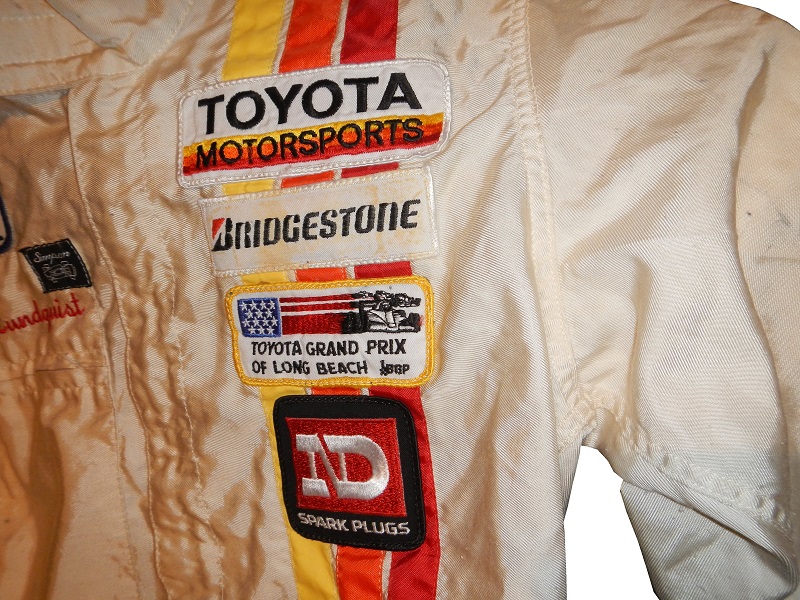
As there are no primary sponsors of the cars, there are no logos on the torso as primary sponsors.
The rights shoulder does not have an epaulet, or any adornment. The right sleeve has an EARL’ S patch and a BLISTEN SHOCK ABSORBERS patch. There are no logos at the end of the sleeve, and heavy wear on the back of the sleeve.


The left shoulder, like the right shoulder does not have an epaulet. The stripe pattern terminates at the hem of the shoulder.
The left sleeve features a SIMPSON RACE PRODUCTS patch, and a JIM RUSSELL RACING SCHOOL patch. There isn’t much wear here.

The back of the suit shows no real wear, and has no patches or design present.


In 1986, at some point, Lundquist race with Valvoline as a sponsor. Where or when he raced is not known, but during that time he wore this suit and helmet.

The suit shows light use, and is in really good condition.
The collar is a Velcro-closure design, and has no adornment on it at all.
The older 3-part Simpson Warranty tag is present in the cowl. Along with flag tags indicating size and a born on date.
The right chest features a VALVOLINE patch, and the start of the torso design is also present.
The left chest features a Simpson patch and STEVE LUNDQUIST embroidered into it, near the top of the stripe design.
The front torso features a VALVOLINE logo in vertical-arched chain stitching, in blue background, with New York Rangers-style striping.
The legs feature red, white and thick blue striping up the sides, which terminates at the waist, but there are no logos.
The shoulders have epaulets, unlike the Toyota Atlantic suit, but the epaulets have no logos present.

The right sleeve has a VALVOLINE patch on the blue, but no other logos present.

The left sleeve has a SIMPSON RACE PRODUCTS patch and a VALVOLINE patch. There are no logos on the end of the sleeves.

The back of the suit shows no real wear to speak of.
The white collar has no decoration on it at all.
The back torso has the same vertically arched VALVOLINE logo in attractive chain stitching on the back on the blue section of the suit.
The matching helmet that comes with the suit has the same VALVOLINE designs, and was boldly autographed by Steve Lundquist on the left side. 


The third driver suit is a Budweiser driver suit from 1990. At this point he was racing in the NHRA and was sponsored by Budweiser. He raced an Oldsmobile, and had a number of sponsors. The suit is in good condition.
The standard Simpson warranty label is present inside the cowl. Additionally, there is a small flag indicating that the suit was made in January of 1990.

The chest is very patch laden, with the right chest features an NHRA MEMBER patch, above STEVE LUNDQUIST. Below that are CHIEF AUTO PARTS, HYDROMATIC and PENNZOIL patches.
The red belt is unadorned.
The legs have no wear or logos on them. The cuffs are standard cuff.
The shoulders have epaulets, and the right shoulder has an OLDSMOBILE patch fully covering the epaulet.
The right sleeve does not have any adornment at all.

The left shoulder has a GOODYEAR patch covering the entire epaulet.  The left sleeve has a SIMPSON RACE PRODUCTS patch on top, but no other adornment present.

The back of the suit has no adornment on the collar, and a large Budweiser logo just below that.


While racing in the NHRA, Lundquist wore this collar. It was designed to keep the neck stable in the event of the crash.


Lundquist wore these large orange gloves while driving to protect his hands while he was driving. They are made of Nomex with extra protection on the palms to provide grip.


These shoes were used by Lundquist to protect his feet in the event of a fire. Leather covered Nomex, which show a lot of wear.


The Driver Suit Blog dies when I do! I will never forsake racing memorabilia, nor will I ever forsake my readers, but I will have some fun with you whenever I get the chance!
DGF2099 Productions-Introduction to Sports Memorabilia-Team Menard’s 1990 Pit Crew Suit
A pit crew suit from the 1990 Indianapolis 500 will be examined this week.
The Driver Suit Blog-Let’s Examine a 1998 Derrike Cope Race-Used Helmet

By David G. Firestone
So this week, we’re going to examine…you know what, I just can’t do this anymore! I’m tired of doing this. I’ve absolutely had it with racing stuff! I’ve done nothing but racing memorabilia for 10 years, I’m tired of it, and I quit. I’M DONE WITH RACING MEMORABILIA! I’m 33 and I need to reinvent myself. There is more to life than racing memorabilia. So I’m switching focus, and I’m gonna start focusing on Olympic memorabilia.
I bought some Olympic memorabilia from Steve Lundquist. Steve Lundquist is a former Olympic swimmer who won gold medals in the 100-meter breaststroke and the 400-meter medley relay at the 1984 Olympics, and 1982 World Championships, and 100 m breaststroke,won gold medals in the 100-meter breaststroke, 200-meter breaststroke, and the 400-meter medley relay at the 1979 and 1983 Pan American games, as well as a bronze for the 200-meter medley in 1983
After his gold medal performance, he came back a hero. A lot of his memorabilia including racing memorabilia has come on the market, such as this trading card from 1992. The card is in good condition, though it shows signs of age.
  Levi’s was an official sponsor and supplier to the 1984 Olympics and this was was issued to and worn by Steve Lundquist, which he subsequently autographed. The cap shows signs of wear from age, but the autograph is still in great condition.


 When he came back to Clayton Country, Georgia an Olympic hero, the Clayton County Chamber of Commerce awarded him this large plaque. Like the cap, it shows signs of age, but is still in good condition.
 This is a sweater vest worn by Lundquist after he retired from competitive swimming. It is custom embroidered, and shows slight signs of age, but is in great condition.


 It’s been both fun and tiring working with driver suits, but as I said, I need to reinvent myself. I’m 33, I need to change focus, I need to refresh myself, and this is, I think the best way to do it.
The Driver Suit Blog-NHRA Mello Yello Drag Racing Series Racing Uniform Variations
 By David G. Firestone
Editor’s Note, I was going to run an article on driver suits as a marketing tool, but I shelved that for now. I wasn’t happy with the way it was turning out so I decidied to run this instead. DF
Drag racing has been a popular form of auto racing, both to watch and participate. The NHRA Mello Yello Drag Racing Series is the top of the mountain in drag racing. Four classes compete in the Mello Yello Drag Racing Series, top fuel, funny car, pro stock, and pro stock motorcycle. Each has their own unique uniform quirks.

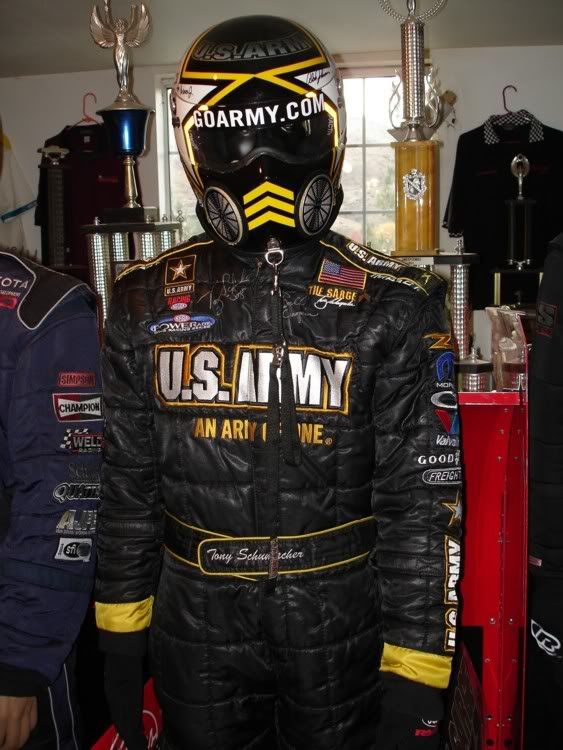
Let’s start with top fuel. Top fuel dragsters are 25 feet long, nitromethane powered and run 10,000 horsepower. While they are traditionally open cockpit, in recent years canopies, introduced by Tony Schumacher have come into style. Schumacher said that when he drives, he wears a 5-layer suit, with two layers underneath that. As the fuel tank is at the front of the car, and the engine directly behind the driver, this style of suit is very necessary. He also wears the older sunglasses style visor, as does TJ Zizzo. I bought this visor from TJ and asked him why he has as much of it blacked out as he does. He explained that when he is in the car, he needs to focus as much on the track as possible, and it’s easy to get distracted. This visor style helps create tunnel vision, and helps keep him focused. He also said that he blacks out more of the visor, so it looks like this now.
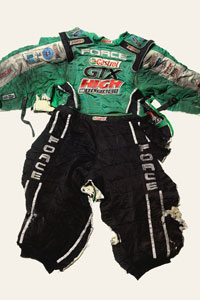
Funny cars are the next category. The name came about when drivers would take a regular car, move the front and rear wheelbases forward, and add large tires on the back wheels. Fran Hernandez, who at the time was head of Mercury’s racing program is credited as the first person to call them funny cars, doing so in 1965. Funny cars are, like top fuel dragsters, nitromethane powered, but these cars are only 8,000 horsepower. The driver suits and helmets are identical in design to top fuel driver suits. Older helmets, such as this Cruz Pedregon model from 2011 have respirators built into them. Since the engine is in front of the driver, breathing in fumes is a concern. However with the new modifications to the cars, these respirators have all but disappeared from the sport.
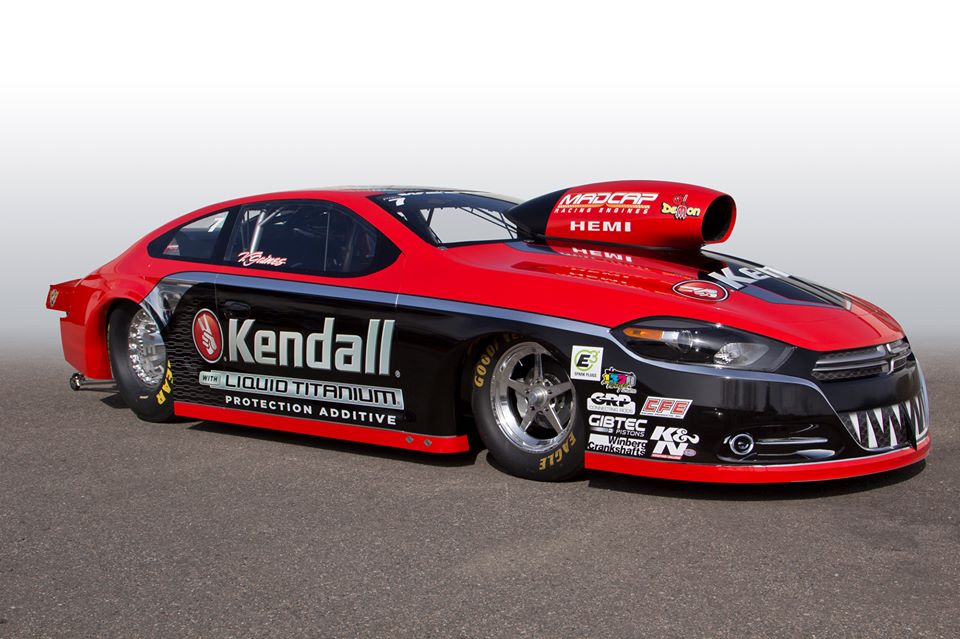
Pro stocks are next. Pro stocks are 1,300 horsepower, the engine has to be made in the same place as the engine, and use 118 octaine racing gas, instead of nitromethane. Because no forced induction can be used in pro stock, such as turbo charges, superchargers, or nitrous oxide, the cars are very technical. While pro stock drivers tend to wear the same basic driver suits, many drivers choose to wear two-piece suits instead of one-piece suits. I’ve never seen that in NASCAR, IndyCar, or F1.
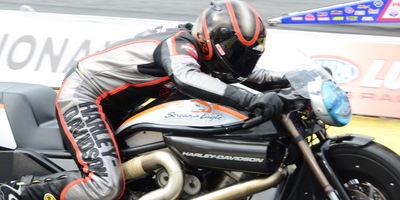
The last class we will cover is pro stock motorcycle. Pro stock motorcycles are rated at around 375 horsepower, are designed to look like their street counterparts, and the handlebars can’t be used to turn the bike. These uniforms are unlike any other uniform in drag racing, in that fire protection is not their major design function. If something goes wrong in pro stock motorcycle, the rider will most likely be thrown from the bike. As such, the riders wear traditional motorcycle leathers, so that if the worst case scenario happens, the rider won’t be skinned alive.
As with all auto racing classes, safety is fluid, it’s constantly changing. After Scott Kalitta was tragically killed in Englishtown in 2008, a controversial decision was made that due to the power and speed that top fuel and funny cars create, they would lessen the length of the race from a quarter mile, or 1,320 feet to 1000 feet. This hasn’t sat well with fans, but has saved lives in the long run. One of the most critical safety features led to the current safety culture. All top fuel and funny car drivers use t-shaped parachutes. These were invented by Bill Simpson after a drag racing accident. This led to him working with NASA as a parachute consultant. As fate would have it, he ran into Pete Conrad, who was a racer when he wasn’t an astronaut. Conrad introduced Simpson to a material used for parachutes called Nomex. Conrad suggested that it would be a great material for driver suits. Simpson agreed, and the rest is history.
DGF2099 Productions-Introduction to Sports Memorabilia-Bill Brach 1972 Driver Suit
A vintage Bill Brach driver suit, circa 1972 will be discussed this week.
DGF2099 Productions-Introduction to Sports Memorabilia-Mish Mosh Edition Part 4-Historical Part 2
Our last Mish Mosh edition features more historical memorabilia.
 DGF2099-Main Page