A Bobby Hillin Jr. Suit from his brief career with Moroso in 1991 will be in the spotlight this week.
Tag: sprint cup series
DGF2099 Productions-Introduction to Sports Memorabilia-Jody Miller 2005 Race Worn Driver Suit
A uniquly designed Jody Miller Toyota Tundra race worn driver suit from 2005 will be examined this week.
DGF2099 Proudctions-Introduction to Sports Memorabilia-Kenny Wallace 1999-2000 Race-Worn Driver Suit
Kenny Wallace is in the spotlight this week, as we look at a race-worn driver suit circa 1999-2000, which he has boldly autographed across the front.
The Driver Suit Blog-The First Question…Where Do You Buy This Stuff?
By David G. Firestone
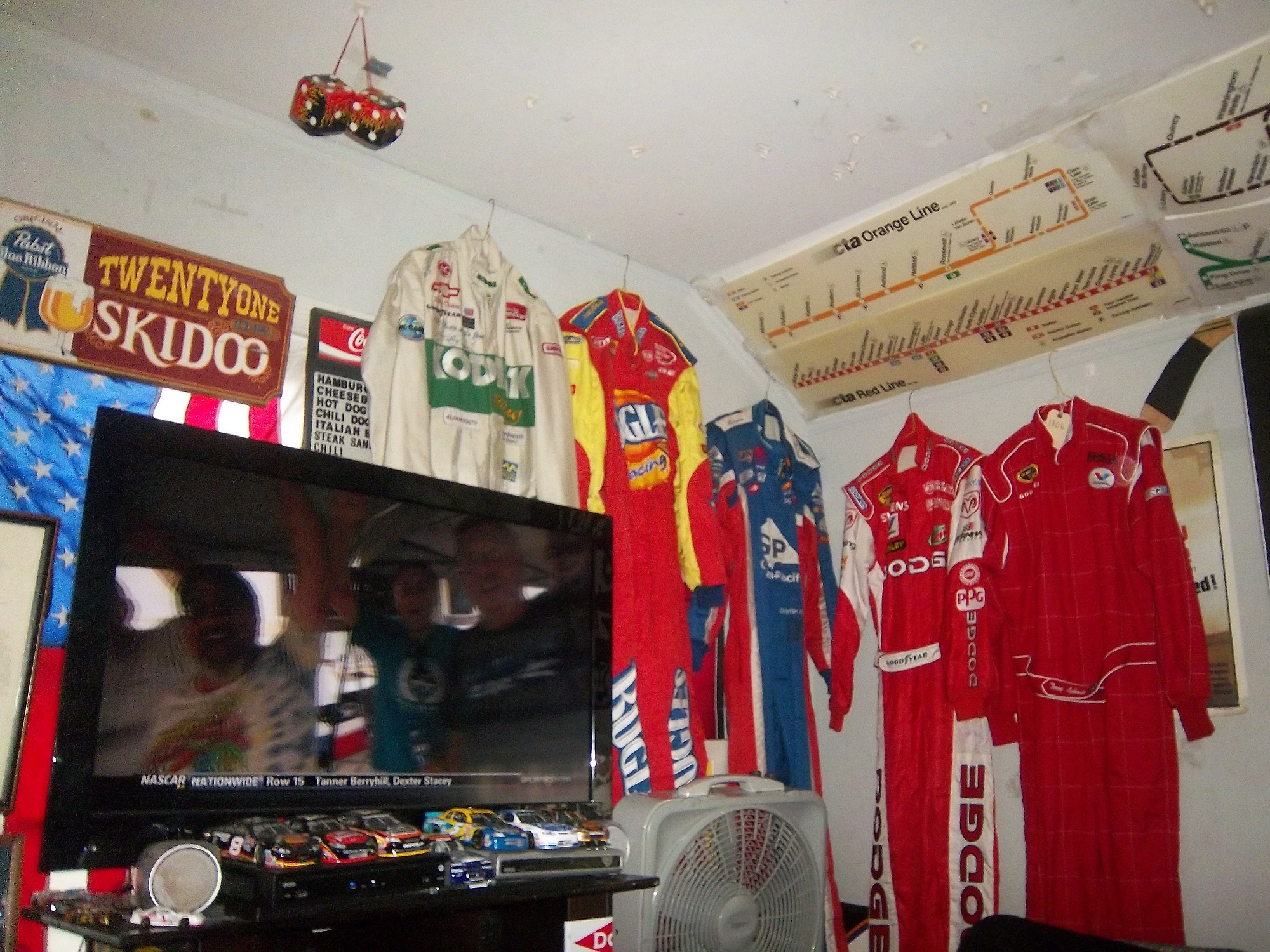
I discuss the various aspects of race-worn and race used collectibles on this blog, and in researching something, I had received a suggestion that sounded like a great idea. The idea that was posed was “You may want to mention where people can actually buy these suits as well.” So I think I will.
The most obvious place to purchase race-worn and race-used items is eBay. Now this is not as simple as it might sound. In the Sports Memorabilia, Cards and Fan Shop section, entering the term “Suit”is a good place to start. Entering the term “driver” can be a mixed bag, and the term “firesuit” as well as “driver suit” work well. If that is not to your liking, search “driver suit” firesuit” “driver firesuit” “NASCAR uniform” “racing uniform” or “driver uniform” in the Any Categories setting.
Another, less likely place on eBay is the Safety Equipment section on eBay motors. Reason being that not all race-worn driver suits end up in collections, many of them are recycled and sold to racers who need a quality firesuit but do not have the resources to spend the thousands needed for a customized one. In fact, many auctions that are geared towards collectors also mention the size in case the suit is bought by a racer.
I have a couple of sellers that I buy from on a regular basis. One of my favorites is Just For Fun Collectibles. They have an amazing selection, and some of the best prices for stuff I have ever seen. I have bought a lot from them, and I always enjoy buying from them. The other seller I buy from regularly is Race Image. Both are based in North Carolina, and Race Image buys regularly from race teams, and resells the items both on their site and on eBay. Like Just For Fun, I have bought a lot from them, and I always enjoy buying from them. Raceusedrescued is another great seller, who has a whole lot of NASCAR stuff.
Using legitimate auction sites can be iffy, not as many people are into race-worn and race-used memorabilia, as are into baseball, or football. But one place that regularly sells race-worn material is Paragon Auctions. They have had a lot of race-worn driver suits for sale in their auctions. Other groups, such as Heritage Auctions and American Memorabilia both have had a lot of suits sell through their auctions.
But with all the places to buy items, doing the research before you buy is critical. That is why I started The Driver Suit Blog, to give collectors the resources and information that they need to do the hobby, and do it right. I’m not someone who just buys these because they look nice, throw them in a closet, and never think about them. I look at them, admire them, and I understand how much work went into designing them. I love this hobby, and I fully support it, and I want to help collectors advance in this hobby in any way I can. That is why I put the time and effort I do into this blog.
Next week, I will announce the 2013 Driver Suit Blog Paint Schemie Awards. The Schemies are a series of awards given out for paint schemes in the Sprint Cup series. For every category, there are two awards given, First and Worst. First awards are given to the best schemes of the year, and worst…well that is pretty self-explanatory, isn’t it?
Tailgating Time!
I took my chili recipe I previously mentioned, and changed the recipe slightly.
You will need:
2 pounds beef chorizo sausage
1 onions, chopped
1 (7 ounce) can diced tomatoes-drained
1 (7 ounce) cans smoked chipotle salsa
1 (12 ounce) can kidney beans-drained
1 cup water
Chili powder and garlic powder to taste
In a large saucepan over medium heat, combine the chorizo and onion and saute until meat is browned and onion is tender. Add the diced tomatoes, smoked chipotle salsa,beans and water.
Season with the chili powder, and garlic powder to taste. Bring to a boil, reduce heat to low, cover and let simmer for 15 minutes.
Paint Scheme Reviews
First we start with 2014 schemes…
Brad Keselowski #2 Miller Lite Retro Ford Fusion This scheme is perfect. There is nothing that can be done to improve it. A+
Marcos Ambrose #9 Twisted Tea Ford Fusion A good color scheme is in play here. I like the shades of yellow, green and blue used here. The overall design works well with the color scheme, and I will give it an A.
Now on to 2013 schemes…
Jamie McMurray #1 Lexar Chevy SS Decent color scheme, and if you get rid of the flash drives at the bottom, it would be an A scheme. This scheme is good, and earns a B+
Dave Blaney #7 Ultra Wheels Chevy SS This is the first time that this car actually looks good…provided you get rid of that door number. B+
Clint Bowyer #15 5-Hour Energy Sour Apple Toyota Camry Another example of why camouflage does NOT work on race cars. What does camouflage have to do with sour apples? This scheme does not work, and it gets an F
Greg Biffle #16 Scotch Ford Fusion Eww…the green design clashes with the red, and the plaid design is atrocious. F
Ricky Stenhouse Jr. #17 RFR Driven Chevy SS Ricky has run a lot of great schemes this year, and this scheme is not an exception. Great color and simple design earns this scheme an A.
Ryan Newman #39 Quicken Loans-Salute to Veterans Day Chevy SS This scheme is a bit more complex in the grade that I gave it, and requires some explanation. This scheme features pictures of United States Military Veterans on the side as a tribute to them. They have earned a place on the car, and have earned the respect as a nation, and an A+++ grade.
Landon Cassill #40 Pirate Oilfield Chevy SS Looks good, great color scheme, simple design, A+
Juan Pablo Montoya #42 Target Camouflage Chevy SS Camo just doesn’t work for race cars, an this is no exception. While they did try to keep the red, it just looks awful, and I’ll give it an F
Bobby Labonte #47 Wounded Warrior Project Toyota Camry Camo doesn’t ever look good on a race car, and this is another example. It looks better than this though…
Kyle Larson #51 Visit Dallas Chevy SS I love color scheme, and I love the skyline on the hood. I’m disappointed that the skyline isn’t on the side of the car, it would look good on the door, but it is still a solid A scheme.
Dale Earnhardt Jr. National Guard Breast Cancer Awareness Chevy SS Pinkwashing is an automatic F grade.
Dale Earnhardt Jr. Amp Gold Chevy SS Not a bad color scheme, though the dot design does not look good at all. I’ll be generous and give it a B-
The Driver Suit Blog-Video-Matching, and The Challenges It has
By David G. Firestone Video matching is another way to authenticate a driver suit, though it is somewhat more complex than simple photo-matching. Whereas a photo stands still, video is in motion, and this method of authentication is more complex and can sometimes be problematic. I will give you the steps to make this happen.
First is that you need to find a video that may have the driver wearing the suit visible in it. Google and YouTube are very good for this. It will take some time, and can be frustrating. Once you think you have found it, you have to watch every second of the video to see if the driver is in fact in the video. This can and often is time consuming and frustrating. If you get lucky and find a video, take a screen shot, and isolate the driver. On a PC you hit prtScn and then save it on an image saving program such as Windows Paint. For Macs, you use Command-Shift-3: Take a screenshot of the screen, and save it as a file on the desktop Once done, you can compare the screen shot to the real suit, as seen below:

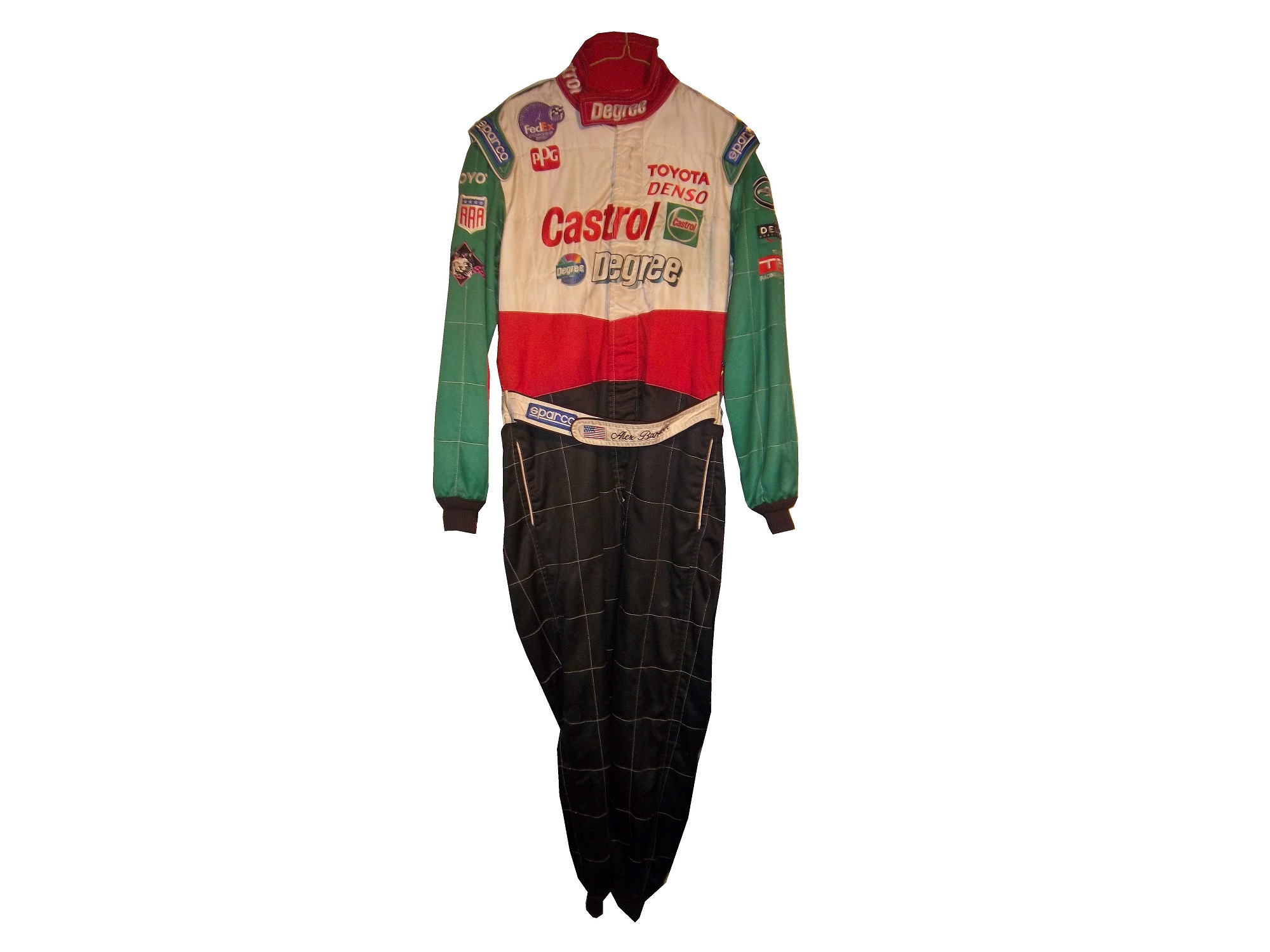
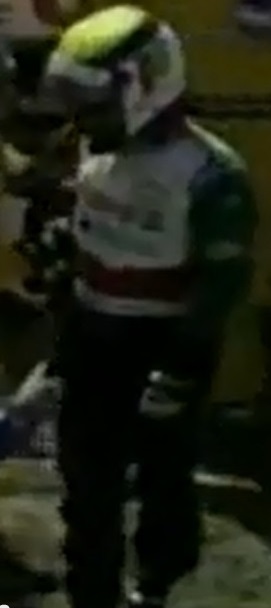 It needs to be noted that race-wear, that is wear that comes from racing does not always show up in video, as it is difficult to pinpoint when and where race-wear happened over the course of the season. In-car cameras can be used for video matching, but the downside to this is that since there is not a lot of the suit that shows up on in-car cameras during a race, this can be problematic, and can in some cases lead to a false identification of a suit.
In a number of instances, drivers appear in video games. Many racing games feature a select screen, where you can choose a driver, and they wear their suits as seen below:
Again, there is not a lot of the suit visible, so total identification can be difficult. I would wait until all other avenues have been exhausted.
The last way is to use a VHS tape of a race that has video of the driver in question. If at all possible, transfer the tape to a computer, or a DVD, but if that is not possible, then, as a last resort, take a picture of the screen, and use that to match the suit. It is not very scientific, and the quality will probably be low, but if it works, it works.
While it is not required to match a suit, real collectors who care about the hobby do so to make sure that they are getting the real deal when they buy a driver suit. But where exactly do you buy these suits? We’ll discuss that next week.
The Driver Suit Blog-Nomex-The Core Of Driver Suits
By David G. Firestone I must have said the word Nomex a thousand times on this blog, but what exactly is Nomex? In short, it is a flame-resistant meta-aramid cloth material. It is an aramid material, which is the same thing as Kevlar, but it is not as strong as a bulletproof vest, but it has great thermal, as well as chemical resistance, which makes it great for racing firesuits.
The development of the Nomex firesuit has been a long road. This road has seen its share of driver deaths and injuries. Before the Coca Cola 600, I discussed the deaths of Fireball Roberts, Eddie Sachs, and Dave McDonald in fire-related crashes over the course of 6 days in 1964. What took place from there would cross the paths of racing and a young drag racer.
Bill Simpson was born in Hermosa Beach, California in 1940. He took up drag racing at a young age, and at age 18, broke both arms in a drag racing crash. As he recuperated, he thought of safety in racing for the first time. He developed the idea of an X shaped parachute, and using materials from his uncle’s army surplus shop, developed a functional drag racing parachute. Don Garlits noticed the new parachutes, and took an interest, which helped the Simpson Drag Chute company to form. As time went on, he started making other racing equipment, which caught the attention of drivers, and, oddly enough, NASA. During a project, he met Pete Conrad, who introduced the now 27 year old Simpson to Nomex in 1967.
Nomex was created in 1967, for NASA. Far from the uses it has today, its main use at the time was for the Apollo Command Module parachutes. NASA needed a material that could stand up to the heat of reentering the earth’s atmosphere, and still remain fully functional. Simpson saw what the material could do, and decided it would work well to make driver suits, and other uniform items.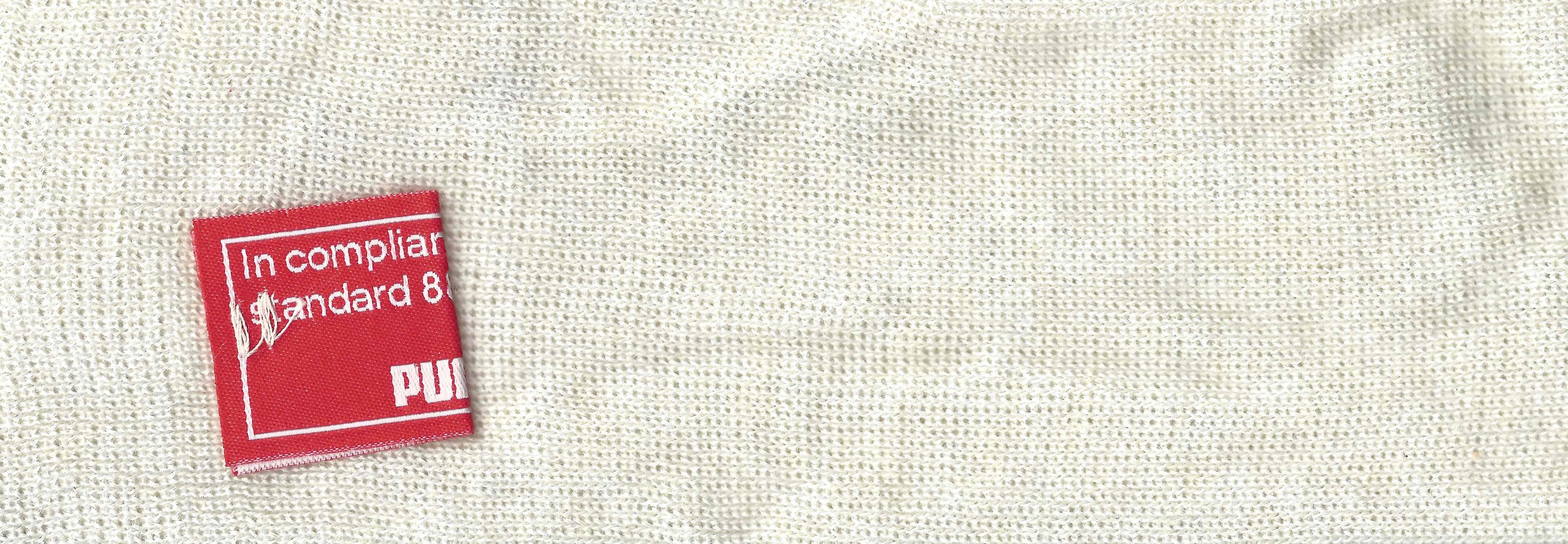 Contrary to what most people think, Nomex is not fire PROOF, rather it is fire RETARDENT. It does burn, but burns at a much slower rate, and that protects the driver in the event of a fire. Bill Simpson decided to show how much better this material was by having a “burn off.” He put on one of his Simpson racing suits, doused himself in gasoline, and lit himself on fire. Though he was fully engulfed in flames, he was not hurt. Though he admits that is was a bad idea, it sold drivers on Nomex. Even today, 46 years later, Nomex is still the go-to material for driver suits.
 Nomex is used for many other things. Nomex sheet is used in power cords for insulation. Fire-fighters use Nomex for protection in saving lives. Fighter pilots wear Nomex suits in case of cockpit fires. Nomex was developed for NASA and NASA still uses a lot of Nomex. It is used in what NASA refers to as the “Thermal Micrometeoroid Garment of the Extravehicular Mobility Unit”, or in regular English, the “outer layer of a spacesuit.” The spacesuits that space shuttle astronauts wore on liftoff and touchdown were primarily made of Nomex. Almost every project that NASA has done in the last 40 years involves Nomex in one form or another, so it is a very versatile material.
Interestingly, as safety concerns increased, and safety equipment changes for the better, you begin to see that Nomex is beginning to have competition in the driver suit market in terms of fire protection. While I’m typically a traditionalist when it comes to sports uniforms, for driver suits that is a great thing. Developing a new material that serves the same purpose as Nomex, but can do it better and longer is a great thing. Eventually, Nomex will go the way of typewriters, film cameras, the printing press, and the floppy disk as an invention that is obsolete but changed the world.
Paint Scheme Reviews!
Some new 2014 schemes released this week:
Danica Patrick #10 Apsen Dental Chevy SS Even though this scheme is better than the *ahem* current Aspen Dental scheme, it still does not look good. But it is still an improvement, and I’ll give it a C
Ryan Newman #31 Quicken Loans Chevy SS Great color scheme-Check, Awesome use of Northwestern stripes-Check, classic design-Check, A+ Grade, Double-Check!
Dale Earnhardt Jr. #88 National Guard Chevy SS The numbers kill what is otherwise a great scheme. I like everything else, but the color of the numbers looks really odd, and I can’t really say it adds to the car at all. Still it is a decent scheme, so I’ll give it a B
Now we move on to 2013
Denny Hamlin #11 FedEx One Rate Toyota Camry Very clean look, with a very good color scheme, can’t say anything bad about this, A+
Greg Biffle #16 Pink 3M Ford Fusion Pinkwashing is an automatic F. I hate it when companies use causes like this to move products, so I show no mercy in this sence.
Ricky Stenhouse Jr. #17 Pink 3M Ford Fusion See Above, F
Ricky Stenhouse Jr. #17 My Best Buy Ford Fusion The blue used on this scheme is a tad too light, but it is still a decent scheme, though the lighter blue takes it from the A grade Best Buy had to an A-
Joey Logano #22 Shell/Pennzoil/Hertz Ford Fusion I’ll be honest, I want to give this scheme a better grade, but the Hertz logo just looks out of place here, and it is awkward on an already iffy scheme. Best I can give it is a D-
Cole Whitt #30 Black Clover Toyota Camry Swan Racing seems to go out of its way to design bad paint schemes this year, and this scheme is no exception. It has no redeeming features at all, and earns an F-
Jeff Burton #31 Sleep Innovations Chevy SS Great color scheme, though the design on the front is a bit overdone, still a good looking scheme that earns a solid B+
Aric Almirola #41 Maurice Petty Tribute Ford Fusion Tribute schemes have worked very well across the board, and this is no exception. Simple, timeless, yet attractive, a great tribute to a great engine builder. Extra points for using Maurice’s #41 for the weekend. Interestingly, Maurice raced in a total of 26 Sprint Cup races, and had 7 top 5’s and 16 top 10’s during the 1960’s.
Travis Kvapli #93 Dr. Pepper Toyota Camry An A+ scheme all around.
The Driver Suit Blog-The Helmet Stripe-An Unusual Place For Sponsorship
By David G. Firestone Last week, I had a column run on Uni-Watch, and I delayed this article until this week. Two weeks ago, we discussed visors, this week, we will discuss what has become known as the “helmet stripe.” Helmet stripes came from IndyCar and Formula 1 cars, which are open cockpit cars. Helmets are clearly visible to television cameras and fans. As a direct result, helmet design in Formula 1 has become its own unique art form. Helmet designs become a part of the driver identity. The other thing that these open cockpits allow is for sponsorship opportunity. As such, a small opaque stripe is used on helmet visors.
 In NASCAR, the visor was slow to arrive. This is due to two reasons, first, many drivers up until the mid 1990’s chose to wear open-faced helmets. While these helmets had a shade to help keep the sun out of a driver’s eyes. While sponsor logos do show up, they were used for the driver’s name. This Brad Noffsinger example from 1988 is an example of that.
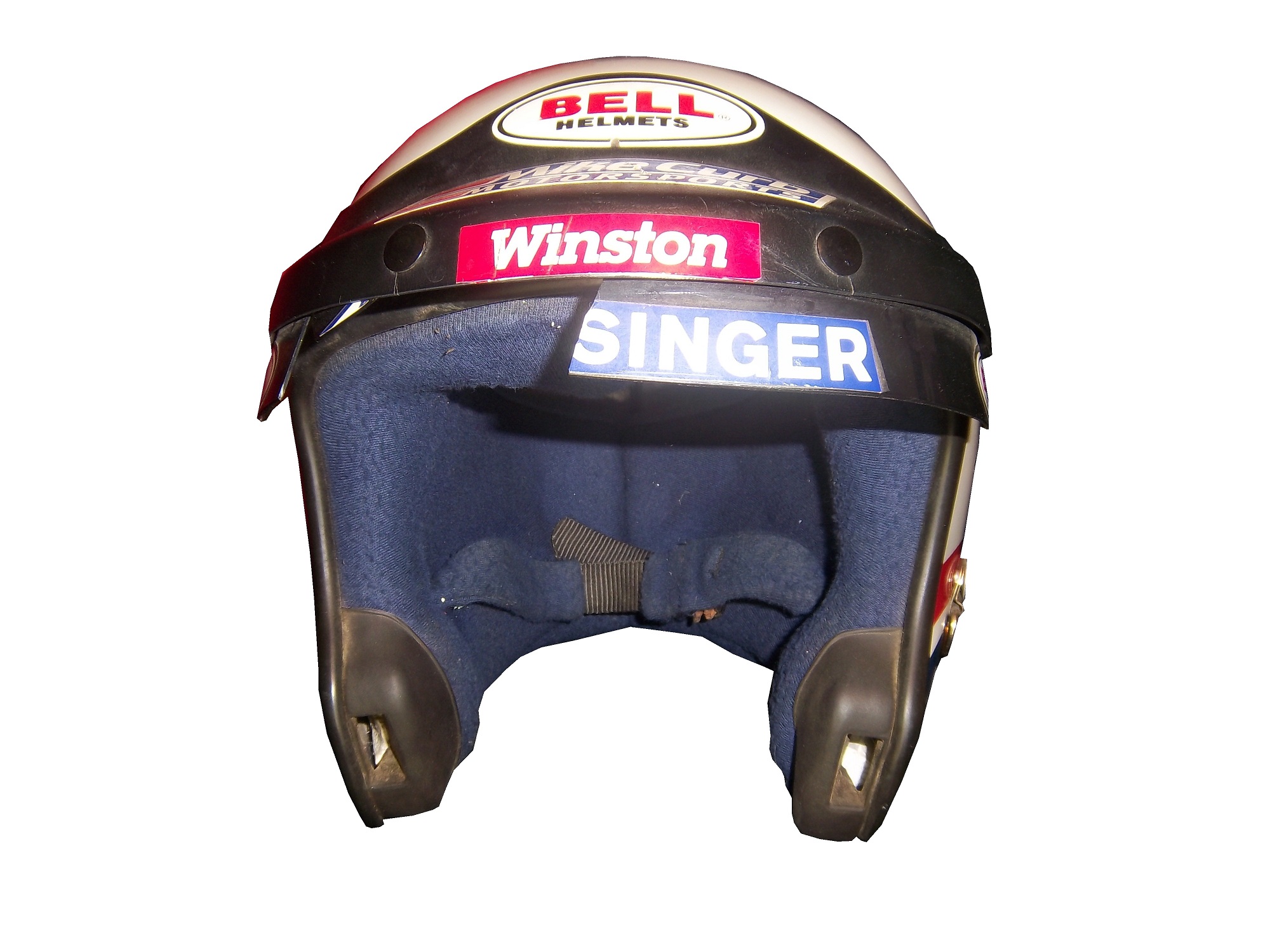 The second reason that helmet stripes were slow to come to NASCAR is that in-car cameras, while used, were for many years positioned in such a way that the visor would not be seen. Even if helmets were painted, the visor had no stripe. When the in-car cameras were positioned to film the driver from the side and even from the front, the helmet stripe became the standard. The stripe is designed to fit over the part of the visor that overlaps the opaque part of the helmet, as this example shows.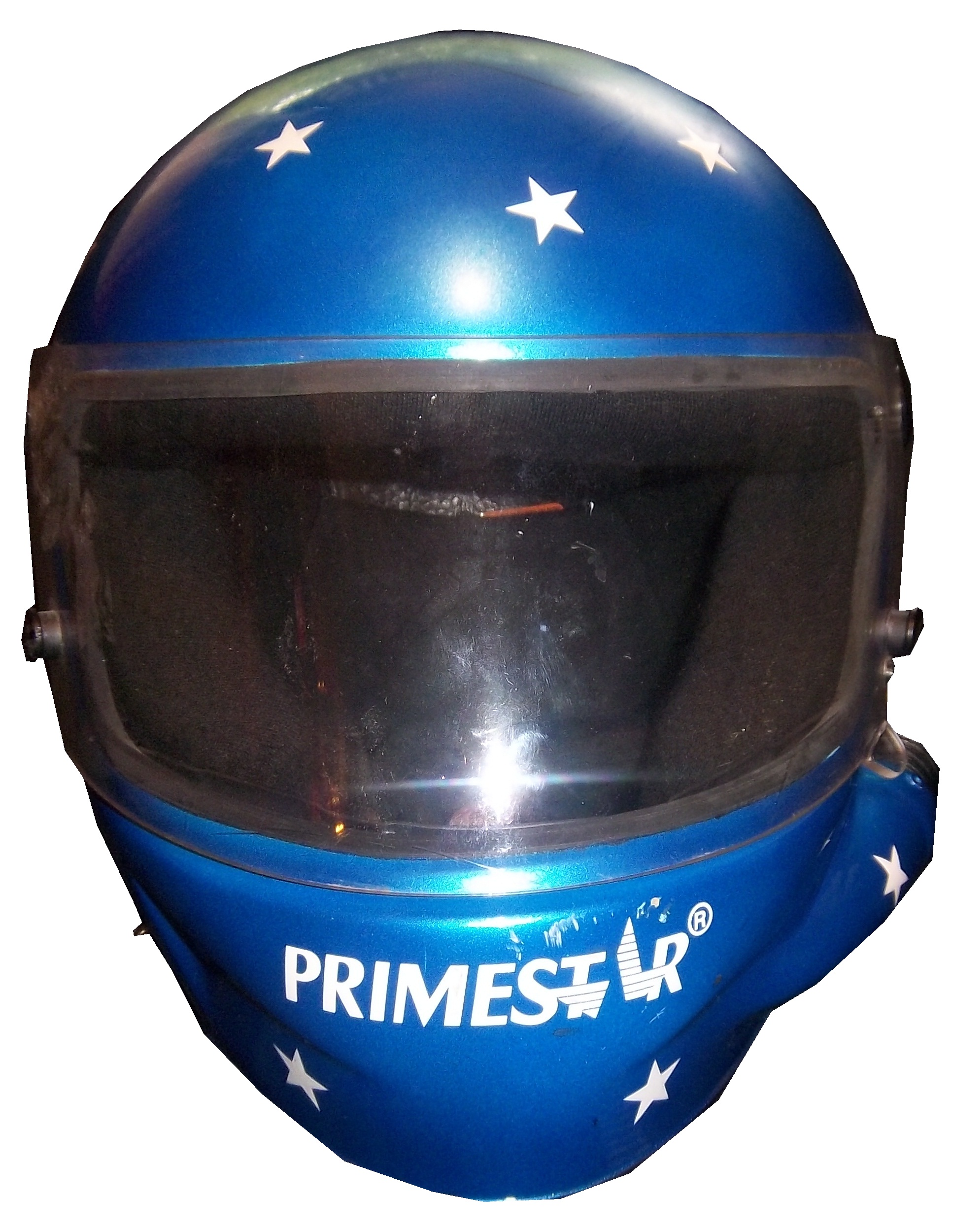
 Helmet stripes have become standard. To show how it affects the overall look of the helmet, I took this Kevin Lepage helmet from 1999, and edited the pictures to show how it looks.
 Not bad, but let’s compare it side by side to the original helmet…

 Helmet stripes have become a unique way for a driver to customize a helmet, as this video shows:
Facebook pages and Twitter helmets are becoming standard on these. All visors that a driver would wear on a helmet have these stripes, which is standard, as visors are changed on a regular basis, and sponsors want the advertising space that they pay for.
Paint Scheme Reviews!
Because of the Uni-Watch article last week, I didn’t get to review paint schemes. Within the last couple of weeks there were a large number of 2014 paint schemes released. Now I know that many of these will change before the start of the 2014 season, but I will grade them anyways.
Brad Keselowski #2 Miller Lite Ford Fusion Same scheme as this year, same grade, C
Kevin Harvick #4 Budweiser Chevy SS Same Scheme as last year, same grade, A
Kevin Harvick #4 Jimmy John’s Chevy SS They improved one of the best schemes in NASCAR and went from an A to A+
Kevin Harvick #4 Outback Steakhouse Chevy SS The color scheme remains the same but red takes over from beige as the primary color, which gives the car a great look, and an A grade
Kasey Kahne #5 Great Clips Chevy SS Same scheme as this year, same D+ grade
Kasey Kahne #5 Pepsi Max Cheyv SS Same scheme as last year, same F grade
Marcos Ambrose #9 Stanley/DeWalt Ford Fusion Great color scheme, though the nose, and quarter panel design are over done. Even still, I give it a B-
Marcos Ambrose #9 DeWalt/Stanley Ford Fusion See Above
Tony Stewart #14 Bass Pro Shop/Mobil 1 Chevy SS I get that two companies with different desgin schemes are sharing the car, but this is just brutal to look at. The orange and camo contrast is hideous, and the overall design is overdone. C-
Tony Stewart #14 Mobil 1/Bass Pro Shop Chevy SS The white and black contrast just looks awful! I really hope this changes before the season starts, because this is a scheme that is painful to look at. I have to give it an F
Tony Stewart #14 Code 3 Associates/Mobil 1 Chevy SS As bad of a color scheme as this is, it is certainly better than the other two Tony Stewart schemes are. That said, the color scheme warrants an F while the design warrants an A, so I’ll split the difference and give it a C
Greg Biffle #16 3M Ford Fusion This scheme is a MAJOR improvement over this year’s design! All of the pointless noise on the door is gone, and the car has a very smooth look because of it, and I have to give this design an A
Ricky Stenhouse Jr. #17 Nationwide Insurance Ford Fusion Great color and design schemes, though the white on light blue lettering and logos are hard to see. Even still, I have to give it an A-
Joey Logano #22 Shell/Pennzoil Ford Fusion Same scheme as last year, same grade, D
Joey Logano #22 AAA Insurance Ford Fusion See Above
Jeff Gordon #24 Pepsi Max Chevy SS I gave this scheme a C-, but given the *ahem* other Pepsi Max scheme, I’ve reconsidered, and I will give this scheme a B
Ryan Newman #31 Caterpillar Chevy SS An improvement on an already good scheme, A+
Aric Almirola #43 Smithfield Foods Ford Fusion If the hood and front were done in the stars design, and the rest of the car was red and white striped, it would look better, and I would be able to give it more than a C+
Jimmie Johnson #48 Lowes Chevy SS Supposidly, this will be the main scheme for the whole season, and I have to say it looks amazing, and is an A+ grade
Jimmie Johnson #48 Lowes/Kobalt Chevy SS This will be run for a few races, and it is an A+ scheme.
Carl Edwards #99 Fastenal Ford Fusion Same scheme as last year, same A grade
Carl Edwards #99 UPS Ford Fusion No redeeming features whatsoever, F-`
Now on to new 2013 paint schemes…
Jamie McMurray #1 Cessna/Auburn University Chevy SS The white hood and roof just look aukward, compared to the black covering the rest of the car. That said, it is still a decent scheme, and I’ll give it a B
Dave Blaney #7 Breast Cancer Awareness Chevy SS Pinkwashing is an automatic F
Landon Cassill #33 T-Mone Chevy SS This is a perfect example as to why only one person should design a car. It looks like it took at least 3 people to design the car, each with a different idea as to what the car should look like. And in the end it is just a mess, and not even a good color scheme can give this scheme a passing grade. F
David Ragan #34 Safercar.gov Ford Fusion See Above. F
JJ Yeley #36 United Mining Equipment Chevy SS Even if I didn’t give pinkwashing schemes an automatic F, this scheme would get an F anyway, it just looks awful
Kyle Larson #51 Target Chevy SS Simple, yet attractive, and it earns an A
Kurt Busch #78 Wonder Bread Chevy SS To celebrate the return of Wonder Bread, Kurt is going to channel Ricky Bobby, except for one difference…this scheme is a lot better than the Ricky Bobby Scheme. No flames and the baloons coming from the brake duct are a great look for this car, and it earns an A
Dale Earnhardt Jr. #88 Mountain Dew/Xbox 1 Chevy SS It has a great color scheme, and that is the nicest thing I can say about it. The design is just awful, and it looks like it will give people seizures as it drives around the track. I give it an F
Blake Koch #95 Supportmillitary.org Ford Fusion Eww…Too much going on, with the over-sized camo in too many different colors, and the door design which is awful. F-
The Driver Suit Blog-The ONLY Time A Visor Looks Good!
By David G. Firestone Some time ago, I did two posts focusing on one item, and for the next two weeks, I’ll do something similar. A part of the driver uniform that is seen by virtually everyone but not really discussed is the visor in the helmet. We see them on in-car cameras and on television, but we don’t think about them by itself that much. It seems like a minor part, but it has an interesting history.
From the 1920’s through the late 1980’s, helmets were primarily open-faced. This example is from the 1960’s, and was worn by Maine short track driver Jim McConnell.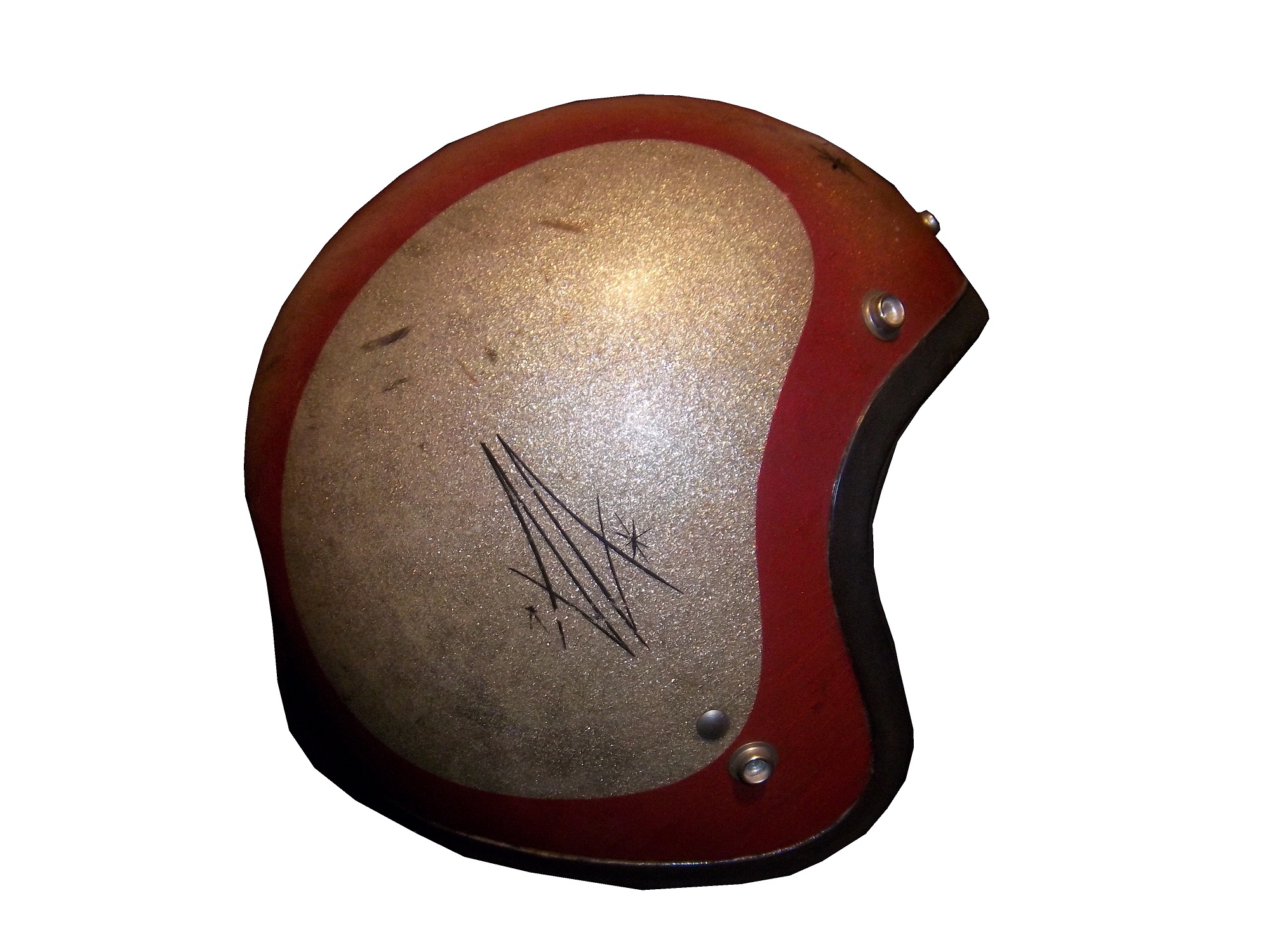

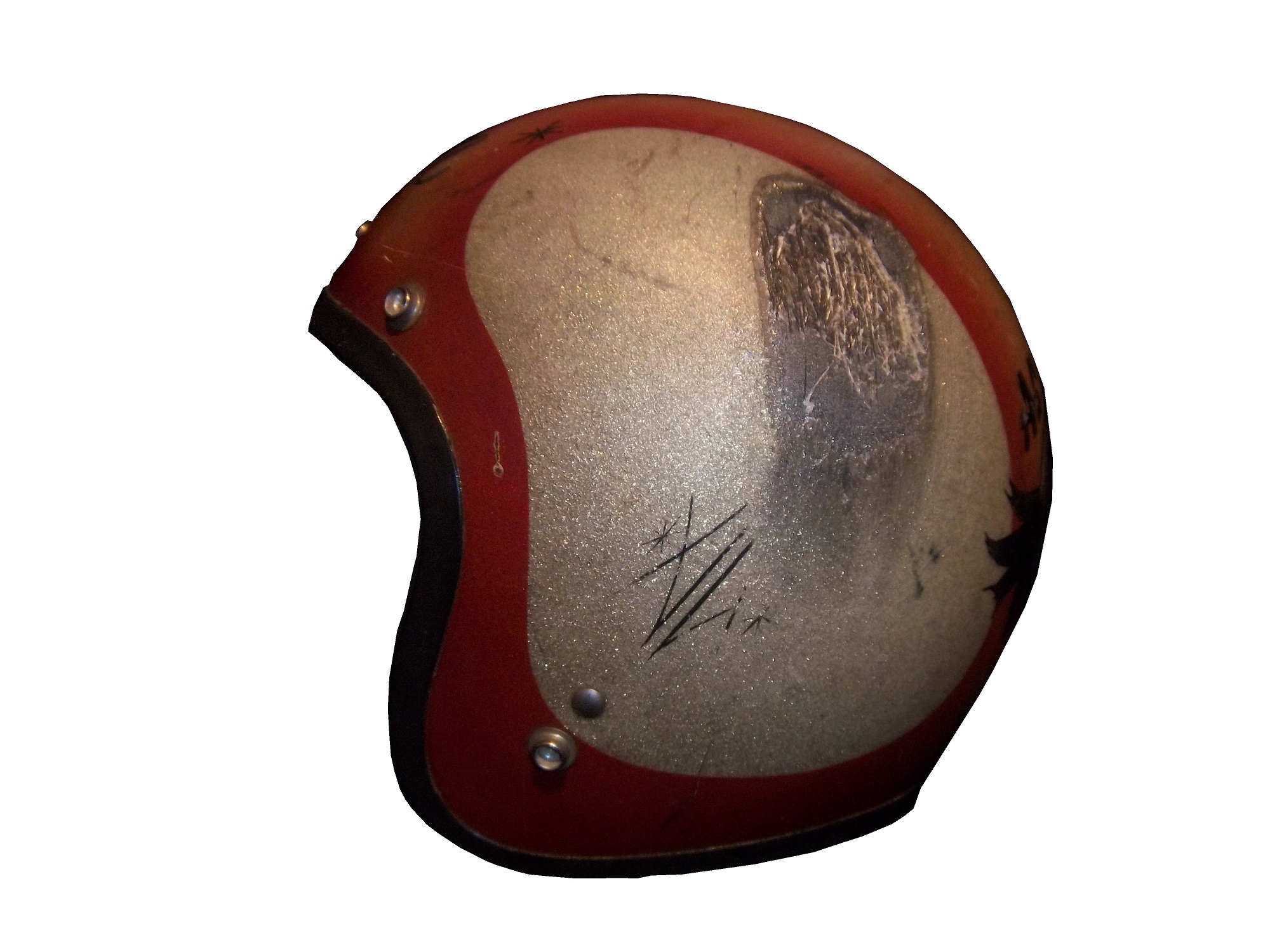

 These helmets are very simple in design, they just cover the whole head, except for the face. The downside to this is that when the sun shines in the driver’s eyes, or if the car is an open-cockpit the wind can and will force the drivers eyes closed, or fumes from the car can get in a driver’s eyes. As such, these helmets were worn with goggles.
 As full-faced helmets took over, the visor came attached to the helmet. The early ones were basically plexi-glass but as safety certification got more advanced, the visors were and still are fire tested. They also have to stand impact testing as well. As the helmets became more advanced over the years, so did the visors. Let’s take a look at one:This visor is from the McDonald’s helmet I covered earlier in the year. It is made of a very tough, but very light clear plastic. The visor is attached to the helmet by 3 screws, two that hold the visor to the helmet and a third that guides the visor and keep it in the proper place. There was a 4th one, but it was removed at the driver’s request. The visor has some unique features. At the bottom-left side there is a small flap, which is used by the driver to open the visor. Next to the small flap is a hole for a small peg. The peg goes in the hole, and holds the visors shut, but is small enough so that if a driver wants to open the helmet, they can do so with no trouble. Drivers frequently leave the visor open slightly, so two small knobs, one on each side so the driver can open or close the visor.
 Notice that it has a yellow-ish tint. This is one of 3 options for drivers, dark tint, light tint, and clear. The visor is designed to be easily changed at the drivers request. Clear visors are used for night races, and tinted ones are used for sunny races. In the event a race goes from day to night, a driver can use a tinted tear off, so that when it gets dark, they can remove the tint and have a clear visor.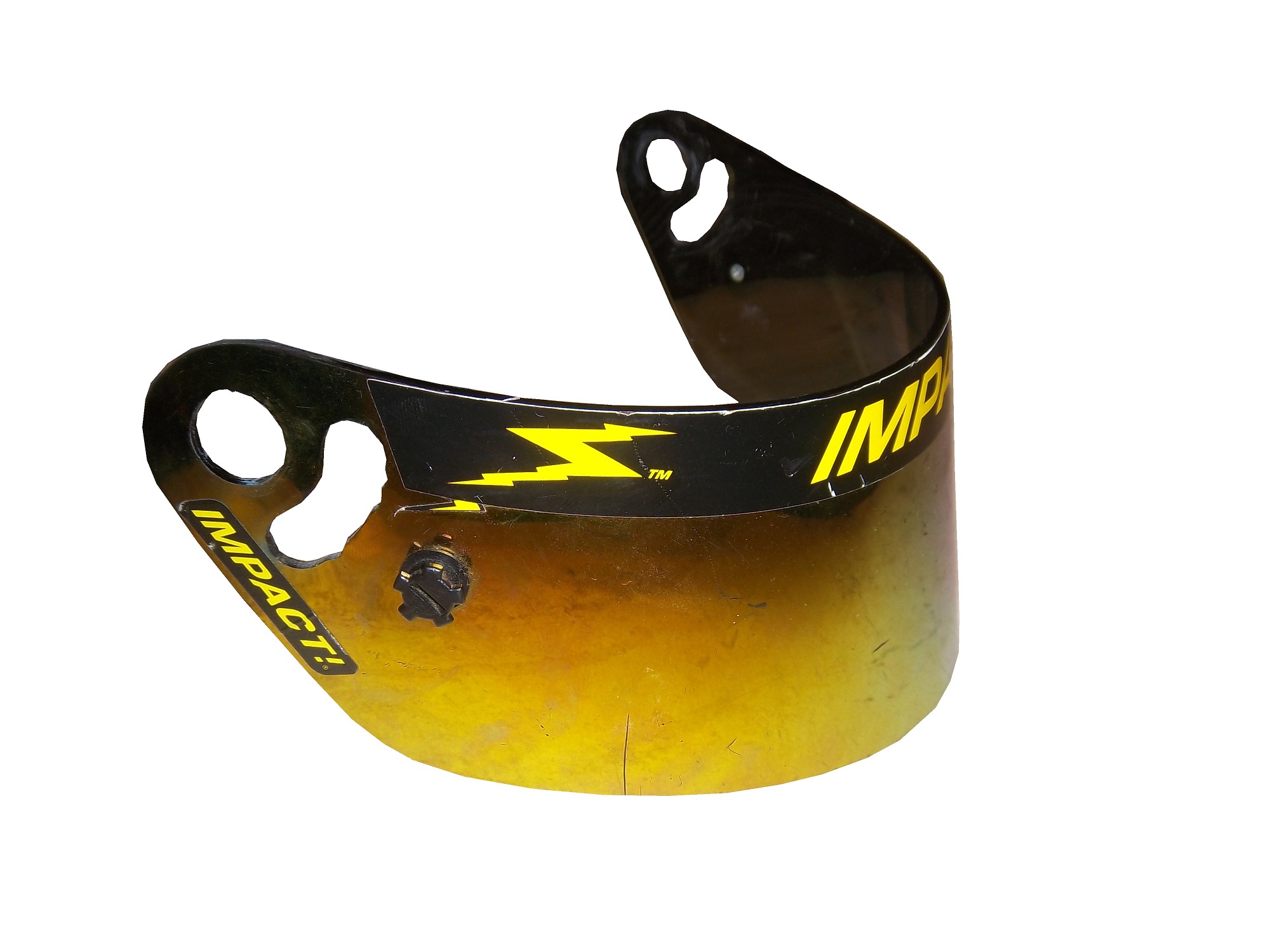
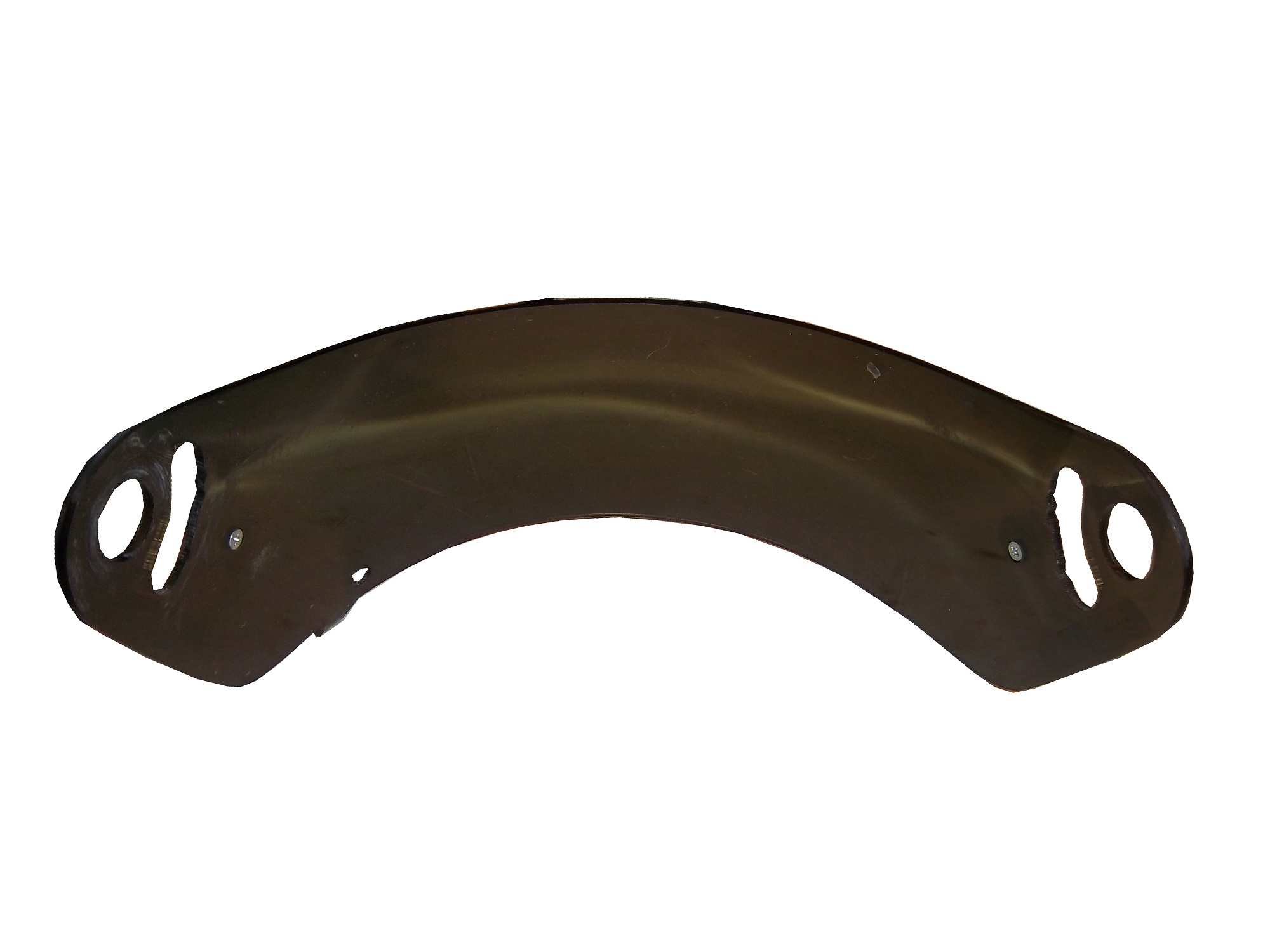 Like eyeglasses, visors get scratched over time. As such, they are changed often. Like most other items racing teams and drivers use, when they are no longed needed, they are sold to the general public. They are frequently autographed by drivers, and are a popular item to get signed by drivers. They are interesting to look at, and interesting to examine up-close. All helmet visors in this day in age have a sponsor stripe across the top, and we’ll cover that next week.
Paint Scheme Reviews
Danica Patrick #10 Go Daddy Chevy SS Pinkwashing is an automatic F
Greg Biffle #16 Sherwin Williams Ford Fusion See Above
Tony Raines #40 Moon Shine Attitude Attire Chevy SS See Above
and we have a new 2014 scheme
Kasey Kahne #5 Farmers Insurance Chevy SS It’s amazing what a different shade of paint can do to a paint scheme. This years Farmer’s scheme earned a D+ because of the primary color, this scheme earns a B+ because of the color. The design needs some work, but the whole scheme is a major improvement.
The Driver Suit Blog-Open or Closed…Which Helmet Would You Have Chosen?
By David G. Firestone
[Editor’s Note: Originally, this week was a post dedicated to primary sponsor logos. However, I had this column on the shelf for a while, but given recent events in the NFL, which fellow uniform blogger Paul Lukas has covered in depth, I felt that this article concerning helmet safety in NASCAR would be appropriate to run this week, with the primary sponsor logo column running next week. DF]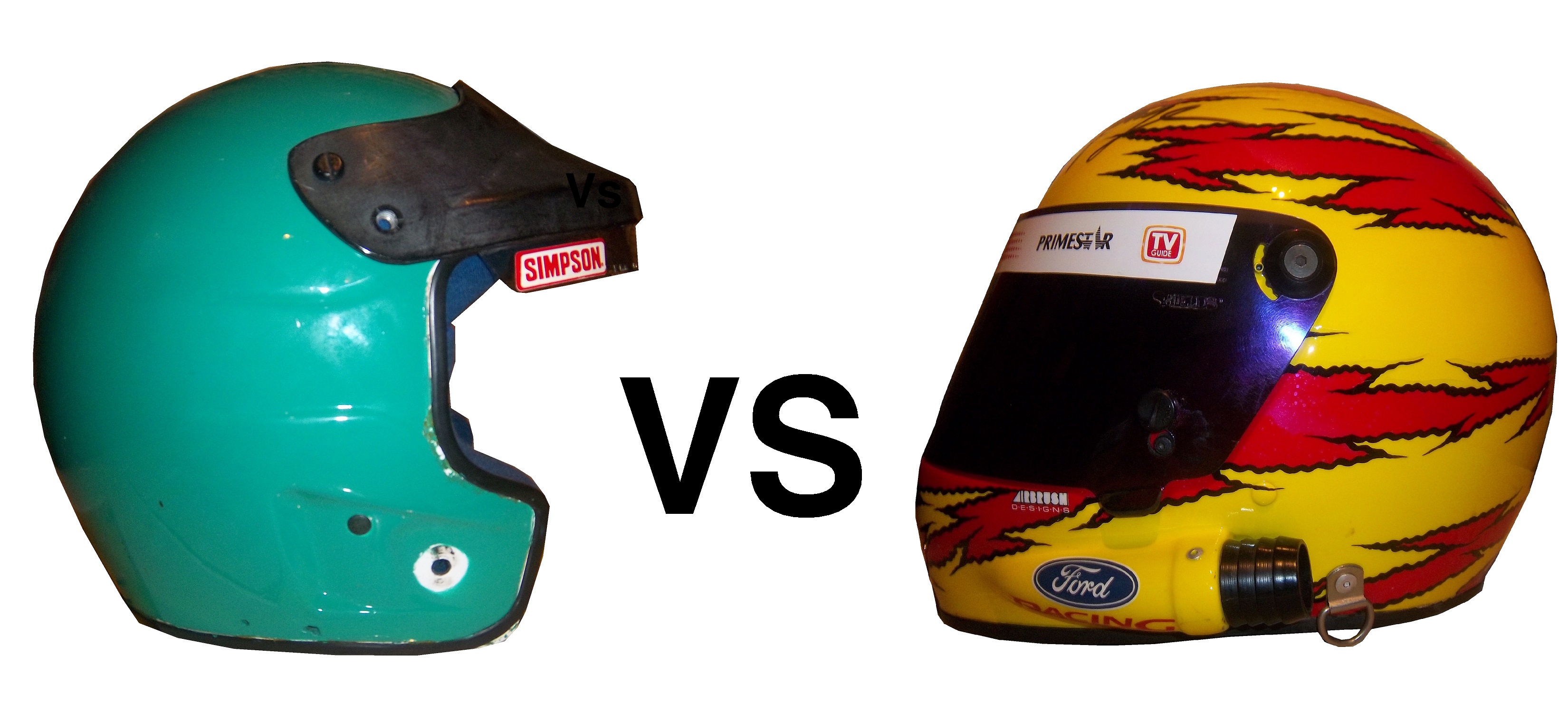 Prior to the tragic events of the 2001 Daytona 500, drivers had to make a choice that in this day in age seems absolutely absurd. From the beginning of NASCAR to that tragic day drivers had their choice of helmets, and they were open-faced,
 or full-face.
 To examine the merits and demerits of both helmets let’s take a look at one example of each, both worn by the same driver, Kevin Lepage. First, the open-faced helmet


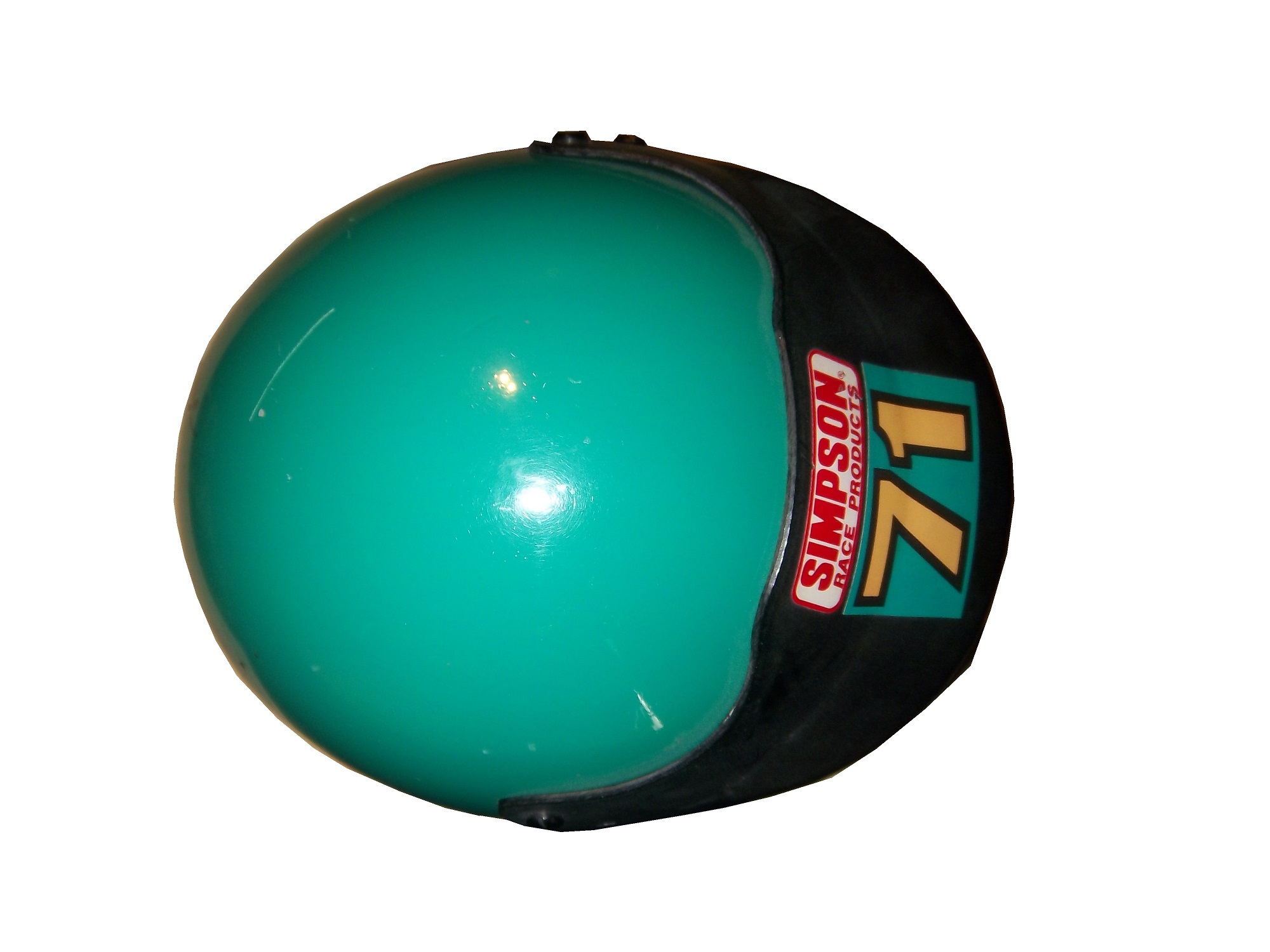
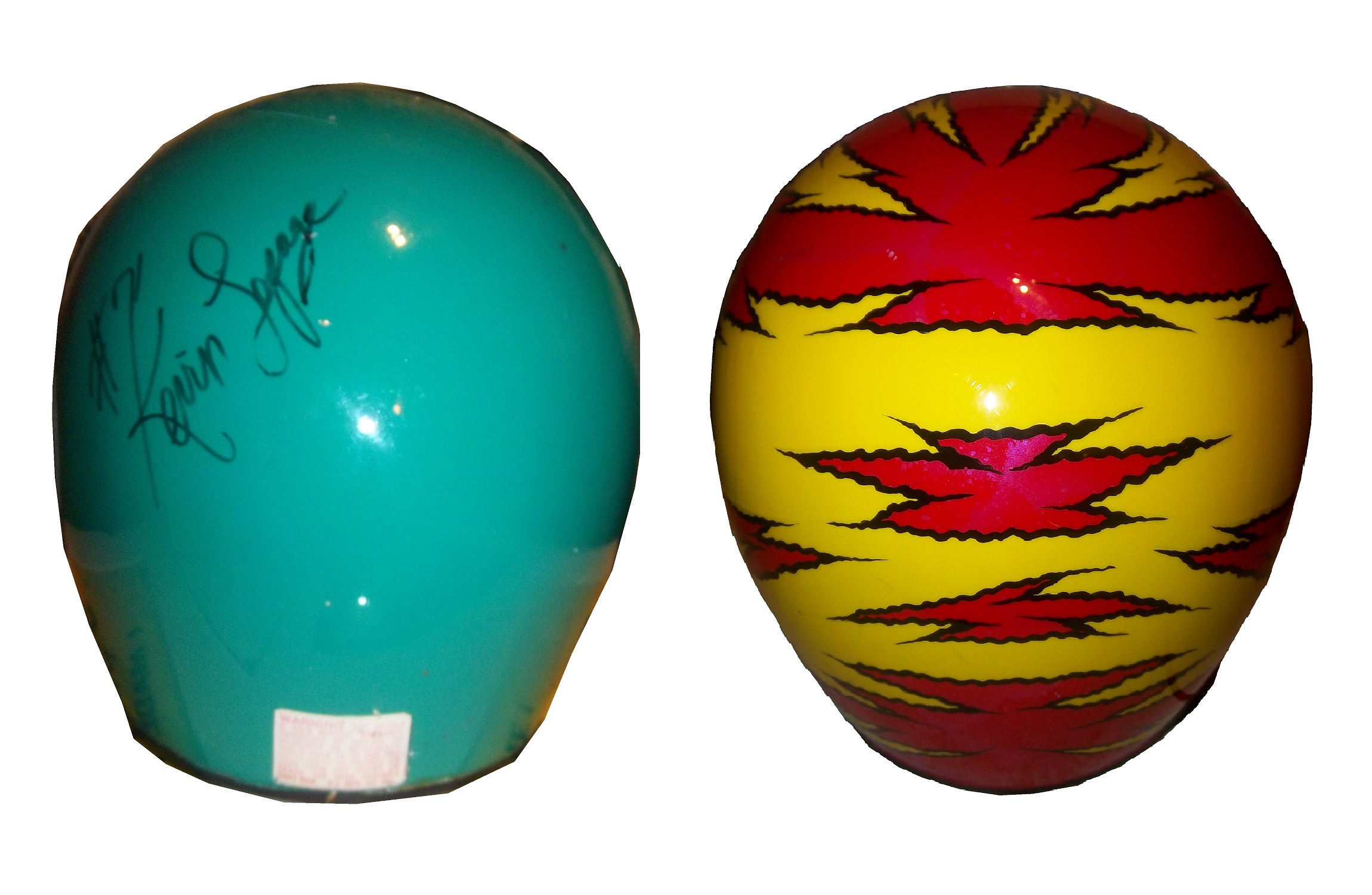
 Worn in the Nationwide Series in 1994 and 1995 during his rookie and sophomore seasons, this helmet bears a decal from high-end plush toy company Vermont Teddy Bears. It shows very heavy use, with scratches and scuff marks, has had the microphone equipment removed, and Lepage has signed the back of the helmet in black Sharpie.
Now let’s look at the full-face helmet,
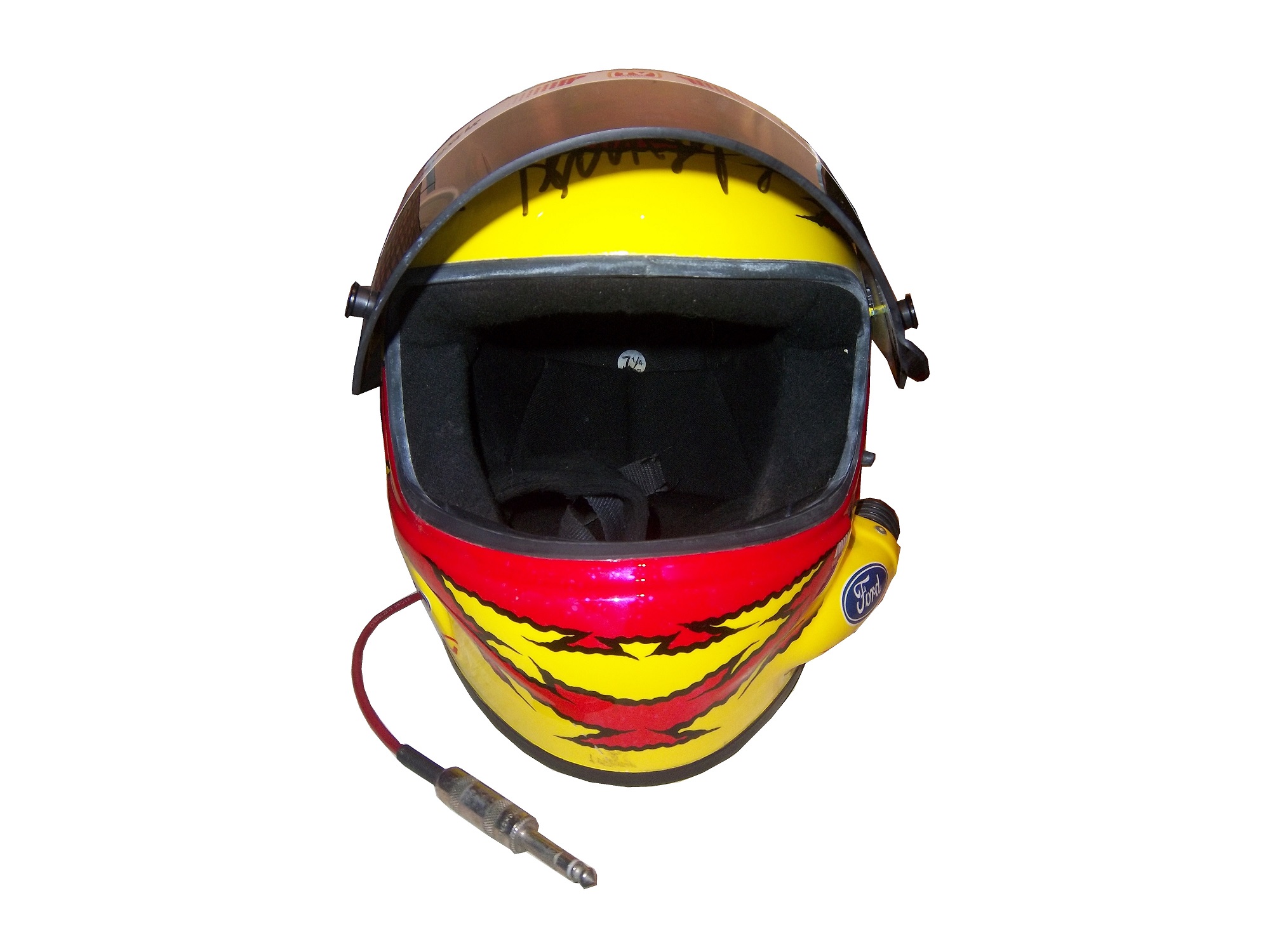

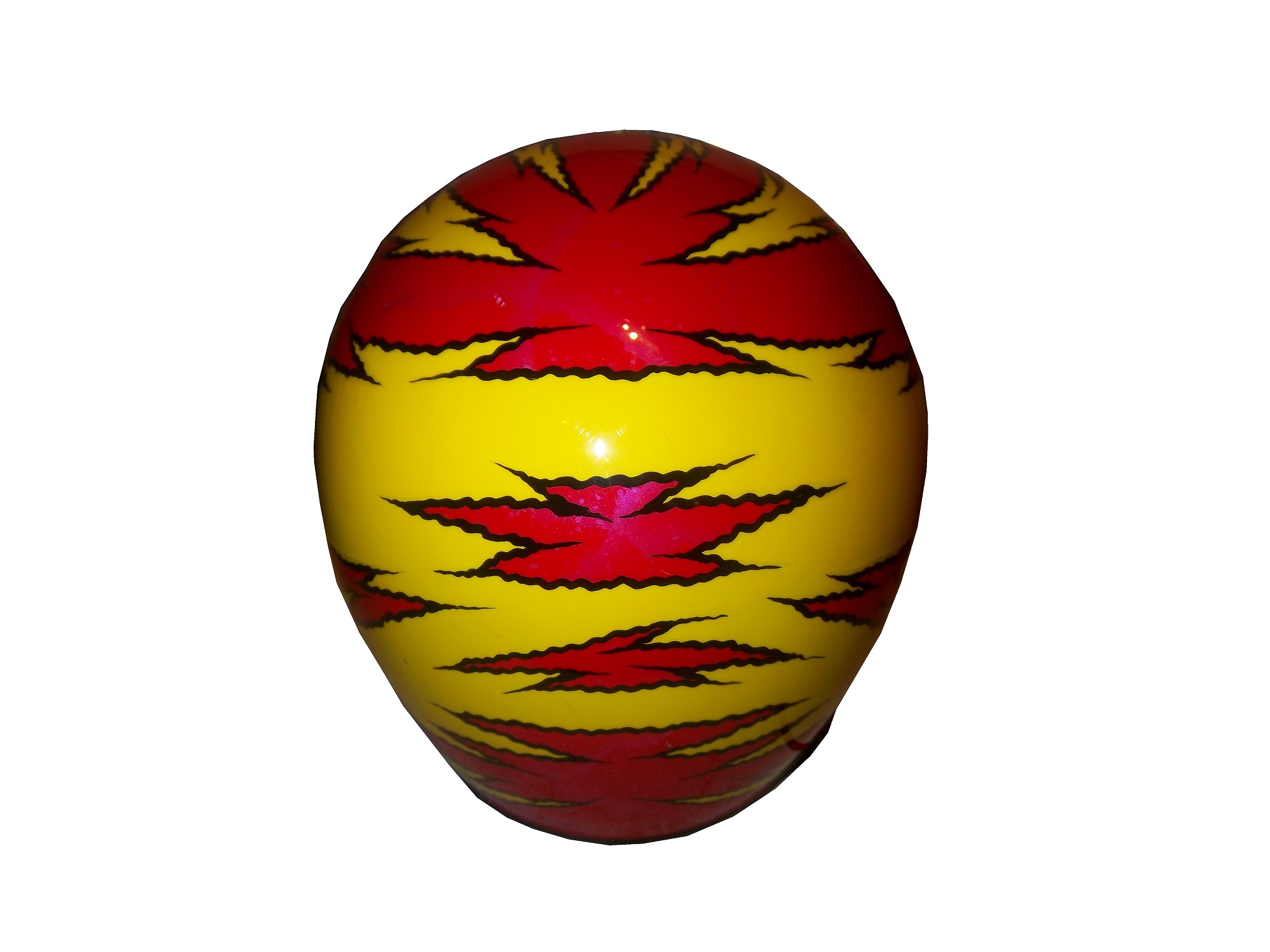
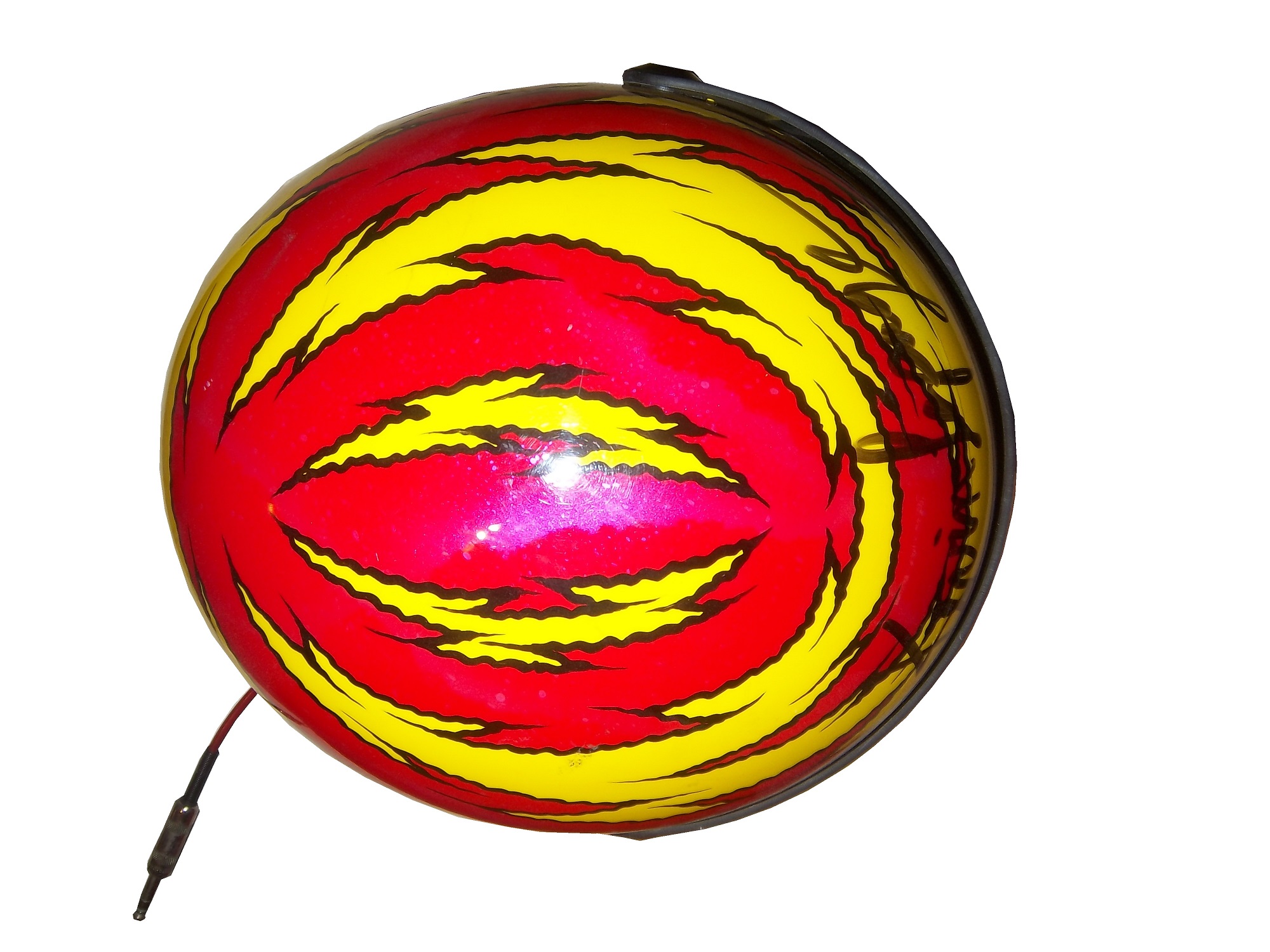
 Worn by Lepage in the 1999 Winston Cup season, this helmet was painted for the combination Primestar/TV Guide #16 Ford. Like the open-faced helmet, it shows scratches and scuff marks, and Lepage has signed the top of the helmet above the visor. Unlike the open-faced helmet, this helmet still has the microphone equipment.
Now on to the comparison…
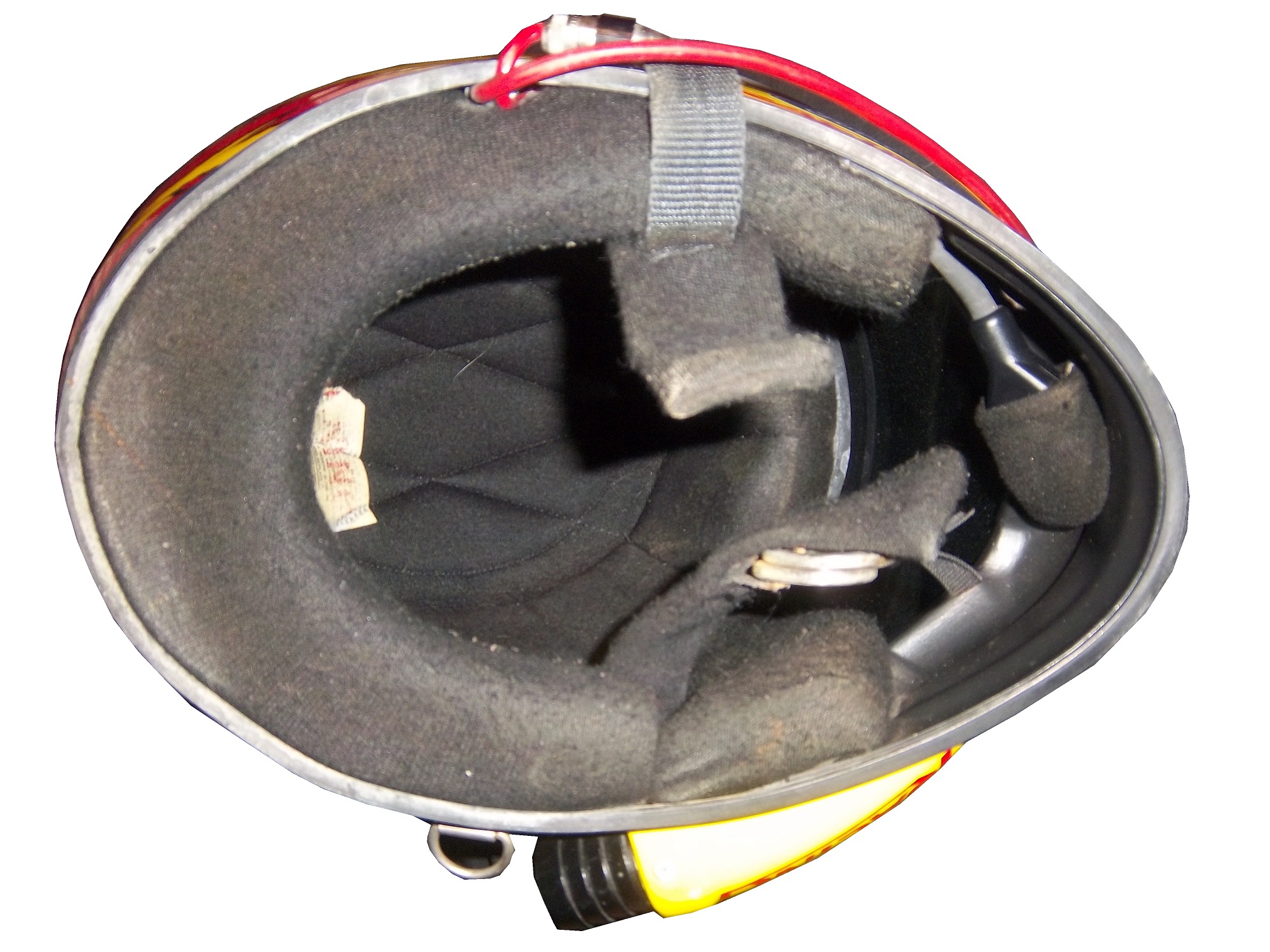
Looking at the helmets from the inside, there was no real difference between the two. Both are the same basic design, with the same inner liner and filler. The left sides of the helmets differ greatly. Notice that there is a hose attachment near the Ford logo on the full-faced helmet. This is to accommodate the “hotbox” attachment. Hotboxes are designed to force air into the driver’s face to help keep them cool. This is not a luxury, as driver compartments can reach as high as 160 degrees Fahrenheit, and drivers typically wear 3-4 layers of Nomex during a race. Keep in mind that in-car drinking systems are not standard as of 2000, and the hotbox is a great tool for driver comfort.
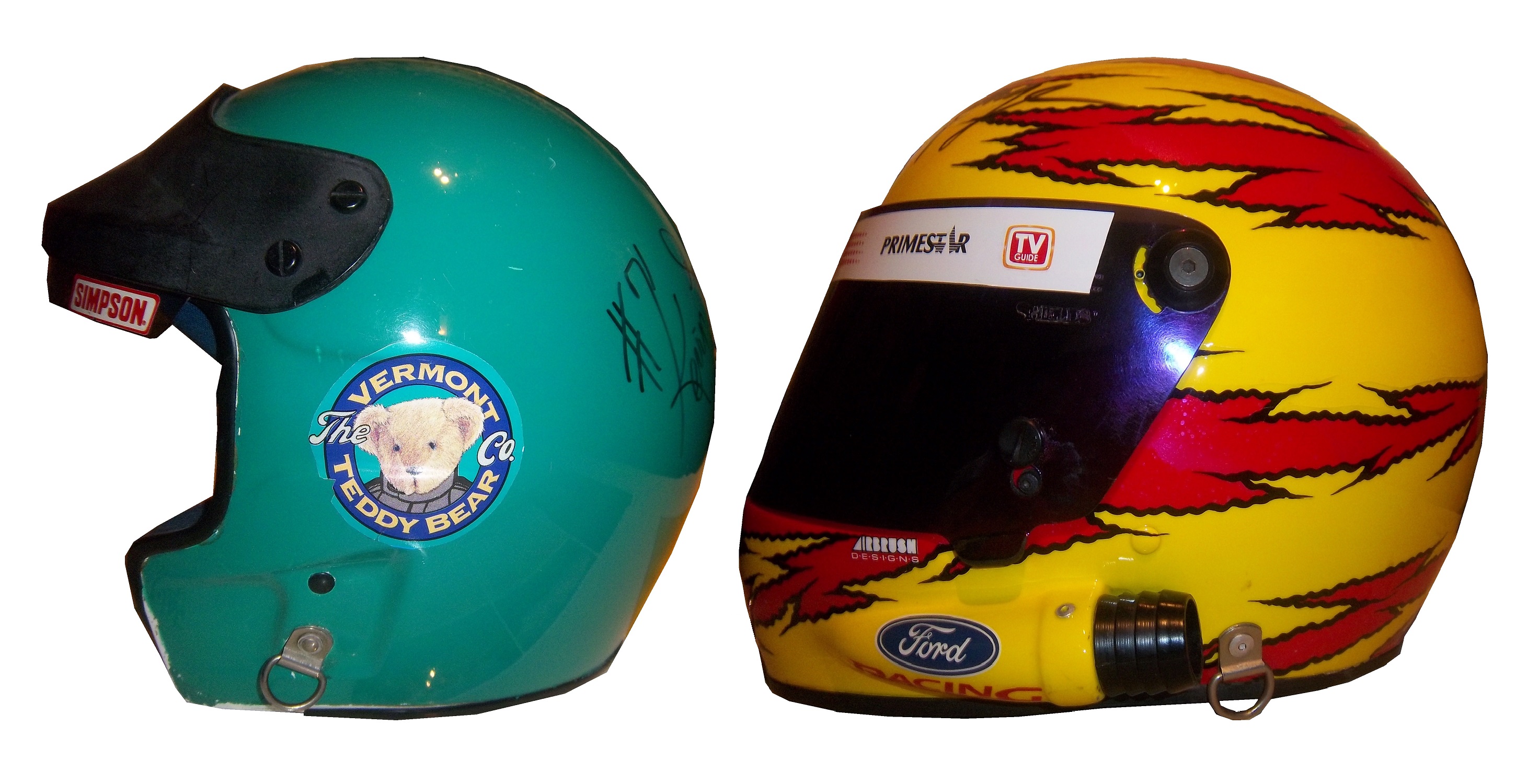 Microphone equipment is added to the helmet on the right side. The only difference between these two helmets is that the microphone has been removed on the open-faced helmet.
 The back of the helmets are virtually identical except for the paint schemes and the liability tag present.
 The front of the helmet is the key to making the decision. Everything else thus far is a minor issue. The question was asked then, and is asked now, why were these helmets legal for as long as they were? These pictures should answer that question: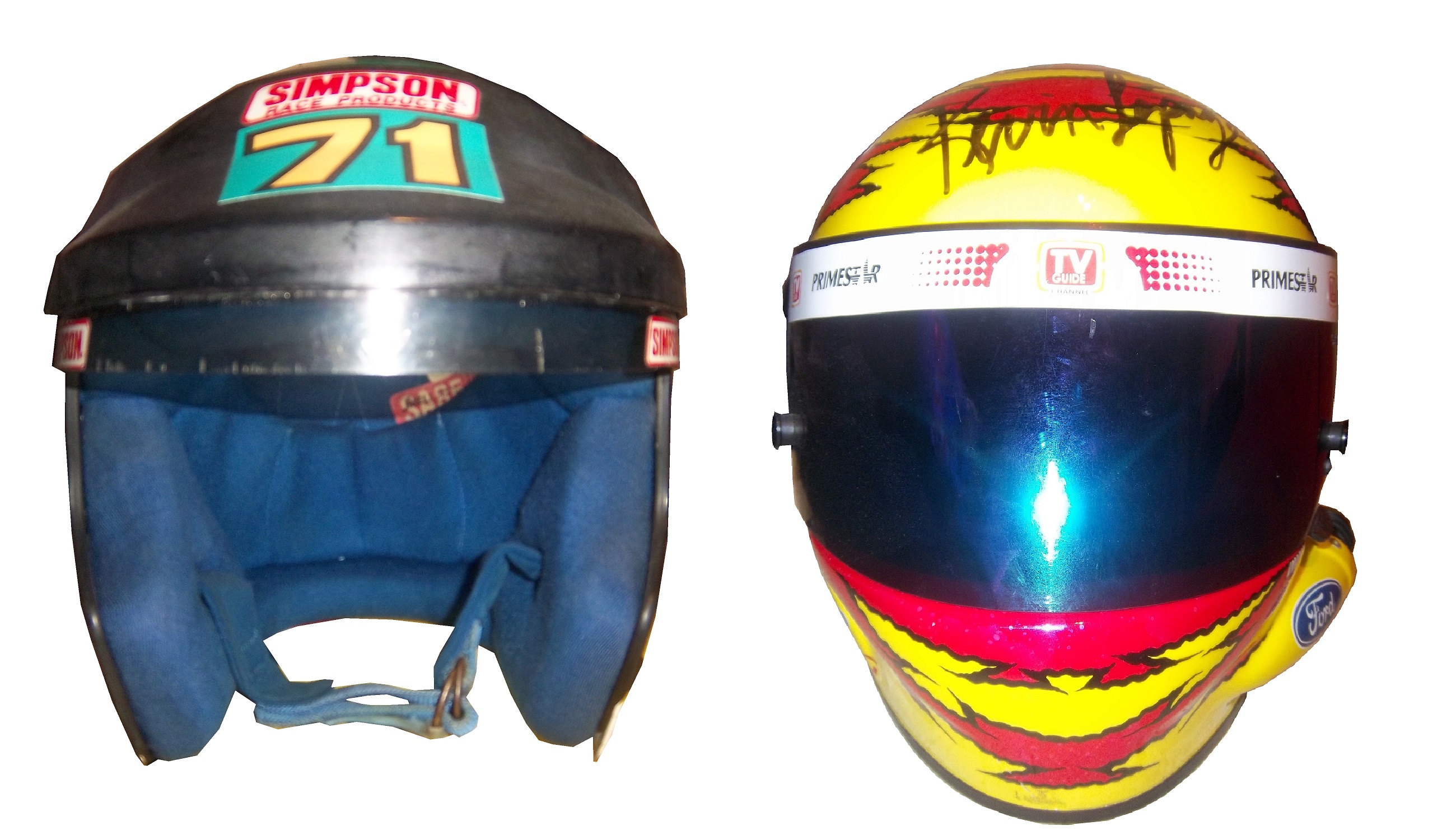
 The bottom of the helmet underneath the visor gives an extra bit of safety in case of fire, BUT takes away about 2-3 inches of visibility. That 3 inches might not seem like that much, but in a race car, trying to keep situational awareness of what the car is doing, those 3 inches are as critical as you can imagine. NASCAR at the time had the opinion that if they had the restriction in place, that the obstruction could cause a driver to lose that situational awareness, and lead to a wreck. NASCAR felt that any rule that could cause a wreck is a bad idea, and rightfully so. How often in the wake and investigation of accidents does it reveal that a rule, regulation, or guideline cause an accident? It happens quite often. NASCAR at the time felt that imposing a rule that all helmets should be full-faced that is could very easily lead to an accident, and as such, allowed open-faced helmets to avoid that from happening.
It was a rule that was easy to understand, but would lead to tragedy. It led to this design, which itself is now becoming obsolete: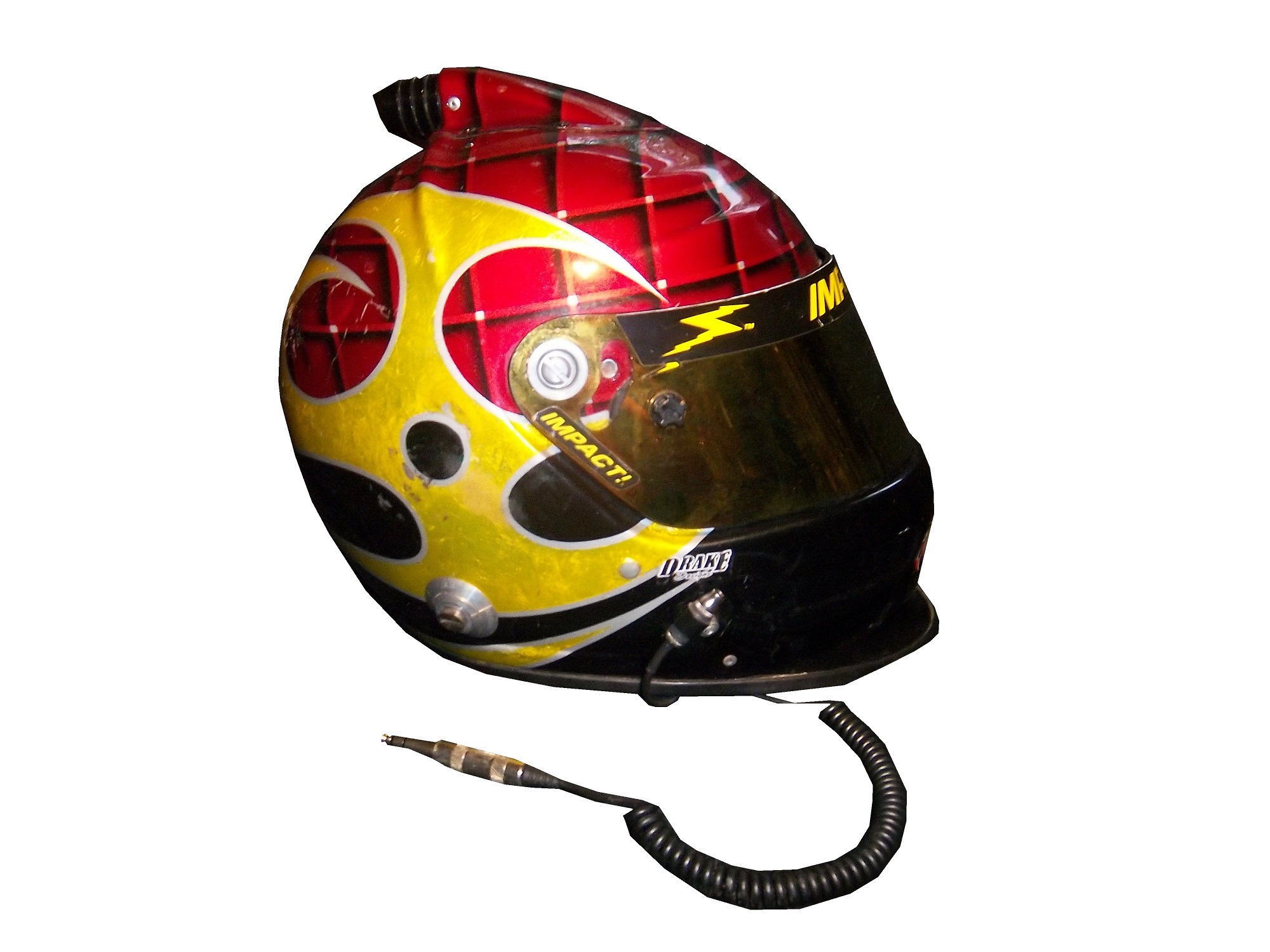


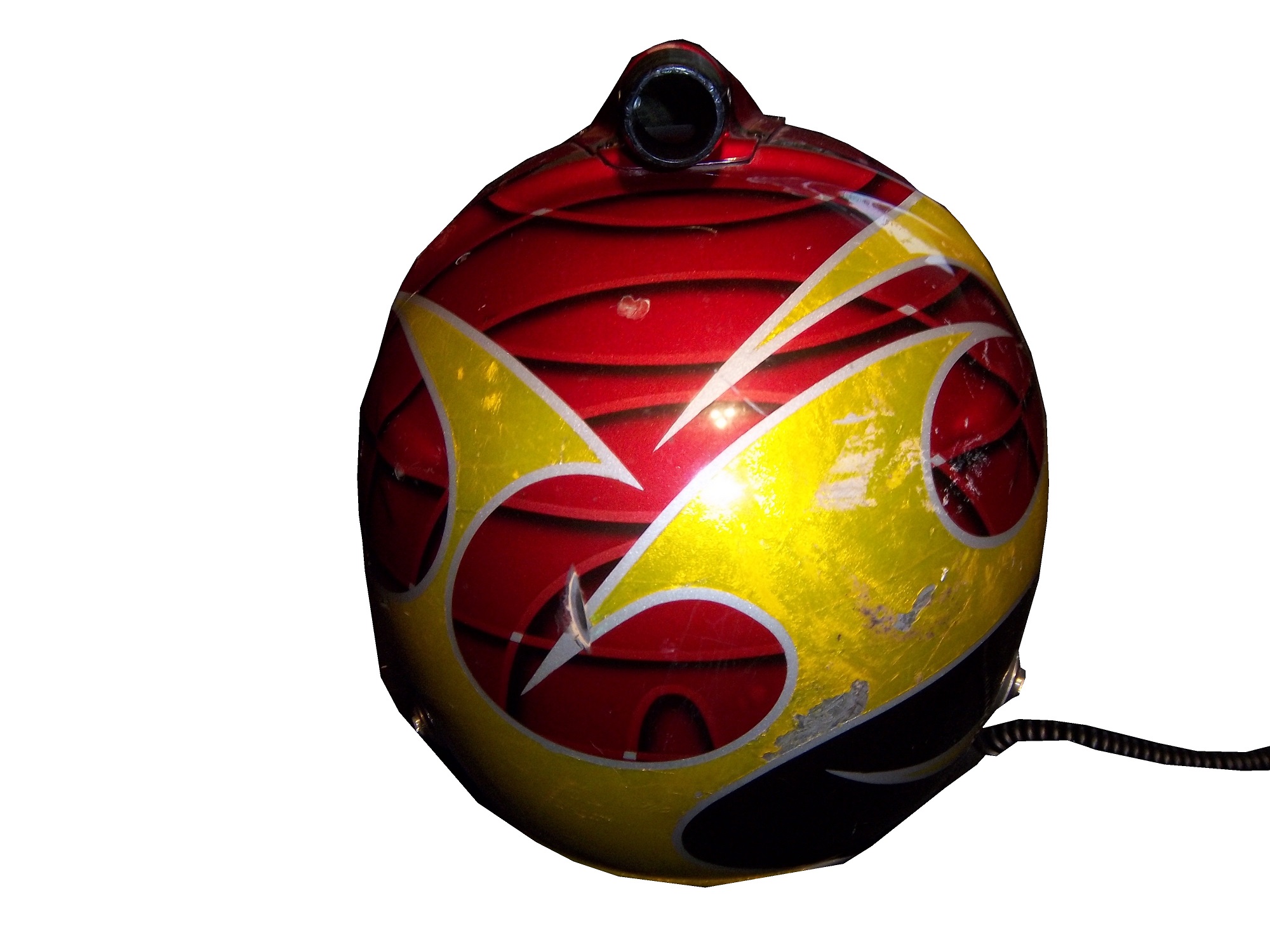
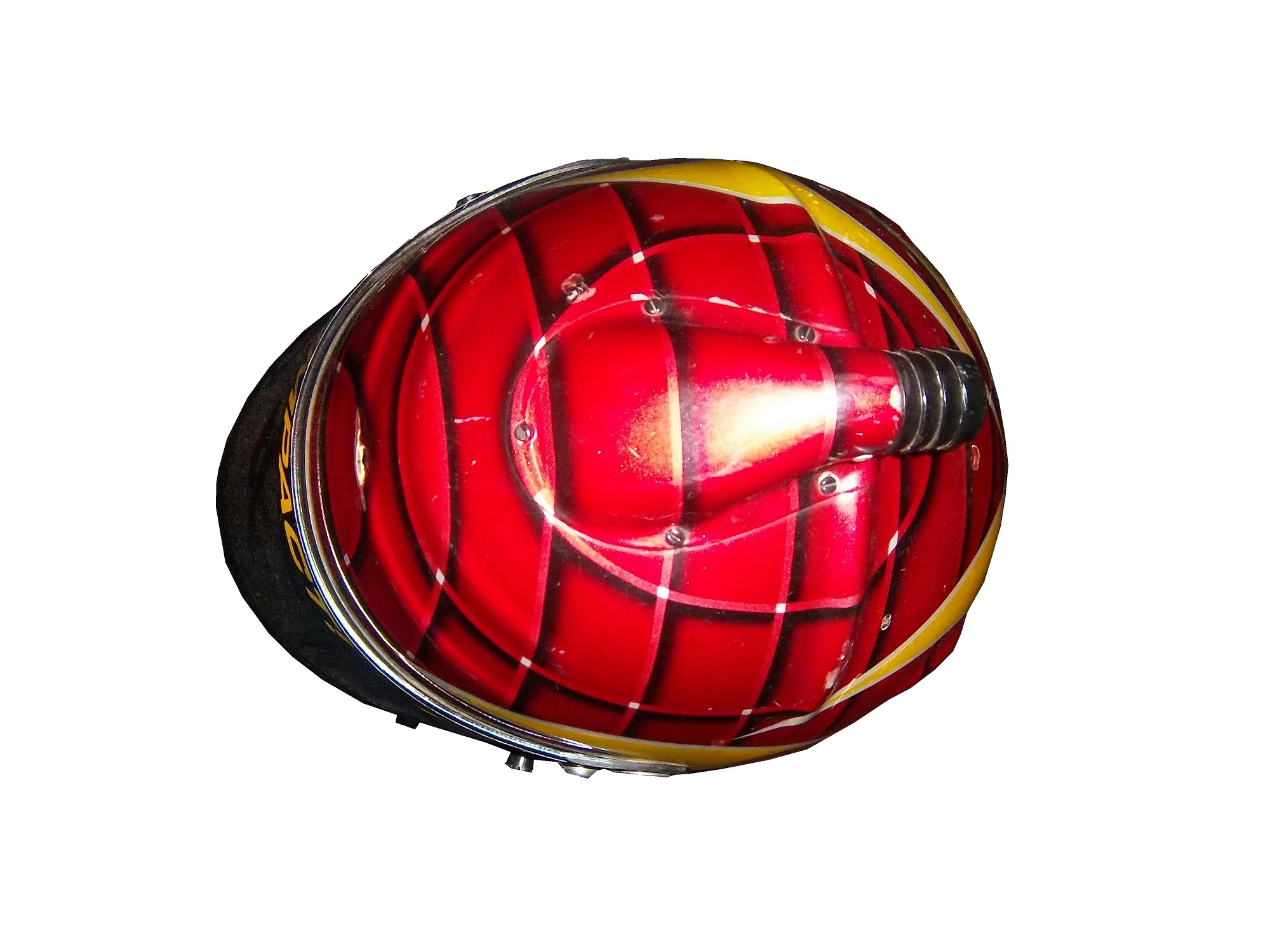

 Now, even the best full-faced helmet designs from the 1990’s are now a distant memory and the current helmet design has taken over. It might seem like unfair, but if these rules were in place at the 2001 Daytona 500, we would have never lost a true legend.
Paint Scheme Reviews!
Jamie McMurray #1 Linksys Chevy SS Clean lines and a great color scheme make for an A+ scheme!
Matt Kenseth #20 Husky/500th Start Toyota Camry The gray-scale design does not work here at all. The rest of the car looks very good, but the black and dark gray color scheme needs work. If the Husky red is where the gray is, it would work better, but the best grade I can give is a C-
Michael McDowell #51 SEM Chevy SS Classic design with a great color scheme, A+
And we have a 2014 leak…
Austin Dillon #3 Cheerios Chevy SS This is the best Cheerios scheme I have ever seen! The goofy bagel design is gone, and has been replaced with a couple of racing stripes. I also love the black around the #3. If this is the final design, it will be a great car, and I give it an A+!
The Driver Suit Blog-My Statement Regarding the events of the Federated Auto Parts 400
By David G. Firestone
I normally don’t do two posts in one week, but after the events of the last two weeks in NASCAR, I felt compelled to state my feelings on the matter. Obviously, what took place at and after the Federated Auto Parts 400 is shocking to say the least. As a NASCAR fan, and collector, I felt that I had to say something.
First, I’ll discuss Joey Logano and David Ragan. Obviously what happened was that Ragan allowed Logano to pass him, to get a position, to get points needed to make the chase. It does need to be noted that on a very technical basis, the two are “partners” as they are both Ford drivers. However, it is still a violation of the rules, but at the same time, I can’t really blame Ragan. Front Row Motorsports is a middle-shelf team that has flashes of success, but is not a championship team. Ragan had nothing to gain in that race at that point. Logano had everything to lose at that point. He is having a great year, with a new team, and I think he can win the Sprint Cup this year. That said, it is a violation of the rules, and the rules are the rules.
Now we turn to the Michael Waltrip situation. Michael Waltrip and his older brother Darrell are old school stock car drivers. Old school drivers are notorious for trying to and finding ways around the rules. However, unlike the old days, in this day in age, cars are very closely inspected, and radio chatter is monitored by fans and officials alike. That is why this whole situation is as important as it is.
Now clearly what took place is that with 10 laps to go, Ryan Newman was leading the race, and with the points they way they were, he would make the Chase with a win. Martin Truex Jr. who would miss the Chase with Newman’s win is trying his best to make as many positions as he can to get as many points as he can to make the Chase, and give his teammate Clint Bowyer an advantage. Bowyer is being given info on the situation via team radio, and was obviously given a very poorly coded radio message to intentionally spin out to bring out a caution, and start a round of pit stops. When all pit stops are said and done, Newman is far back in the pack, and is out of the Chase Points wise. The race restarts, and on lap 198, Brian Vickers, the third driver for Michael Waltrip Racing, was ordered by his spotter Ty Norris, who is also the general manager and vice president for Michael Waltrip Racing to make a green flag pit stop, which gives Truex another boost in the point standings.
When the checkered flag flew, both Logano and Truex were in the Chase, and Jeff Gordon, and Ryan Newman were out. Gordon and Newman were disappointed, but they handled it well. Almost instantly, the issue came to light, starting with ESPN’s coverage. The commentators knew something was up, and it was clear from the in-car camera that the spin was intentional. Between Richmond and Chicago, the investigation led to the biggest penalty in the history of NASCAR, with a $300,000 fine and 50 owner point reduction for all 3 teams, all crew chiefs, were placed on probation, and Ty Norris was suspended indefinitely. Because of this, Truex was removed from the Chase, and Ryan Newman was added. Furthermore, with the Logano/Ragan situation, a 13th driver, Jeff Gordon, was added to the Chase.
Drivers know when they have in-cars, so it makes no sense that he would intentionally spin out. If Brian Vickers, who did not have an in-car had spun out, it would have been much more difficult to make a case. Also, if Vickers had pitted under green to fix some damage, it would have been much harder to prove something would have happened.
If this was a unique incident for Michael Waltrip Racing, I think that it could be forgiven at the end of the season, but let’s take a trip back to 2007, specifically, the days leading up to the Twin 125’s before they Daytona 500. Evernham Motorsports and Roush Fenway were caught with “illegal modifications” for their cars, and fines and suspensions were levied. Michael Waltrip Racing was caught with an illegal fuel additive in his primary car, and was fined 100 points for the violation.
NAPA, who had sponsored Waltrip since his 2001 Daytona 500 win had said that they would stand by him, but if something like this happened again, that would not be guaranteed. Well something like that happened again. This morning, NAPA announced that they will not sponsor MWR anymore after this season, which is understandable. NAPA is a very loyal sponsor, so clearly what happened was that they decided that the cheating was going to continue until they said something. It is sad, but it happened.
My question is this, a very valid argument could be made that Truex himself did not do anything intentionally wrong, and that he was thrown under the bus because of the actions of his teammates. Another argument can be made that NASCAR stated when announcing the penalty, that they could not prove that Bowyer spun intentionally. Taking all the evidence into consideration, it appears that Truex had no idea what was going on around him, and that his teammates kept this information from him. I think with the penalties NASCAR levied against MWR, that Truex did in fact get thrown under the bus. At the same time, the rule comes across as a “hand of one is the hand of all” rule, which means that if your team cheats to help you, you are just as responsible for what happens.
To summarize, I think that NASCAR did what they felt was right, and I feel as though NAPA had to do what they they thought was right. Do I agree with it? Absolutely! NASCAR and its sponsors need to make it as clear as they can that cheating will not be tolerated. The rules are the rules, and even if the drivers disagree with them, they have to be followed.
 DGF2099-Main Page


