The Driver Suit Blog-Grading The 2021 Throwbacks

By David G. Firestone

So the 2021 Throwback Race at Darlington has come and gone. I’m going to do my usual throwback grades. Usually, the top pick will win the Paint Scheme Award for Best Throwback, but if something better comes along, it will take first place. We have a lot of season left. So, without further ado, my ranks:

1-Joey Gase #28 Register Me Ford MustangNew scheme for 2021, based on Davey Allison’s 1991 Texaco Havoline scheme. A

I love a good, faithful throwback, and this is a good, faithful throwback. I miss Texaco as a sponsor, and this brings back memories. This gets an A.

2-Erik Jones #43 STP Throwback Chevy CamaroNew scheme for 2021, based on John Andretti’s 1999 STP Pontiac Grand Prix. A

This is another contender for the most faithful throwback I’ve ever seen. Everything is perfect here, even that stupid yellow stripe. A

3-Corey LaJoie #7 Zerex Chevy CamaroNew scheme for 2021, based on Alan Kulwicki’s 1990 Zerex Ford Thunderbird. A

This might be the most faithful throwback I have ever seen! I loved the old Zerex scheme, and this is a great look. A

4-Chase Elliott #9 Hooters Throwback Chevy CamaroNew scheme for 2021, based on Alan Kulwicki’s 1992 Hooters Ford Underbird. A

I like a faithful throwback, and this is a great looking faithful throwback. It’s almost perfect, it’s just not on a Ford. A

5-2-Austin Dilon #3 Bass Pro Shops Throwback Chevy CamaroNew scheme for 2021, based on Fireball Roberts’ 1959 Pontiac. A

This is a really good and faithful throwback, and I really like the throwback logos. A

6-Tyler Reddick #8 Quartz Hill Records Throwback Chevy Camaro-New scheme for 2021, based on Marty Robbins’ #42 Dodge. A

Pink and yellow isn’t the best combination,but this is a pretty decent throwback, so I give this an A.

7-Kevin Harvick #4 Mobil 1 Throwback Ford MustangNew scheme for 2021, based on Kevin Harvick’s 2001 #29 Chevy Monte Carlo. A

I liked the white version of the Goodwrench scheme, and this is pretty faithful. I will say the black and silver one was better though. A

8-Michael McDowell #34 Fr8 Auctions Throwback Ford MustangNew scheme for 2021, based on Bill Elliot’s 1985 Coors Ford Thunderbird. A

Often imitated, the Bill Elliott Coors scheme is a great one, and this might be the best and most faithful one yet. A

9-Justin Haley #77 Fraternal Order of Eagles Throwback Chevy CamaroNew scheme for 2021, based on Robert Pressley’s 1998 Jasper Ford. A

It’s a faithful throwback, and I like the old Jasper schemes, so this gets an A.

10-Josh Bilicki #52 Insurance King Throwback Ford MustangNew scheme for 2021, based on Lennie Pond’s 1979 Burger King Oldsmobile. A

A unique and very faithful throwback will ALWAYS earn an A.

11-Anthony Alfredo #38 We Care/Fr8 Auctions Throwback Ford MustangNew scheme for 2021, Based on Alan Kulwicki’s 1985 Hardee’s Ford Thunderbird. A

I never got to see the Hardee’s scheme on track, but it was original. This is an awesome and faithful throwback, and it gets an A.

12-William Byron #24 Valvoline Throwback Chevy CamaroNew scheme for 2021, based on Neil Bonnett’s #75 Pontiac. A

This is a great throwback, and I like it. This is amazing, and gets an A.

13-Bubba Wallace #23 Root Insurance Throwback Toyota CamryNew scheme for 2021, based on Wendell Scott’s #34. A

You can’t go wrong with a Wendell Scott throwback, and this is another example. I also like the throwback Dr. Pepper and McDonald’s logos. A

14-Quin Houff #00 Bos Klein/RCA Throwback Chevy CamaroNew sponsor for 2021, based on John Andretti’s RCA Ford Thunderbird. A

I liked the RCA Ford back in the day, and this is a very faithful replica. A

15-BJ McLeod #78 CorvetteParts.net/Keen Parts Ford MustangNew scheme for 2021, based on Joe Weatherly’s 1963 Pontiac. A

It’s a solid scheme, is very faithful, and looks really good. A

16-Joey Logano #22 Shell/Pennzoil Throwback Ford MustangNew scheme for 2021, based on Mario Andretti’s 1971 Ferrari. A

This is a great throwback! I love the look the car has, and it’s smooth. A

17-Chase Briscoe #14 Highpoint Throwback Ford MustangNew scheme for 2021, based on A.J. Foyt’s #14 1986 Copenhagen Delta 88 Royale. A

A.J. had some great schemes in NASCAR, and this is one of them. This is a great look, and it gets an A.

18-James Davison #15 HOPEGIVERS Throwback Chevy CamaroNew scheme for 2021, based on Dick Johnson’s 1990 #38 Rednote Ford Thunderbird. A

This was an awesome scheme back in the day. Silver and red work well when done right. This is also a faithful throwback, so this gets an A.

19-Denny Hamlin #11 SportClips Throwback Toyota CamryNew scheme for 2021, based on Julius “Slick” Johnson’s 1980’s Monte Carlo. A

It’s a nice throwback, very faithful and it looks great. A

20-Ryan Preece #37 Velveeta Throwback Chevy CamaroNew scheme for 2021, based on Trent Owens’s 2002 Dickies Ford. A

I like the look here. The Velveeta as flames works, and the throwback is pretty faithful, so this gets an A.

21-Erik Jones #43 Tuskegee Airmen Tribute Chevy Camaro-New scheme for 2021, designed as a tribute to the Tuskegee Airmen. A

This is an amazing scheme! It has a great look, and color scheme, so it gets an A.

22-Alex Bowman #48 Ally Financial Throwback Chevy CamaroNew scheme for 2021, based on Greg Ives’ late model. A

I like the look, and it’s a great throwback. A

23-Ricky Stenhouse Jr. #47 Kroger/Tide Throwback Chevy CamaroNew scheme for 2021, blue fade to orange. A

Not a full throwback, but a good look. The fade works well, and this is amazing. A

24-Kyle Busch #18 M&M’s 80s Anniversary Toyota Camry-New scheme for 2021, much more toned down. A

I like this scheme a lot more, as it’s smoother, and I really like the plain black numbers. A

25-Martin Truex Jr. #19 Auto Owner’s Insurance Throwback Toyota Camry-New scheme for 2021, black. A

A smooth look, with a great color scheme will always earn an A.

26-Kyle Larson #5 Hendrickcars.com Throwback Chevy CamaroNew scheme for 2021, based on Kyle’s first car he ever raced. A

It’s faithful, and it’s well done, so I’ll give it an A.

27-Ross Chastain #42 McDonald’s Throwback Chevy CamaroNew scheme for 2021, based on Jimmy Spencer’s 1994 McDonald’s Ford Mustang. A-

The fact that the white square is missing takes away from the scheme as a whole. It isn’t as faithful, and, as such, will get an A-.

28-Ryan Blaney #12 Advance Auto Parts Throwback Ford MustangNew scheme for 2021, based on Blaney’s 2010 PASS Series Chevy Impala. B

29This was a mediocre scheme to begin with, but the dimensions here just look odd. But it is faithful, so I’ll give it a B.

30-Aric Almirola #10 Smithfield Throwback Ford MustangNew scheme for 2021, based on Mark Martin’s 2000 Winn-Dixie Ford Mustang. B

I’m going to knock this one down because I hated the original. I loved the classic black Winn-Dixie scheme, but the flames one is awful. Still, it’s a faithful throwback, so I’ll give it a B.

31-Cody Ware #51 Nurtec ODT Throwback Chevy CamaroNew scheme for 2021, based on Darrell Waltrip’s 1990 Superflo Chevy Lumina. B

It’s a good attempt, but the incorrect and rather gaudy colors take away from what could have been an amazing throwback. This gets a B.

32-Daniel Suarez #99 Camping World Throwback Toyota Camry-New scheme for 2021, vintage design to celebrate Camping World’s 55th anniversary. B

This is one that, while it looks good, I don’t get. It’s clearly inspired by 1969-1970’s designs, but if it is there to commemorate Camping World’s 55th anniversary, it should look like it is from 1966. It’s not bad, I just don’t get it, so I’ll give it a B.

33-Ryan Newman #6 Kohler Generators Throwback Ford MustangNew scheme for 2021, base on Kohler’s 1976 SCCA Championship car. B

This is kinda odd looking, especially since I wasn’t able to find an image of the car itself. Still, it isn’t bad, so I’ll give it a B.

The Driver Suit Blog-Parts and Recreation ReRevisited

By David G. Firestone

You can’t collect racing memorabilia without talking about equipment. The parts and pieces that make the car go, are just as important, and interesting as most other racing memorabilia.

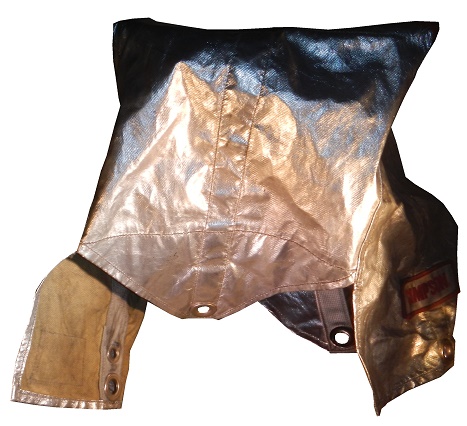
One incarnation that Don Garlitts worked with before he settled on Swamp Rat XIV was Swamp Rat VIII. Swamp Rat VIII was built in 1964. Swamp Rat VIII was designed to use the Dodge 426 Elephant Hemi engine. The 426 was a lot harder to tune than the old 392, so Garlitts did not have a good year, though once he figured it out, it was an impressive car. The 426 Hemi was such a good design, it is still the car used by the NHRA to this day, in Top Fuel and Funny Car. Garlitts cut the car in half, and used the front half to make Swamp Rat X. In 2005, Garlitts rebuilt the car, and in 2006, took it to a few vintage races.  This is a set of spark plugs pulled from that recreated car. The set of 8 plugs comes in a Styrofoam case, which has been autographed by Garlitts. Each plug shows some wear, some more than others. This is a spark plug from Morgan Lucas Racing.In 1970, Johnny Rutherford raced an Eagle chassis with an Offenhauser engine. He didn’t score a win, and had 3 DNS’s. These plugs came from that Offenhauser engine. They have been mounted to a wood display, with a small paper sign. When the race is on, a thousand things can go wrong with the car, especially the engine. One of the most common pieces of equipment to go wrong is with pistons. Top fuel and funny car pistons generate 1,250 horsepower each. If they aren’t aligned right, aren’t lubricated enough, or something is wrong, that can cost the driver a win or even a championship. This example is a piston head used and autographed by Brandon Bernstein. It was only used for one run, but shows some light use, and is in good condition. Now let’s look at an interesting Del Worsham piston from 2002. The story behind this piston is interesting. At the 2002 Checker Schuck’s Kragen Nationals at Firebird International Raceway, Del Worsham beat John Force in the final. Worsham temporarily denied Force his 100th event win. This mangled piston wrecked the engine block during that run. The piston chewed the block and itself up during that final run. Part of the piston arm is still wedged inside the piston, and one side is almost completely gone. Brainerd International Raceway in Brainerd, Minnesota isn’t known as a place where records get broken. In 2015, the big highlight for funny car at Brainerd was Del Worsham vs. Matt Hagan in an elimination round. During that run, Hagan ran a blistering 3.879 second elapsed time. This piston head came from Hagan’s car during that historic run. This piston shaft was used and autographed by Bob Vandergriff. Valve springs help the opening and closing of the valves at the speed the engine requires. These are three examples, one from Cruz Pedregon, and two from Paul Lee. On the subject of Paul Lee, these are what are known as manifold burst panels. These are specifically design to burst when the pressure in the manifold gets too high. They are meant to sacrifice themselves to save the engine. I also have this head gasket from Paul Lee. NHRA engines are sealed systems, under a lot of pressure and heat. Expansion of engine parts will occur, and copper head gaskets are used to keep the seal intact. They will expand with the rest of the engine. This is an example Paul Lee’s funny car. It is bent, and shows staining from race wear. This is a head gasket from Morgan Lucas. It shows decent wear. At Route 66 in 2014, I got this ignition coil from Morgan Lucas Racing. Ignition coils are used to turn on cars in general, but this MSD 8142 is designed to fire up these 11,000 horsepower engines, which need a lot of electricity to start and operate. I was fortunate enough to have Tony Schumacher and Ron Capps autograph it in person. I have this timing belt from Bob Tasca’s Motorcraft Funny car, this one used in his first qualifying session at the Ford Thunder Valley Nationals in Bristol Tennessee. This run he had a 4.15 second, 306 MPH run. This thing is HUGE, measuring over 64 inches in circumference and 3 inches across. Pistons in an engine need things to function. An example are valves, and valve springs. The valves move in conjunction with the movement of the pistons. One set introduces fuel and air into the engine, and the other set removes exhaust from the engine. These examples are from Bob Tasca’s funny car. This burnt hose cover is a perfect example of why Nomex is the go-to material for driver suits. This Nomex hose cover went through a serious fire, and was burnt. Nomex isn’t fireproof, it’s fire retardant, which means it will burn, but much slower than most fabrics. It will burn, but will protect whatever it is covering from fire damage for a brief time. The easy way to see if the material has been compromised is if the fabric is discolored. Notice the areas of light on the black fabric, that means that area of the fabric has been compromised. This Jimmie Johnson spark plug is part of a display which features other parts, specifically a piece of the track bar, a lifter, a valve spring, and a piece of sheet metal. Part of the plug has been modified to make the plug useless. Interestingly, sometimes oil was sold to collectors, as is evidenced by this display of oil from Kyle Busch’s #18 Toyota Camry when he won the 2009 Shelby 427 at Las Vegas. The package is about 5 inches long by 3 inches wide. Inside the box is the display. It has a small oil drum with a small amount of motor oil. The oil has a thick viscosity, which is needed because of the wear that Cup engines produce during a race. The COA comes in the box, and states that this is #359 of 504. Let’s switch from engines to wheels. I have a brake rotor used by John Andretti in the 1998 Bank of America 500 at Charlotte, which has been signed by Richard Petty. In 2014, at the U.S. Nationals, TJ suffered a major engine explosion. He still has the blower drive seen flying in the video. I wound up getting one of the rear tires from that race. Rear tires from top fuel dragsters are 3 feet tall by 17 inches wide. I’m planning on getting a glass to and making a coffee table at some point. The level of wear on the tires is amazing, with large patches of damage from the explosion. TJ also signed it and personalized it to me! I also got a front tire, which is 22 inches tall, by 3 inches wide. These tire covers are meant to protect the tires from the shade. Why is this important? Well tires are 36 inches tall by 17 inches wide. These races often take place in bright sunlight on hot days. If there was no shades, tire pressures could be very uneven, and as a direct result, the tire wouldn’t race as well, and there could be safety issued. These are designed and marketed by Jeg’s. These are designed for top fuel dragsters. Funny cars have a square piece that covers the wheel on the body. Tires can be purchased whole, but since they can weigh as much as 90 pounds, they are often cut up and the pieces are sold, like sheet metal. This example, used by Kevin Harvick in the 2002 Daytona 500 is an example. it gives a good example of the thickness of the tire. Race-used lug nuts go hand in hand with tires. Lug nuts are used once, and then sold after the race, such as these Tony Stewart examples. Lug nuts are Super glued to the rim, and one of these still has superglue residue on it. Moving away from the wheels, this is a parachute bag used by Frank Pedregon Jr. It’s designed to hold the parachute on the back of the car, and was from the car when Frank hit Scotty Canon. One of the best tools at a drag racer’s disposal is the parachute, and for Scelzi, that was no different. You can’t be the first driver to reach 330 MPH in a funny car without a good parachute to stop the car. Scelzi raced with many different parachutes throughout his career, and this 12′ x 12′ Mopar example from his days with Don Schumacher Racing. It shows heavy use with numerous scuff marks, and holes. One of my big gets was a TJ Zizzo Peak parachute. Zizzo ran two of these chutes on the back of his dragster from 2010 to 2013., and this example is 12 feet by 12 feet. It shows a decent amount of wear, with stains and holes. There is a hole in the center that allows the chute to be deployed, and there is an inventory tag placed here as well. On the cables connecting the chute to the car, there is some extra protection. This is necessary because on top fuel dragsters, the engine is very close to the parachute attachment, and in the event of a fire, the chute will still be able to function. This shows some wear on the silver layer. Pilot chutes are universally used to deploy parachutes. When the cords are pulled, and the chute is released, the pilot chute deploys, which catches air and pulls the primary chute behind it. The chutes are strapped to a bar at the back of the car, and are covered in Nomex to prevent fire damage, then packed into a bag, before the race. This is a carbon fiber dashboard from a Cup car. It is very light, and SFI Certified. When KV Racing Technology folded, they sold off their assets, including this digital fuel pump, which still works. Next week, the 2021 Throwback grades!

The Driver Suit Blog-A Crew Suit From An Under Appreciated Team

By David G. Firestone

From 1989 to 2017, The NASCAR Whelen Southern Modified Tour was a mainstay in the southern territories. NASCAR National Series Drivers such as Jimmy Spencer, Ted Christopher, Corey LaJoie, Ryan Preece, Randy LaJoie, Mike McLaughlin, Steve Park, Mike Stefanik, and Ken Schrader all have raced in the NASCAR Whelen Southern Modified Tour. Other drivers stayed in the series, until it merged with the NASCAR Whelen Modified Tour in 2017.

One team that was deeply rooted in the Southern Modified Tour was Riggs Racing. As a team, they won more races and championships than any other team in Southern Modified Tour history. One driver who raced for Riggs Racing was Andy Seuss, who would win a championship with Eddie Harvey Racing. From 2008-2009, Seuss raced with Riggs Racing, and was sponsored by Advanced Auto Parts. During that time, a crew member wore this single-layer Leaf firesuit. The suit shows a little use, but is otherwise in great condition.

The collar is a standard version with a LEAF SAFETY EQUIPMENT INC tag sewn on to it.

Inside of the cowl is a small size and wash tag, that has faded with time. Another LEAF SAFETY EQUIPMENT INC. tag is sewn inside the front of the collar.

There is a WHELEN SOUTHER MODIFIED TOUR patch sewn onto the right chest.

The left chest is unadorned.

The front torso features an ADVANCE AUTO PARTS logo embroidered into it.

The suit has a belt, which is unadorned.

The suit has unadorned legs with standard cuffs. The cuffs are somewhat stained.

The shoulders have no adornment.

The right sleeve has a LEAF SAFETY EQUIPMENT INC. tag sewn into the top of the sleeve, and is unadorned at the end.

The left sleeve has a LEAF SAFETY EQUIPMENT INC. tag, and an SFI 3-2A/1 certification sewn into the top of the sleeve, and is unadorned at the end.

The back doesn’t show any real wear, aside from the cuffs.

The back of the neck is unadorned.

The back torso features an ADVANCE AUTO PARTS logo embroidered into it.

The next Friday Feature is going to be a difficult one, as I will explain what the future of The Driver Suit Blog is, and why it is changing.

The Driver Suit Blog-Just Some Random Stuff This Week

By David G. Firestone

We’re going off topic this week…kind of. I’ve been wanting to do a column based on what I call “random items,” or items that don’t fit into any other category. Let’s get started.

Further proof that wine is becoming a standard in auto racing is that Mario Andretti, Richard Childress, and Jeff Gordon, all own wineries or vineyards. Benny Parsons owned one before he passed away. Many other athletes own them as well, including Wayne Gretzky, Valeri Bure, Mike Ditka, Dan Marino, Joe Montana, and Charles Woodson. In addition to his successful iced tea/lemonade drink, Arnold Palmer has his own line of wines. Wine really is mainstream, and is popular in auto racing.

Most tracks will sell event branded pint glasses, but I came across these wine glasses from The 2015 Rolex 24 at Daytona. These lead crystal glasses are about nine inches tall, and have the Rolex 24 logo printed on the side with some very nice etchings on the Rolex logo. These are high quality wine glasses. Lead crystal is used on wine glasses because of the strength, clarity, ease of etching, and, interestingly, the tone made during a toast.

The 1973 Schafer 500 was a race in the 1973 USAC Champ Car Series. It was a forgettable race, as evidenced by the fact that unused tickets for the race, especially the time trials are easy to find on eBay. This set of 10 tickets from the time trials, is a set of examples. For their age, they are in good condition.

As regular viewers of my YouTube channel know, I love doing box breaks. I especially love doing 1994 Finish Line Gold box breaks, as that was my favorite set to collect growing up. Sometimes you get autographs, sometimes you get phone cards, some of which are pictured below.

Moving on from the racing stuff. I’m not the biggest basketball fan, but I do watch occasionally. I do also occasionally collect basketball stuff. One example is this Derrick Rose swatch card. The card is in good condition.

At my old job, there was a Tyrus Thomas autograph signing, and I got this Chicago Bulls Starbury issued sneaker.

I occasionally find trading card sheets. One such example is this 1998 Upper Deck Black Diamond sheet.

This crystal trophy was presented to Nick Anderson by the Orlando Sentinel, and Goodings. Anderson was awarded the trophy as the fan favorite in 1997-1998.

That was fun, I should do this more often. Next Friday Feature, a firesuit!

The Driver Suit Blog-The Vest Project Part 26-Auto Owners Insurance Revisited

By David G. Firestone

Harry Scott Jr. purchased the Phoenix Racing Sprint Cup Series in late 2013. He renamed the team HScott Motorsports. HScott Motorsports was a little team with big dreams. They did have some success in the form of top 10’s, but aside from that, they never won a race, even though they had some great drivers racing for them. HScott Motorsports raced from 2013 to 2016, with Justin Allgaier, Kyle Larson, Michael McDowell, Ryan Truex, Bobby Labonte, Michael Annett, and Clint Bowyer as drivers. The team didn’t have that much success on track.

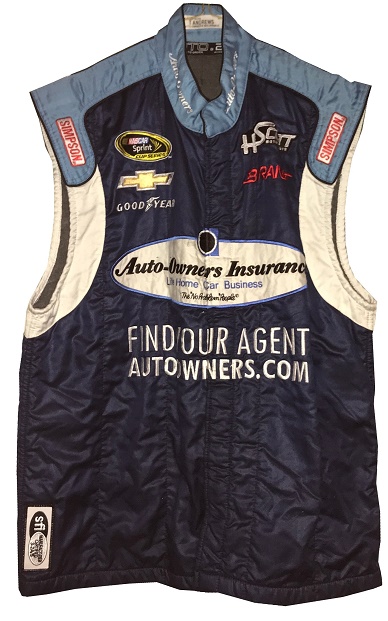
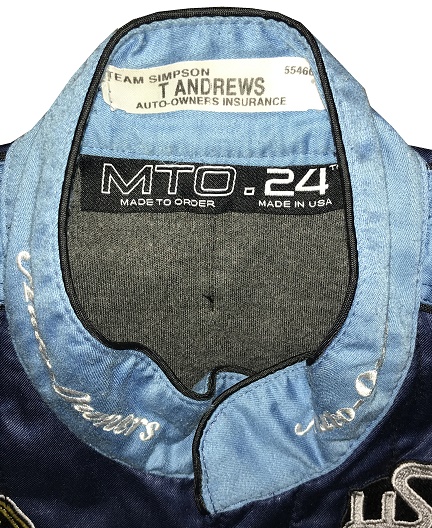
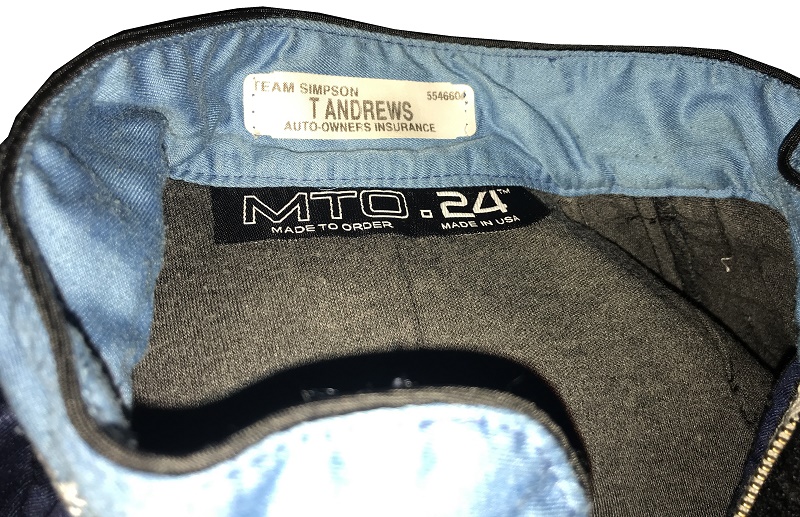
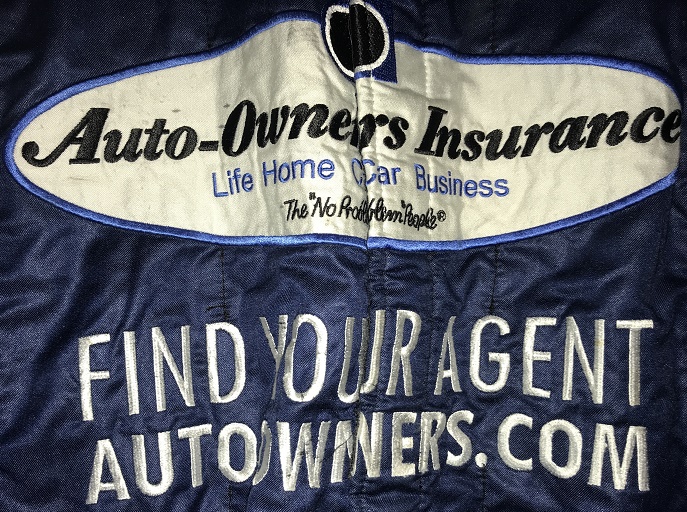
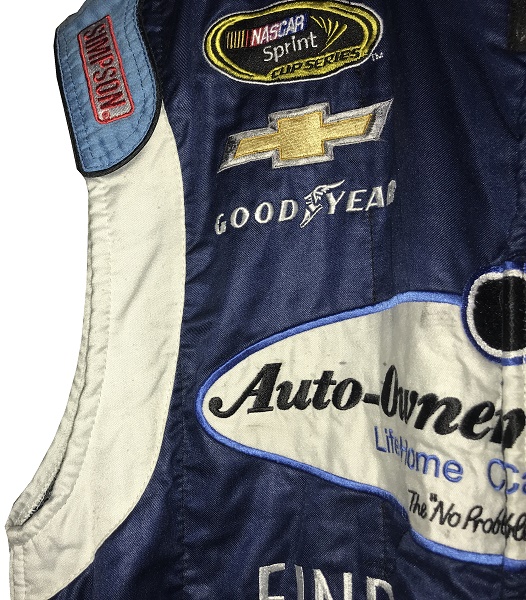
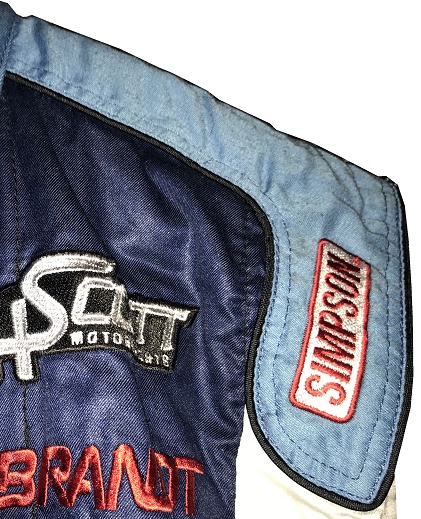
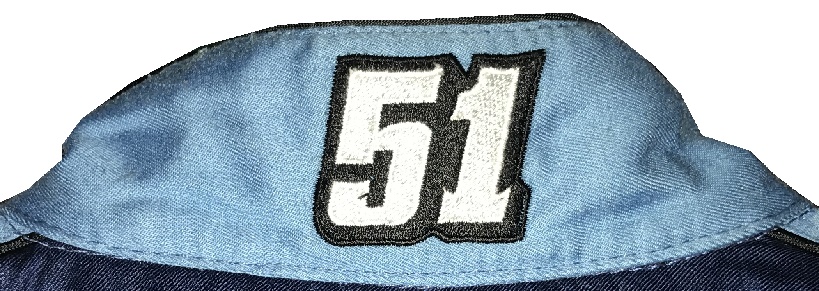
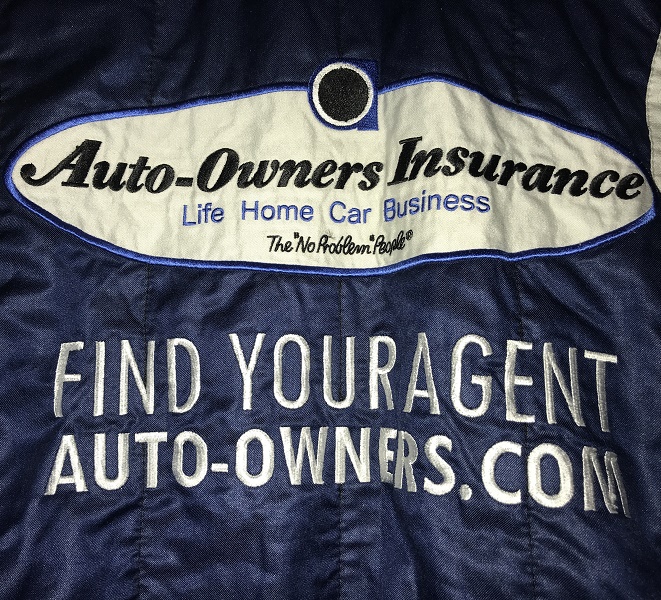
Founded in 1916 by Vern V. Moulton, Auto-Owners Insurance offers auto, home, business and life insurance through independent agents. It was founded in Mount Pleasant, Michigan, moved to Lansing in 1917, and finally to Delta Township, Michigan in 1976. They have been a sponsor of auto racing, including Justin Allgaier’s time at HScott from 2014-2015, though they didn’t have much success. During that time, a crew member wore this vest. The vest shows light use.The blue collars have black borders, with AUTO-OWNERS INSURACE embroidered in white.The cowl has a SIMPSON MTO 24 tag and an XL tag present. There is also a tag indicating the wearer of this vest is T ANDREWS, though I could not find any information on who this crew member was.The right chest features a NASCAR SPRINT CUP SERIES logo, a CHEVY bow tie and a GOODYEAR logo embroidered.The left chest features a HSCOTT MOTORSPORTS logo and a BRANDT logo embroidered into it.The front torso features AUTO-OWNERS INSURANCE FIND YOUR AGENT AUTO-OWNERS.COM embroidered into it.Under the zipper is the SIMPSON warranty tag and identification label. The hems don’t have comfort straps, but the right side does have the SFI rating. The shoulder epaulets don’t have adornment on the top, but have SIMPSON logos on the sides. There are also standard arm holes present. The back of the vest doesn’t show any real wear.The back of the neck has 51 embroidered into it.The back of the vest has AUTO-OWNERS INSURANCE FIND YOUR AGENT AUTO-OWNERS.COM embroidered.Next Friday Feature, I will discuss some of the random items in my collection

The Driver Suit Blog-The Final Jack Beckman Infinite Hero Challenge Column

By David G. Firestone

I’ve discussed Jack Beckman on The Driver Suit Blog many times. He is a great driver, he connects with the fans, and he was kind enough to grant me an interview last year. I’ve been into the Infinite Hero Challenge Coin program since the beginning, and love collecting them. Well, I’m back with another profile of the coins.
Launched in 2011, The Infinite Hero Foundation “…is to combat the most difficult front line issues – mental and physical – facing returning military heroes and their families.” Military personnel returning from overseas deployment face long term employment, mental and physical problems that the majority of Americans don’t understand. They work with other non-profit veterans groups and give out grants to help service men and women cope with these long term problems.
In April 2014, they started appearing on the side of Jack Beckman’s funny car. The late Terry Chandler, who also sponsors Tommy Johnson Jr.’s Make a Wish Foundation Funny Car, is the financial backer of the car. She pays for Infinite Hero to race on the sides of the car. This also began the NHRA coin program. When Jack Beckman gets into his funny car to race, he carries Infinite Hero Challenge Coins in the pocket of his driver suit. Once the race is over, he will autograph them and sell them at the track and on eBay. They cost $100 with all proceeds going to the Infinite Hero Foundation.

The 2014 design is quite thick, and has a ridged edge. One side featured “Courage, Honor, Virtue, Heroism,” around a globe design with an Oakley logo. Oakley is a partner with the Infinite Hero Foundation. The other side features an Infinite Hero Foundation logo with purple enamel. The coin was placed in a round, flat plastic container, with black foam braces. The retail coin lacks the blue enamel that the coin that comes with the glasses coin, and future coins, and has a very plain look. I do like the plain look.Jack used was identical to the one sold in stores. Jack autographed the plastic case.   In 2014, this 1/24 scale die cast was produced. It is a full replica of Beckman’s funny car. Valvoline was a primary sponsor, and this was the only season Infinite Hero and Valvoline were together on the car. It’s also the only time that Infinite Hero Challenge appeared on the older Dodge funny car body. In 2015, the current body was introduced, and Pennzoil replaced Valvoline. Jack has autographed the windshield. A redesigned coin of the same size was introduced for 2015. The Oakley logos are gone. One side features a design similar to the globe design, but the globe design has been replaced with an American Flag design. “Courage, Honor, Virtue, Heroism” has been replaced with “Duty, Honor, Innovation, Courage.” The new emblem on the reverse side has one of the across bands removed. The new packaging is an upgrade, with the circular plastic cylinder replaced with an attractive box. It comes with a card that Jack Beckman autographed, and on the reverse it has the Infinite Hero Foundation Pledge. The first one is from The CARQUEST Auto Parts NHRA Nationals at Phoenix on February 22, 2015, where Jack was eliminated in the first round. The second one is from the Summit Racing Equipment NHRA Nationals in Norwalk, Ohio, where Beckman won the event, beating Courtney Force in the final round. Also in 2015, these hero cards were produced. Hero cards are given away at racing events and driver appearances. They have Jack’s picture, and information about the driver, team, and the Infinite Hero Challenge. For 2016, the coins got a major makeover. The Infinite Hero logo is now bigger. The words “Reimagine” and “Recovery” are stamped near the logo, and on the opposite side, a picture of Jack’s funny car replaces the flag motif. It should also be noted that the coin is slightly smaller, because it isn’t as tight in the coin case as the previous version. The Infinite Hero Pledge accompanies the coin. Also changed from 2016, Jack doesn’t sign the box and the pledge, he just signs the pledge. The 2017 Infinite Hero coin is slightly larger than the 2016 coin, and fits snugly in the box. The pledge piece remains unchanged. The coin itself has a plain pewter Infinite Hero Challenge logo on one side, and a blue enameled claw stripe design with a hex nut design on the border. Hero cards are given away at racing events and driver appearances. They have Jack’s picture, and information about the driver, team, and the Infinite Hero Challenge. For 2016-2017, a new card design was introduced. It has updated information, as well as the updated paint scheme introduced at the beginning of the season. This year’s design is done in memory of the late Terry Chandler, who passed away from cancer prior to the 2017 event. The front has a heart design with Chandler’s initials. The back of the coin has the Infinite Hero logo, with blue enamel. Jack also autographed a copy of the Infinite Hero pledge. For 2018, a new Hero card design was released. The 2019 coin design features the features the Air Force seal, with SGR “FAST” JACK BECKMAN INFINITE HERO FUNNY CAR engraved on the outside. The standard Infinite Hero challenge logo is on the reverse. This was autographed by Jack at the Route 66 Nationals. The 2020 coin design depicts a solder calling for his troops to FOLLOW MW, with SGT “FAST” JACK BECKMAN SALUTES UNITED STATES ARMY 1772 2020 engraved on the outside. The standard Infinite Hero Challenge logo is on the reverse. This was autographed by Jack at the 2020 Dodge NHRA Indy Nationals presented by Pennzoil at Indianapolis. Jack Beckman is a great driver, who races for a great sponsor, and supports a great cause. He has been really amazing not just to me, not just to to The Driver Suit Blog, but to the NHRA and their fan base. I’m glad he’s going to be racing for The Infinite Hero Challenge until at least 2020. As long as he is selling them, I will continue buying the Infinite Hero Challenge Coins, and promoting them on The Driver Suit Blog. I can’t wait to see next year’s coin design.

Next week, some race-worn gloves.

By David G. Firestone

I’ve discussed Jack Beckman on The Driver Suit Blog many times. He is a great driver, he connects with the fans, and he was kind enough to grant me an interview last year. I’ve been into the Infinite Hero Challenge Coin program since the beginning, and love collecting them. Well, I’m back with another profile of the coins.
Launched in 2011, The Infinite Hero Foundation “…is to combat the most difficult front line issues – mental and physical – facing returning military heroes and their families.” Military personnel returning from overseas deployment face long term employment, mental and physical problems that the majority of Americans don’t understand. They work with other non-profit veterans groups and give out grants to help service men and women cope with these long term problems.
In April 2014, they started appearing on the side of Jack Beckman’s funny car. The late Terry Chandler, who also sponsors Tommy Johnson Jr.’s Make a Wish Foundation Funny Car, is the financial backer of the car. She pays for Infinite Hero to race on the sides of the car. This also began the NHRA coin program. When Jack Beckman gets into his funny car to race, he carries Infinite Hero Challenge Coins in the pocket of his driver suit. Once the race is over, he will autograph them and sell them at the track and on eBay. They cost $100 with all proceeds going to the Infinite Hero Foundation.

The 2014 design is quite thick, and has a ridged edge. One side featured “Courage, Honor, Virtue, Heroism,” around a globe design with an Oakley logo. Oakley is a partner with the Infinite Hero Foundation. The other side features an Infinite Hero Foundation logo with purple enamel. The coin was placed in a round, flat plastic container, with black foam braces. The retail coin lacks the blue enamel that the coin that comes with the glasses coin, and future coins, and has a very plain look. I do like the plain look.Jack used was identical to the one sold in stores. Jack autographed the plastic case.   In 2014, this 1/24 scale die cast was produced. It is a full replica of Beckman’s funny car. Valvoline was a primary sponsor, and this was the only season Infinite Hero and Valvoline were together on the car. It’s also the only time that Infinite Hero Challenge appeared on the older Dodge funny car body. In 2015, the current body was introduced, and Pennzoil replaced Valvoline. Jack has autographed the windshield. A redesigned coin of the same size was introduced for 2015. The Oakley logos are gone. One side features a design similar to the globe design, but the globe design has been replaced with an American Flag design. “Courage, Honor, Virtue, Heroism” has been replaced with “Duty, Honor, Innovation, Courage.” The new emblem on the reverse side has one of the across bands removed. The new packaging is an upgrade, with the circular plastic cylinder replaced with an attractive box. It comes with a card that Jack Beckman autographed, and on the reverse it has the Infinite Hero Foundation Pledge. The first one is from The CARQUEST Auto Parts NHRA Nationals at Phoenix on February 22, 2015, where Jack was eliminated in the first round. The second one is from the Summit Racing Equipment NHRA Nationals in Norwalk, Ohio, where Beckman won the event, beating Courtney Force in the final round. Also in 2015, these hero cards were produced. Hero cards are given away at racing events and driver appearances. They have Jack’s picture, and information about the driver, team, and the Infinite Hero Challenge. For 2016, the coins got a major makeover. The Infinite Hero logo is now bigger. The words “Reimagine” and “Recovery” are stamped near the logo, and on the opposite side, a picture of Jack’s funny car replaces the flag motif. It should also be noted that the coin is slightly smaller, because it isn’t as tight in the coin case as the previous version. The Infinite Hero Pledge accompanies the coin. Also changed from 2016, Jack doesn’t sign the box and the pledge, he just signs the pledge. The 2017 Infinite Hero coin is slightly larger than the 2016 coin, and fits snugly in the box. The pledge piece remains unchanged. The coin itself has a plain pewter Infinite Hero Challenge logo on one side, and a blue enameled claw stripe design with a hex nut design on the border. Hero cards are given away at racing events and driver appearances. They have Jack’s picture, and information about the driver, team, and the Infinite Hero Challenge. For 2016-2017, a new card design was introduced. It has updated information, as well as the updated paint scheme introduced at the beginning of the season. This year’s design is done in memory of the late Terry Chandler, who passed away from cancer prior to the 2017 event. The front has a heart design with Chandler’s initials. The back of the coin has the Infinite Hero logo, with blue enamel. Jack also autographed a copy of the Infinite Hero pledge. For 2018, a new Hero card design was released. The 2019 coin design features the features the Air Force seal, with SGR “FAST” JACK BECKMAN INFINITE HERO FUNNY CAR engraved on the outside. The standard Infinite Hero challenge logo is on the reverse. This was autographed by Jack at the Route 66 Nationals. The 2020 coin design depicts a solder calling for his troops to FOLLOW MW, with SGT “FAST” JACK BECKMAN SALUTES UNITED STATES ARMY 1772 2020 engraved on the outside. The standard Infinite Hero Challenge logo is on the reverse. This was autographed by Jack at the 2020 Dodge NHRA Indy Nationals presented by Pennzoil at Indianapolis. Jack Beckman is a great driver, who races for a great sponsor, and supports a great cause. He has been really amazing not just to me, not just to to The Driver Suit Blog, but to the NHRA and their fan base. I’m glad he’s going to be racing for The Infinite Hero Challenge until at least 2020. As long as he is selling them, I will continue buying the Infinite Hero Challenge Coins, and promoting them on The Driver Suit Blog. I can’t wait to see next year’s coin design.

Next week, some race-worn gloves.

By David G. Firestone

I’ve discussed Jack Beckman on The Driver Suit Blog many times. He is a great driver, he connects with the fans, and he was kind enough to grant me an interview last year. I’ve been into the Infinite Hero Challenge Coin program since the beginning, and love collecting them. Well, I’m back with another profile of the coins.
Launched in 2011, The Infinite Hero Foundation “…is to combat the most difficult front line issues – mental and physical – facing returning military heroes and their families.” Military personnel returning from overseas deployment face long term employment, mental and physical problems that the majority of Americans don’t understand. They work with other non-profit veterans groups and give out grants to help service men and women cope with these long term problems.
In April 2014, they started appearing on the side of Jack Beckman’s funny car. The late Terry Chandler, who also sponsors Tommy Johnson Jr.’s Make a Wish Foundation Funny Car, is the financial backer of the car. She pays for Infinite Hero to race on the sides of the car. This also began the NHRA coin program. When Jack Beckman gets into his funny car to race, he carries Infinite Hero Challenge Coins in the pocket of his driver suit. Once the race is over, he will autograph them and sell them at the track and on eBay. They cost $100 with all proceeds going to the Infinite Hero Foundation.

The 2014 design is quite thick, and has a ridged edge. One side featured “Courage, Honor, Virtue, Heroism,” around a globe design with an Oakley logo. Oakley is a partner with the Infinite Hero Foundation. The other side features an Infinite Hero Foundation logo with purple enamel. The coin was placed in a round, flat plastic container, with black foam braces. The retail coin lacks the blue enamel that the coin that comes with the glasses coin, and future coins, and has a very plain look. I do like the plain look.Jack used was identical to the one sold in stores. Jack autographed the plastic case.   In 2014, this 1/24 scale die cast was produced. It is a full replica of Beckman’s funny car. Valvoline was a primary sponsor, and this was the only season Infinite Hero and Valvoline were together on the car. It’s also the only time that Infinite Hero Challenge appeared on the older Dodge funny car body. In 2015, the current body was introduced, and Pennzoil replaced Valvoline. Jack has autographed the windshield. A redesigned coin of the same size was introduced for 2015. The Oakley logos are gone. One side features a design similar to the globe design, but the globe design has been replaced with an American Flag design. “Courage, Honor, Virtue, Heroism” has been replaced with “Duty, Honor, Innovation, Courage.” The new emblem on the reverse side has one of the across bands removed. The new packaging is an upgrade, with the circular plastic cylinder replaced with an attractive box. It comes with a card that Jack Beckman autographed, and on the reverse it has the Infinite Hero Foundation Pledge. The first one is from The CARQUEST Auto Parts NHRA Nationals at Phoenix on February 22, 2015, where Jack was eliminated in the first round. The second one is from the Summit Racing Equipment NHRA Nationals in Norwalk, Ohio, where Beckman won the event, beating Courtney Force in the final round. Also in 2015, these hero cards were produced. Hero cards are given away at racing events and driver appearances. They have Jack’s picture, and information about the driver, team, and the Infinite Hero Challenge. For 2016, the coins got a major makeover. The Infinite Hero logo is now bigger. The words “Reimagine” and “Recovery” are stamped near the logo, and on the opposite side, a picture of Jack’s funny car replaces the flag motif. It should also be noted that the coin is slightly smaller, because it isn’t as tight in the coin case as the previous version. The Infinite Hero Pledge accompanies the coin. Also changed from 2016, Jack doesn’t sign the box and the pledge, he just signs the pledge. The 2017 Infinite Hero coin is slightly larger than the 2016 coin, and fits snugly in the box. The pledge piece remains unchanged. The coin itself has a plain pewter Infinite Hero Challenge logo on one side, and a blue enameled claw stripe design with a hex nut design on the border. Hero cards are given away at racing events and driver appearances. They have Jack’s picture, and information about the driver, team, and the Infinite Hero Challenge. For 2016-2017, a new card design was introduced. It has updated information, as well as the updated paint scheme introduced at the beginning of the season. This year’s design is done in memory of the late Terry Chandler, who passed away from cancer prior to the 2017 event. The front has a heart design with Chandler’s initials. The back of the coin has the Infinite Hero logo, with blue enamel. Jack also autographed a copy of the Infinite Hero pledge. For 2018, a new Hero card design was released. The 2019 coin design features the features the Air Force seal, with SGR “FAST” JACK BECKMAN INFINITE HERO FUNNY CAR engraved on the outside. The standard Infinite Hero challenge logo is on the reverse. This was autographed by Jack at the Route 66 Nationals. The 2020 coin design depicts a solder calling for his troops to FOLLOW MW, with SGT “FAST” JACK BECKMAN SALUTES UNITED STATES ARMY 1772 2020 engraved on the outside. The standard Infinite Hero Challenge logo is on the reverse. This was autographed by Jack at the 2020 Dodge NHRA Indy Nationals presented by Pennzoil at Indianapolis.

The Infinite Hero Foundation is a worthwhile charity, designed to help our nations veterans. I fully support them, and I encourage my readers to try and buy at least one of these coins. Jack Beckman is a great spokesman for the Infinite Hero Foundation. I reached out to him for an interview about his racing uniforms, and he happily obliged…

DGF-Could you explain, from a driver’s perspective, how you want your suit to fit?

JB-It really depends on the kind of vehicle you are driving. Top Fuel dragsters you are more sitting on the ground, funny cars you are sitting more upright. Sponsors want their logos front and center, so we have to work around that. I also don’t like my suit to be too baggy, because when they put the seven point harness on, it will fold over.

DGF-You wear an SFI 20 rated suit, how many layers of Nomex does your suit have?

JB-Well, the SFI rating is only based on how long the suit will protect the wearer. In testing, a 20 rated suit will protect the wearer for up to, I think, 40 seconds, and that is based on how long it takes the mannequin in the testing facility to sense the fire. Older generations of suit would need 12 layers to do what the new materials could to in 6 or 7 layers. If there were an amazingly durable material, you could have it in one or two layers.

DGF-When a suit is burned so that the Nomex is discolored, do you feel anything?

JB-The discoloration is from the dye in the suit, but not really. The big screens and the slow motion video are astounding though. We as drivers experience it in the moment, but watching it on the big screen, you see so many more things than you never would notice otherwise. When the body gets lifted during the explosion, the firewall that’s to shield the fire coming back from the engine is no longer there. Then you can feel it get warm. But the materials today and the construction of the suit, they’re just light years better than one and two generations ago, to the point that I don’t ever want to say that there’s a “routine fire” but you could have one that looks pretty darn impressive on the big screen, and get out of the car 100% unscathed.

DGF-My next question, it’s a hypothetical one, but it is one I think I need to ask, For most of your career, you have worn Impact driver suits. If you were to switch manufacturers, let’s say to Simpson, would you be able to notice the difference?

JB-Hmm…interesting question. If they are using different materials, maybe. The older style Impact suits, when I first started running funny car in 2006, were much stiffer, it was a different material, it was bulkier, more constrictive. I believe, along manufacturers lines, you might still have a choice of material there. The construction methods are all very similar, and sizing, it’s an individual thing. You can check a box on your order form that says “small” “medium” or “large,” or you can send them custom measurements and they’ll build it to that. So I don’t think you would notice with the newest light weight material for manufacturer to manufacturer. That said, you’d have to stick me in a room with a blind fold, and have me try on every men’s suit so I could give you an answer with some authority.

DGF-Along those same lines, would you have any concerns going into the switch?

JB-Well they all have to meet the same criteria. Here’s the thing, the NHRA rule book mandates a minimum amount of protection. When they tell you, if you drive a fuel funny car, you need a 3.2-20 suit, which includes a certain spec of gloves and over-boot worn on top of your driver shoes. They don’t tell you that you have to wear thermal underwear underneath. Up until 4 years ago, they didn’t tell you that you needed to wear a head sock under your helmet. You don’t have to wear inner-liner gloves under your fire gloves. I wear all that stuff. So it’s up to the driver if they want more protection than the minimum.

The fire suit manufacturers have to prove that their equipment satisfies a certain spec. There is no spec higher for drag racing that the 20. But it’s possible that some of the suit manufacturers make them to a higher level spec. I’ve been in some pretty big fires, and have walked away, I singed my eyebrow once, when the concussion blew my visor up on the helmet. Aside from that, I have had zero injuries, which gives me a lot of confidence in the equipment I wear. I feel that I have tested several times, and it’s passed with flying colors every time. Now the other manufacturers have to meet that same spec.

DGF-Do you, over the course of an event, wear the same suit for every run, or do you switch them out occasionally?

-Typically at the beginning of the year, we will have two suits constructed, just in case one gets in a fire, and gets disfigured. I had a sleeve changed out, and it wasn’t a safety issue, it had melted some of the sponsor logos. Typically, I won’t switch suits until we get to The Countdown, because the funny car suits tend to get run down, and dirty from the continual clutch dust, run after run. I just want a fresh looking suit for the photo shoot, once I get to The Countdown. Then I’ll save the suit I wore for the first 18 races as a backup suit. I will wear the same suit the whole weekend long. The only thing I rotate out over the course of a weekend are the thermal underwear and the head sock because once I get out of the car, they’re sweaty, and I’ll hang them up to dry, and put fresh ones on for the next run, and keep rotating them.

DGF-When you are getting into your uniform prior to a run, start to finish, how long does it take to get everything on?

JB-It’s no longer…getting suited up is really no longer than getting street clothes on. I’ve got thermal underwear, top and bottom, so that would be like putting on underwear and a t-shirt. I’ve got my driving shoes…I’m sorry, I put on my firesuit, driving shoes, my over-boots-so it’s almost like a pair of slip-om rain galoshes over your tennis shoes. The thing that’s a little more time consuming is once your getting ready to get into the car, is getting the head sock on, getting that tucked down into the collar of the jacket, my helmet on, and strapped. I wear glasses, so I put those on. Inner gloves have to go on, outer gloves have to go on. I’ve got to walk over to the car, duck down underneath, get in, and then, the 7-way harnesses, as well as the fact that I’m wearing a head and neck protection device, they make it really tight, once you are in the cockpit, and the crew guys are working in some pretty constrictive spaces. The body’s still on the car, so they’re ducking under that. You’ve got this bulky firesuit, so you’re taking up most of the cockpit. They’re getting these straps laid out on you, they gotta plug the radio in, plug the air hose into the helmet, get all the straps buckled in, then get you tightened, so that can take a good amount of time, but I’ll tell you, you get in a pretty good rhythm with this thing.

I typically get suited up and walk over to the car five pairs from when we run. If we were pinched for time, we could do it with two pairs to go. But I don’t like to do that for a couple of reasons. The first one is that you just hate to feel rushed, but I’m okay with that, psychologically it doesn’t affect me. I don’t like doing that to the crew guys because typically, once they’ve got me strapped into the car, they’ve got a couple other tasks that they need to do as we’re towing up to the starting line. I don’t want to rush them, and have them feel any extra anxiety about the things they need to get done.

DGF-Alright, you mentioned gloves, shoes, and over-boots, how long do those items typically last over the course of a season?

JB-I’ll typically put my firesuit on with my driving shoes, and my boots on in the tow vehicle, I’ll walk up to the starting line, inspect things, walk back to the tow rig, so I’ll put a couple of miles a year on my driving shoes. The only thing that wears them out, as you can imagine, is the sole if you walk enough steps. Other than that, you can get a full season out of them. The over-boots, it really depends. If you have a fire, since they’re typically near the source of the fire, I would replace them after that. They get pretty beat up with the clutch dust on them, and blowing them out run after run, so I’ll typically use two pairs of them over the course of a season. Same thing with the gloves. Putting them on and off is what eventually wears them out. I like wearing the tight gloves which means the crew guy is rolling them up, stretching them over my hand, pulling them back down over the cuff of the firesuit, and that takes its toll on them. We’ll make 170 runs over the course of a year, so after 100 runs, it’s usually time to replace those.

DGF-I’d like to talk about your helmet visor for a second, because I’ve noticed that there are a lot of drivers who black out part of their visors to create tunnel vision, so they can only focus on their lane. Are you one of those drivers?

JB-The Clydesdale Effect? Like blinding the horses so they don’t get spooked? No, I’ve tried that in the past, and I’m a big proponent of doing anything that you think will make you perform better. If you think a red glove will make you drive better than a blue glove, it will. It’s psychological more than it’s mechanical. There is definitely a value in removing distractions, when you get up to the starting line. But to do that, you’d better have three visors prepared. Let’s say you wear a clear visor, and the helmet rolls out of the tow vehicle in the staging lane, and the visor gets scratched. You’d better have another clear visor, with the blinders in place. Because if you swap it out for one without them, that’s gonna screw you up, probably, right? You did it for psychological purposes, and now somethings change. Ponoma is a track where we really face, Sonoma it happens too, but Ponoma is probably the worst, we get very high glare conditions, and you have to go to a dark visor. So you’d better have a dark visor prepared for that, and a clear one ready to go in case the clouds come in. So I’m fine with that. I feel like whatever a driver needs to do to keep them in a mental zone, where their performance is at a top level. That’s not to say in two years, I might decide that that works better for me. I’ve tried yellow visors, clear visors, light tint, dark tint, glasses, no glasses, and the reality is that I’m pretty much the same without them. But I do the one that I feel like, removes the most distractions, and therefore, puts me at a higher level of focus.

DGF-Alright Jack, this is my last question. I’m a memorabilia guy, and do you keep uniforms, or other items from special moments in your career that have special meaning to you?

JB-Yeah, it’s funny you ask that, because my wife is so clean and organized, and not sentimental. And I don’t get to keep anything. I get some bitchin’ souvenirs from fans, and I bring them home and say “where do you think that’s gonna go?” So I’ve got a little pile of stuff there. Yes, I do keep all my helmets. I’ve only ever sold…I’m sorry, let me rephrase that, I’ve only ever…not kept…two of my helmets. One of those I gave to my good friend Ronnie Swearingen, and last I checked, it was on display, with the rest of his helmet collection at the Garlitts museum. The other one was I had a duplicate helmet painted because a gentleman really, really, REALLY liked the design, and I told him “I’m not getting rid of helmets.” He paid to have a duplicate made, and I wore it for one race. Firesuits, Schumacher gets them back at the end of the year, and puts them on eBay. But if we do multiple suits, usually I can keep one of them.

DGF-Alright Jack, thank you very much, it was an interesting interview.

JB-You know it’s interesting, I’ve done thousands of interviews, which typically means, when I do an interview not much is unique. Yours was a completely unique interview.

I can’t believe that this part of The Driver Suit Blog has come to an end…but it has.

Next Friday Feature, I discuss another vest.
The Driver Suit Blog-The Vest Project Part 25-Another Central Merchant Vest

By David G. Firestone

Until being taken over by NASCAR, ARCA was an alternate group to NASCAR, with their own rules, teams, drivers, and fan bases. Many drivers used ARCA to get to NASCAR, and if their NASCAR careers didn’t work, they had the option to return to ARCA.

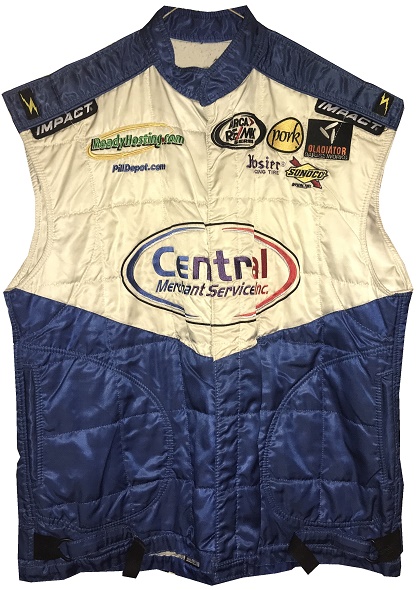
Central Merchant Services, Inc sponsored a few teams in ARCA from 2006 to 2009 for S&H Motorsports and Venturini Racing among others. They had some success on track. During that time, one of the pit crews wore this Impact vest. The vest shows very light use.

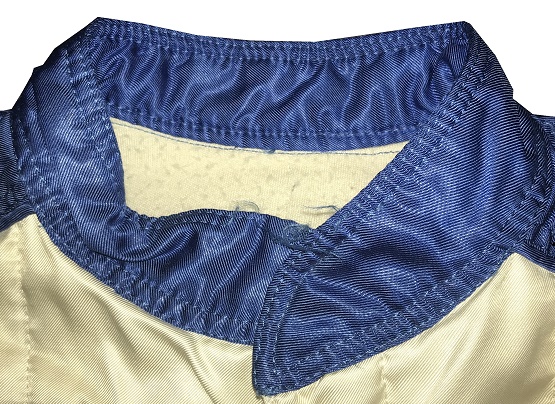
The blue collar is unadorned.

The right chest features READYHOSTING.COM, and PILLDEPOT.COM embroidered into it.

The left chest features ARCA RE/MAX SERIES, PORK, GLADIATOR GARAGE WORKS, HOOSIER RACE TIRE, and SUNOCO logos embroidered into it.

The front torso features a blue CENTRAL MERCHANT SERVICES logo embroidered in the white material. There is blue material below that.

Inside the front zipper is the Impact warranty label.

The corners have Velcro comfort straps attached. The blue shoulder epaulets are unadorned. The vest has standard arm holes present. The back of the vest doesn’t show that much use.

The blue collar is unadorned in the back.

The back torso features a blue CENTRAL MERCHANT SERVICES logo embroidered in the white material.

It’s sad that ARCA, once an independent stock car racing series with its own identity is going to become just another NASCAR developmental series. Guys like Billy Venturini need ARCA to help their careers, and help keep their identity. I hope the ARCA guys are able to find their places after this is all said and done.

Next Friday Feature will feature the final Infinite Hero Challenge column.

The Driver Suit Blog-Wheel Reviews-Excuse My Dust

By David G. Firestone

Long before Disney took the concept of needless sequels to the level it is today, there were other examples. Sometimes these sequels were great, other times they serve no real purpose. This is especially true if the movie in question can be considered to have a “They lived happily ever after” ending. Today’s movie is one such example.

The Roaring Road ended in “and they lived happily ever after.” However, the writer of The Roaring Road, Byron Morgan decided to write The Bear Trap in 1920. This story would evolve into Excuse My Dust, a sequel to The Roaring Road in 1920. All the main cast members return for this sequel. As with the last movie, this is somewhat difficult to follow without sound.

The movie starts with a decent explanation of the events of The Roaring Road, then sets up the movie stating that ‘Toodles’ Walton has retired from racing, has Dorothy as his wife, and Toodles Jr. as a son, played by Wallace Reid Jr., It also explains that Toodles is now a high ranking member in Darco Automobiles. Wallace, Dorothy, and Toodles are a happy family, with Toodles Sr. giving Toodles Jr. his own play car. Dorothy chides Toodles Sr. for teaching Jr. how to speed, and Jr. almost rides into the street.

The scene then shifts to a top secret room in Darco, where J. D. “The Bear” Ward, and Tom Darby develop a brand new, more powerful stock motor for a car. Max Henderson, a salesman described as “A six-cylinder man with a one-cylinder conscience” is introduced. Darby and The Bear don’t trust Henderson, but Toodles likes him.

We are then introduced to The Fargot Bunch, representing Fargot, who is the chief rival to Darco. They have plans as well. Leading the bunch is President Mutcher, who has questionable ethics. It’s revealed that Henderson is in fact working for Fargot, and trying to steal the secret engine. The come to the conclusion that Toodles is testing the new engine, and decided to get him to race, and get a peek at the motor, not realizing he has left the speed game.

Ritz, Mutcher’s stooge, scouts Toodles’ route, and tries to get him to race, with his wife holding his infant son. The cops pull them over, and take him to the station. In court, Toodles waits for the judge, and his wife calls The Bear, asking for help. As The Bear arrives for court, he catches Ritz trying to spy on the engine, which isn’t on the car that Toodles was driving. Ritz dejectedly walks away.

Back in court, The Bear and the judge have a talk, and Toodles thinks he is getting off easy, but the judge suspends his license for six months. The Bear then proceeds to place signs in all Darco offices stating that any employee caught speeding will be promptly fired. Toodles argues with The Bear, but not only does he get nowhere, The Bear reveals that he is selling all three of their race cars. Dorothy talks Toodles down.

Fargot learns that Darco is selling their race cars. They set up a plan for a dummy company to buy their cars. This plan is successful, and within a week, Fargot has all of Darco’s race cars. That, coupled with his probation, takes a toll on him. The Bear becomes enraged when he sees a Darco add talking about their racing cars, which was pitched by the spy Henderson. Thus the trap is set.

The scene shifts to an automobile show, where all the manufacturers show off their latest models. At the show, a clipping is given to Toodles, claiming that Darco has no real racing prowess left. This sends The Bear into a rage, and a Darco/Fargot race from LA to San Francisco is set. This is not a race for just road cars, but full on race cars are in this race. Because of his probation, Toodles isn’t allowed to drive officially. However, through Henderson, his old race car is sold aback to him. In testing, he nearly hits his own son and nanny, which enrages his wife.

Toodles and his mechanic Griggs work on Toodles’ car. While the car is being worked on, Toodles goes home to make things right with Dorothy. He runs into his eternally cigar smoking father in law, who give him a note. Dorothy won’t see Toodles until he gives up speeding forever. The Bear sides with his daughter. Griggs reluctantly agrees to race, and Henderson tries to find out more about the Darco engine.

Henderson mentions to Toodles that he thinks the new engine is in the car Toodles is going to drive, and calls Fargot. Toodles, realizing what is going on, tells Henderson that the new engine is, in fact, in Toodles’ car, and alerts The Bear. When the night of the race comes, all are ready, but Toodles gets a telegram asking him to come to San Francisco, because his baby is sick. Toodles decided to replace Griggs in the race. Mutcher tells his driver to wreck Toodles, and The Bear replaces his driver in his car to protect his son-in-law. The race then begins.

The night racing shots are really well done, as it’s actually shot at night. Daytime comes, and Toodles is in the lead. The Bear has to pull over for a pit stop, and realizes that Toodles is still in the lead. The course is changed by a bridge out sign. In trying to catch up with Toodles, The Bear drives over a railroad bridge, narrowly missing a train. Ritz catches up to Toodles, and they wreck. Ritz inspects the car, and realizes they have been duped. A fight ensues, and Fargot’s second driver vows to chase down The Bear. He finds out that Fargot bought all of Darco’s racing cars.

The Bear is now unknowingly in the lead. Thinking he is in third, he actually wins the race. It’s announced that Toodles and Ritz were in a wreck, and as The Bear tries to figure out what happens, Toodles and Oldham, Fargot’s driver, come in second. Toodles reveals that the car is a Darco car in disguise, and he leaves to check on his child, which turns out to be a false alarm. Relieved, The Bear gives the $10,000($134,833.68 in 2020), Dorothy forgives Toodles, and the movie ends.

The movie was a little too complex, given the technical restrictions. Also, without sound, it’s really hard to tell who is who sometimes. This could have been an original movie, but it’s a sequel for no real reason. Still, it is well shot, the racing is good, and there was a lot of effort put into it. So I’ll give it a C.

Next Week, a silent movie from 1924 featuring another silent film comedy legend.

The Driver Suit Blog-Wheel Reviews-The Roaring Road

By David G. Firestone

While short silent films are easy to watch, there are also longer, multi-reel full movies that without audio can be difficult to watch sometimes. This is also true when it comes to more serious movies. One such example is the 1919 Wallace Reid classic The The Roaring Road. It’s a decent movie, but can be difficult to watch.

The movie starts with with a title card describing “the four hundred mile Santa Monica race, known as the grand prize, has long been a classic event in motor-dom, but has never been won three times by any one make of car.” Short aside, I should use the term “motor-dom” more often. There is a brief shot of racing before we get a title card introducing “J. D. Ward, nicknamed “the Bear,” President of the Darco Motor Company. Theodore Roberts.” Roberts is the actor playing Ward. The shot then turns to footage of an actual bear sitting at a desk, which fades to the character of J. D. Ward. Another title card states that he has won the Grand Prize with the Darco Ninety, and he wants to win a third one.

Ward gets a phone call telling him that his cars will be in town later that day. Ward meets with the drivers, and they talk about the race. We are then introduced to Wallace Thomas Walden, better known as Toodles, who is Ward’s best salesman, and played by Wallace Reid. Toodles wants to race in the Grand Prize, but Ward won’t let an amateur race in his cars. Toodles enjoys taking his anger about this situation out on motor cops. He proceeds to outrun a motorcycle cop.

Then we get introduced to Dorothy Ward, referred to as “The Bear’s motherless cub.” Toodles wants Dorothy’s hand in marriage. Dorothy and Toodles meet and talk, and then The Bear calls Fred Wheeler in to explain his resignation. The scene shifts between Fred and The Bear , and Dorothy and Toodles. Toodles gets suggested to replace Fred, and The Bear gets a test. While Toodles passes the test, he quits in anger. Tom Darby, a Darco mechanic is introduced. As if this isn;t bad enough, the tran carrying the race cars has wrecked, and Darco is out of the race.

Inspecting the wreckage, Dorothy, Tom, and Toodles hatch a plan to enter a Darco in the race, by salvaging the three wrecked cars into one car. The Bear is not happy, but because Toodles owns the car himself, The Bear can’t stop him from entering the race. The 400 mile race starts. The Bear is not sold on the “Three-in-One” but the car starts to show speed. The Bear is still negative about the situation. As the race continues, Dorothy tries to convince The Bear that this isn’t an act of revenge, but Toodles and Tom really trying to win the race.

Then The Bear gets a signed contract from Toodles, and The Bear. The letter contains a threat to slow down on lap 40. The Bear doesn’t want to sign, but by lap 38 out of 40, Toodles is in the lead. Toodles goes through on his threat to throw the race by slowing on lap 40, but then roars back into first. Toodles wins the race, and The Bear and Darco win their third Grand Prize. All is forgiven between The Bear and Toodles, but there is tension, when Toodles asks for Dorothy’s hand in marriage. The Bear responds by saying that she won’t get married for 5 years.

This does not sit well with Toodles, who vents to Dorothy, without realizing that The Bear is listening. As this is happening, we learn that Rexton, the main competitor to Darco has been disqualified from the record from San Francisco to Los Angeles, supposedly with Toodles behind the wheel. The Bear is furious, and calls Toodles into his office, demanding an explanation. Before he can talk, Toodles tells The Bear that the wedding is next week. The Bear shows Toodles the newspaper, and demands answers. Toodles quits and messes up The Bear’s office, and leaves. The Bear calls his pro drivers to beat the Rexton San Francisco to LA record. There will be a total ban on road racing soon, and none of the pro drivers can make it, so The Bear enlists the help of Toodles, who rejects him.

The Bear tries to convince Dorothy that she and Toodles are done, and they are moving starting that night. This is part of a plan hatched by The Bear to get Toodles back in a car for the record attempt. It’s then revealed that Toodles has been jailed for 10 days for speeding. After a long scene of Toodles in jail, he is broken out by Tom. Tom provides Toodles with a stock car, and the chase is on. While Tom pretends to send a telegram, he officially records the start of Toodles’ attempt. It’s at this point, that I notice that Toodles and Tom are racing while wearing sunglasses AT NIGHT! The Bear is nervously chain smoking.

While racing, Tom and Toodles have to deal with hazards, such as roads closed, and getting stuck. The run continues into the night. The Bear and Dorothy continue their train trip while Toodles continues his run. Eventually, the two vehicles meet. The Darco races in front of the train, and makes it to San Francisco. The Rexton record is beaten by an hour, and The Bear allows Dorothy and Toodles to be married.

I really liked this movie, though the lack of sound made it hard to follow sometimes. The only real thing I didn’t like was J.D. The Bear Ward. He isn’t a true antagonist in certain points. Also, I don’t like that every time he is on screen, he is smoking a cigar. Still, I like this movie so I’ll give it an A-.

Next Week, the sequel to The Roaring Road, Excuse My Dust.