The Driver Suit Blog-Pit Crew Shirts-Fashon and Racing Meet

By David G. Firestone

I’m not a fashionista…and that’s putting it lightly. I wear my work uniform to work, and when I’m off duty, I wear t-shirts, and shorts, especially while lounging around the house. When I go out with friends and/or family, or when I go to races, I will wear pit crew shirts. I will pair these with baseball stirrups, shorts, and a baseball cap.

Pit crews are proud of what they do. They get to work on race cars for a living, which many fans would love to do. Sponsors are proud of their race teams, and want their crew members to represent the brand. As a result, teams and sponsors create pit crew shirts. These shirts are designed similar to the driver suits. Like driver suits, they are sold to collectors after the season. These aren’t as valuable as other race-used memorabilia, and while some collect them, others, like me wear them.

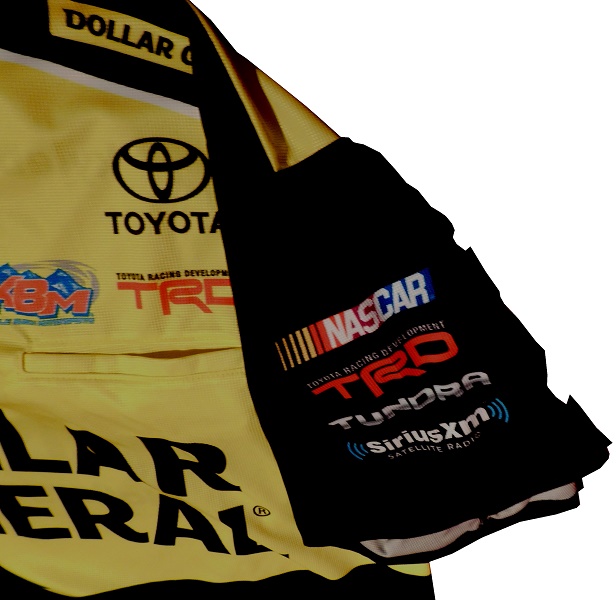
There are many kinds of materials that pit crew shirts are made of. Some of the older ones are made of polyester with heavy patches. Then there are newer shirts that are made of a light, breathable materials, with the logo sublimated on the material, like this 6Xl Dollar General Truck Series shirt. The shirt shows some light wear, but is in great condition.

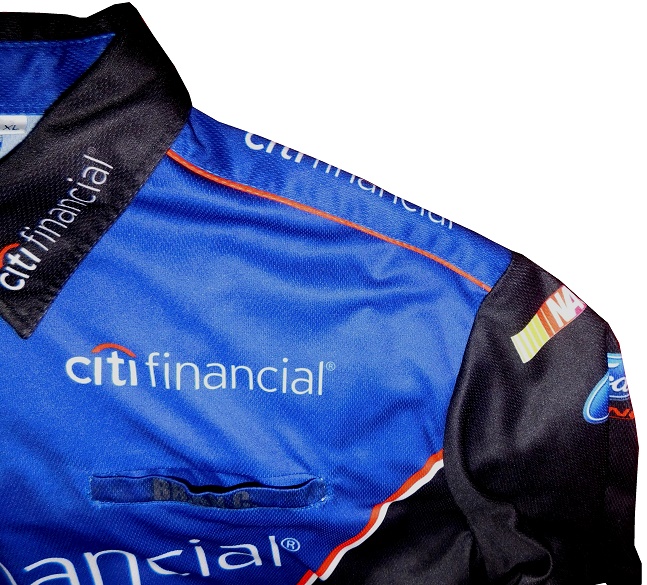
The shoulders have epaulets with DOLLAR GENERAL logos present. The sleeves have logos, the right sleeve has SUNOCO and SAFETY KLEEN, the left has NASCAR, TOYOTA RACING DEVELOPENT, TUNDRA, and SIRIUS XM logos. This is one of the newer shirts, and it has a jocktag. The shirt was made by ESM of Indianapolis.Sticking with the Camping World Truck Series, this 6Xl shirt was worn by the crew from Venturini Racing, when they were sponsored by ZloopIt in 2014. It has a combo of thin polyester, and breathable mesh. It is in great condition. The shirt has blue epaulets on the black material, and the epaulets have ZloopIt logos. The sleeves have logos, the right sleeve has NASCAR, TOYOTA RACING DEVELOPENT, TUNDRA, and SIRIUS XM logos, and the left sleeve has a SUNOCO logo. There is an Outer Circle tag in the cowl, indicating that the size is 6XL.Moving on to the Xfinity Series, this is a Nike-made example from when PPI Racing was sponsored by Albertson’s. It is in great condition. The shoulders have no adornment at all, the chest logos are all embroidered. The sleeves have patches, the right one has a 57 patch, an ALBERTSONS logo, and a NASCAR logo. The left sleeve has a FORD logo, an ALBERTSONS logo, and a NIKE logo. The cowl has a classic Nike 3Xl tag present.This example, from when John Andretti raced for Braun Racing, with Camping World as a sponsor. The shirt is made from a slightly thicker polyester with sublimated logos. It’s in great condition. The blue shirt has yellow epaulets, with CAMPING WORLD logos present. The sleeves have the same set of logos on each side. First is the Impact Z logo, then there is a CAMPING WORLD logo, followed by a FREEDOM ROADS, and a TOYOTA. The cowl features an Impact crew tag, no size tag is present.Sticking with Braun Racing in the Xfinity Series, this Berringer Wines pit crew shirt comes from that team as well. This is also a thicker polyester in great condition. The shoulders have no epaulets, or adornment, and the logos are sublimated. The sleeves have sublimated logos. The right sleeve has ABF, FOE, OGIO, SEM, and NEW BALLANCE logos. The left sleeve has HAAS AVOCADOS, TOYOTA, NORTHEASTERN SUPPLY, SEYMOUR and BRAUN ABILITY logos. The shirt is made by Vicci, and there is a size 4XL tag in the cowl.One of the best designs in pit crew shirts is Texaco Havoline, as exampled by this Juan Pablo Montoya shirt from his days with Chip Ganassi Racing. It is in great condition. The shoulders have epaulets with HAVOLINE logos, and the chest has logos as well. The sleeves have sublimated logos, including, NASCAR, HAVOLINE, WRIGLEY’S BOSCH, LINCOLN WELDING, and SUNOCO logos on the right sleeve.  The left sleeve has NASCAR, HAVOLINE, COORS LIGHT, TARGET, FREIGHTLINER, and SHERWIN WILLIAMS Logos. The cowl has a tag from Revi, but there is no size tag present.Ricky Stenhouse Jr. is a two-time Xfinity Series champion, and while with Roush-Fenway Racing, he was sponsored by CitiFinancial, and this pit crew shirt was prepared. It is in decent condition. The shoulders have epaulets with CitiFinancial logos on them. The sleeves have sublimated logos. The right sleeve has a MAC TOOLS logo and a DUPLICOLOR logo. The left sleeve has a NASCAR logo and a FORD logo. The shirt is made by The Winning Team, and a tag is present in the cowl. There is also a size 5Xl tag as well.One of Greg Biffle’s sponsors in the Monster Energy NASCAR Cup Series was the National Guard. This shirt, made of dress shirt material, with heavy patches. The shoulders have epaulets with NATIONAL GUARD logos embroidered into them. The right sleeve has MAC TOOLS and JACKSON HEWITT logos, and the left sleeve has NASCAR, FORD RACING, and LABOR READY logos embroidered into it. The cowl has a tag from Apex designs, and size XXXL tag.Front Row Motorsports has a few different sponsors, so, like many teams, they have team-branded pit crew shirts. This is one example, and it’s in great condition. The shoulders have unadorned epaulets. The sleeves have sublimated logos. The right sleeve has SUNOCO, SHERWIN WILLIAMS, SEM, LINCOLN WELDERS, and THE PETE STORE logos. The left sleeve has NASCAR, FORD PERFORMANCE, RACING ELECTRONICS, DR PEPPER, and K&N logos present. This is one of the newer shirts, and it has a size 3XL jocktag. The shirt was made by ESM of Indianapolis.Bob Vandergriff is a former driver who turned into a team owner. For many years, he was sponsored by CJ Energy Services, This long-sleeve pit shirt was prepared for a crew member. The sleeves are a thin polyester, the rest of the shirt is a thicker material. The shoulders are completely unadorned. The sleeves have black on the outside, but gray flame materials on the undersides. The right sleeve has VANDERGRIFF APPAREL GROUP and SPLIT SECOND SPEEDSTERS logos The left sleeve has THE VANDERGRIFF FOUNDATION, and HEDMAN HUSLER HEDDERS logos. The Vandergriff Apparel tag is printed directly on to the back of the collar. It indicates the size as 4XL.The fan appeal of pit crew shirts hasn’t been lost on teams, and there have been replica shirts made in the past. But for some seasons, replica crew shirts are made, but other seasons, they aren’t. Fans do like these, but for some reason, they are not as prevalent as replica driver suit jackets. I can only hope that these shirts do start getting made again.
Next week, we discuss the 50th Anniversary of the introductory of Nomex.

The Driver Suit Blog-Most NASCAR Teams Have A Contingency Plan!

By David G. Firestone

Contingency means many different things. Some definitions include “a future event or circumstance that is possible but cannot be predicted with certainty,” “a provision for an unforeseen event or circumstance,” “an incidental expense,” or “the absence of certainty in events.” When it comes to NASCAR however, contingency has a very specific meaning. The group of small decals in front of the door number on stock cars are refereed to as “Contingency sponsorship.”

Aside from the series logo, and pole decal, many of these small decals are from companies that made equipment used in cars, or used by the team. Some may include sponsors that aren’t paying enough to qualify as an associate sponsor, which earns a much bigger decal on the rear of the car. For many years, there was little, if any thought given to the layout of the decals. For example, here is a contingency panel from Steve Park in 1997.Here is one from Bobby Hamilton during his time in 1999.As can be seen, decals are covering other decals, there seems to be no thought given to appearance in this respect. The decals appear to be sent wherever there is room. Interestingly, I have found that while this was somewhat forced, at least they were consistent.

In more recent years, teams have become very conscious of contingency decal placement. These are some more recent car sides, and as you can see, decal placement is very clean and the setups are more thought out. This transfers over to the die cast models. This is an example of a Carl Edwards model, vs a picture of the real thing.

These small decals are a big business. Many fans will put them on their cars and tool boxes. They can be found on eBay. They are also seen on many other racing categories. But since body panels don’t hit the collector market, or the decals are on the chassis in some instances, they don’t often get bought by collectors.

Next week, I will show my collections of pit crew shirts.

The Driver Suit Blog-The Vest Project Part 16-Front Row Motorsports Part 2

By David G. Firestone

Last week, I gave a brief overview of the history of Front Row Motorsports. I primarily discussed their Monster Energy NASCAR Cup Series history. This week, I’m going to discuss their Xfinity Series history. Like many Cup teams, Front Row Motorsports decided that they should expand from the Cup series to what is now the Xfinity Series starting in 2008. This is a rational decision, as many teams use driver feedback from the Xfinity Series to help their Cup cars, and often use the Xfinity Series as a developmental program for future drivers.

Front Row’s efforts in the Xfinity Series weren’t great. Their driver lineup for that time period was Eric McClure for 32 races and Brian Simo for 3 races in the number 24 Chevy 2008. For the following season, Tony Raines was in the # 34 Chevy for all 35 races in 2009. Jeff Green, Kevin Hamlin and Johnny Sauter each ran a few races each in the #36 Chevy in 2010. Their efforts resulted in a top 5 and three top 10’s, as well as three laps led during that time. A couple of members of the Front Row pit crew wore this vest during that time.The vest shows heavy wear, in the form of a lot of stains and some scuff marks from race-use.

The collar is unadorned, and there is no tag in the cowl, though the name DENNIS is written in faded Sharpie .The right chest features a NASCAR NATIONWIDE SERIES logo, a GOODYEAR logo and a FRONT ROW MOTORSPORTS logo embroidered into it.The left chest features a TACO BELL patch,and a LONG JOHN SILVERS logo embroidered.The front torso is unadorned, but it has a large amount of black staining present on the white material.Underneath the front logo, next to the zipper is a tag that indicated that the vest was also worn by “Ryan” as that is written in faded Sharpie, and the warranty tag.Impact has special Velcro adjustment straps on the hem, and this vest is no exception. The vest epaulets are black strips with no logos present. The standard vest sleeve holes are also present. The rear of the vest is unadorned shows some dirt and scuff marks below the logo.The back of the neck is unadorned.The back torso of the vest has a lot of dirt visible on the white material.While Front Row had little success in the Xfinity Series, it wasn’t enough to justify them continuing to compete in the Series, especially when they switched from Chevy to Ford in the Cup Series starting in 2010. It’s also understandable that multiple crew members would wear this vest. These vests, though an affordable option to one-piece suits, are still expensive to produce, and if a crew member leaves the team, the vest can still be used with another crew member. I love uniforms like this that shows a lot of wear. You don’t see that too much in racing memorabilia.

Next week, I’m going to discuss a design aspect that a lot of people notice, but might not understand.

The Driver Suit Blog-The Vest Project Part 15-Front Row Motorsports Part 1

By David G. Firestone

In NASCAR, there are usually two kinds of teams: big and small. The big teams include Stewart-Haas Racing, Hendrick Motorsports, Team Penske, Chip Ganassi Racing, Joe Gibbs Racing, and Furniture Row Racing. Big teams are multi-car teams that are championship caliber, and have little if any trouble with sponsorship issues. Small teams are teams like Tommy Baldwin, Germain Racing, Premium Motorsports, BK Racing, The Wood Brothers, Go FAS Racing, Circle Sport/TMG, Rick Ware Racing, and Leavine Family Racing. These teams, while they may have more than one team, are often underfunded, have mediocre drivers and on track results.

Interestingly, there is a third group, which could really either be considered big or small, depending how one looks at them. These teams include Richard Childress Racing, JTG Daugherty, Richard Petty Motorsports, Roush-Fenway Racing, and Front Row Motorsports. These are all teams that while they have multiple teams and decent sponsorship, they aren’t championship caliber, even though they do often make the playoffs and win races. The have a decent driver or two, and have decent fan bases. One of the most well-known and least appreciated of these teams is Front Row Motorsports.

Founded by Bob Jenkins and Jimmy Means in 2005 as a single-car team, the original team merged will Mach 1, and began a two-car operation. Eventually, the team shad as many as three teams, with two full time. Since team owner Bob Jenkins owns over 150 franchises from Yum! Brands, including Taco Bell and Long John Silver’s, as well as Morristown Driver’s Services or MDS, those sponsors frequently appear on the sides of his cars. While the team hasn’t shown much strength on many tracks, they show strength on superspeedways.

Mach 1 Motorsports, which would merge with Front Row in 2005, was founded by William Edwards in 2004, and raced with Randy LaJoie, Todd Bodine, Geoff Bodine, Larry Gunselman, Derrike Cope, Chad Chaffin, Jeff Fuller, P.J. Jones, Ted Christopher, and Mike Skinner in 35 races from 2004 to 2005. The team was a failure, failing to score even a top 10. While Randy LaJoie raced the #34, everyone else raced the #98, except Mike Skinner, who raced the #00. During their run, a crew member wore this vest/shirt pit crew suit.Obviously, being a minor team searching for sponsorship, this Impact! vest/shirt combination was used. The vest could be swapped out if a sponsor was found for a race, or even a season. The vest itself is in good condition, though some race wear is present. The undershirt doesn’t show that much wear.

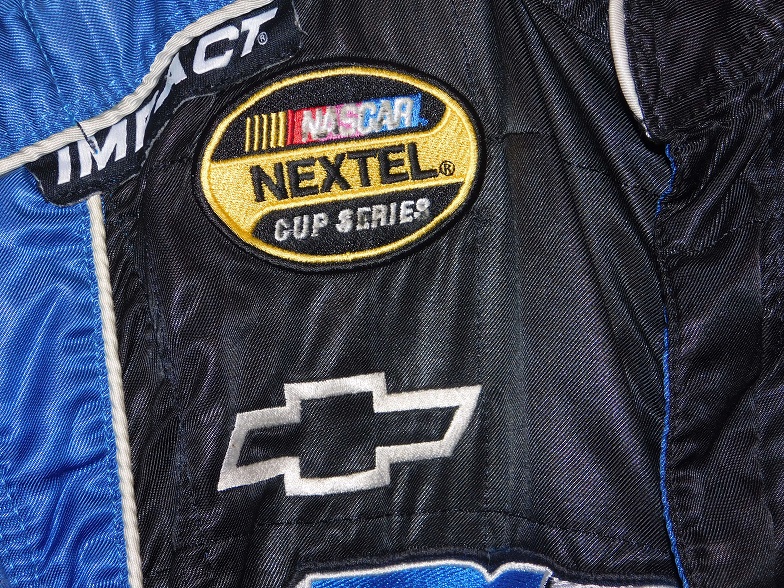
The vest shows some scuff marks from race-use.The collar is unadorned, and there is no tag in the cowl.The right chest features a NASCAR NEXTEL CUP SERIES logo and a Chevy bowtie logo embroidered into it.The left chest features a GOODYEAR logo embroidered.The front torso has a MACH 1 MOTORSPORTS logo present.Underneath the front logo, next to the zipper is the Impact warranty tag.Impact has special Velcro adjustment straps on the hem, and this vest is no exception. A second Impact tag is in the bottom of the hem, in the rear, and has the name J MAZZA written in faded Sharpie.The vest epaulets are blue strips with white outlines, with no logos present. The rear of the vest shows some scuff marks below the logo. The back of the neck features 34 embroidered into the collar, and an American Flag patch sewn just below it.Just below the American Flag patch is a MACH 1 MOTORSPORTS logo, embroidered higher than the logo on the front.While the shirt did see race use, it doesn’t show any wear to speak of.The collar doesn’t have a tag, but it has an Impact logo on the back of the neck, and the name Adam is written in faded Sharpie in the square.The front of the shirt is unadorned blue Nomex.The shoulders are unadorned. The right sleeve has an IMPACT Z logo, a NASCAR logo, and the SFI certification. Usually,the SFI certification is on the left sleeve, but here it is on the right sleeve for some reason. There are no logos in television position. The left sleeve has an IMPACT Z logo, a NASCAR logo, and a SUNOCO logo, with no logos in television position. Aside from the small Impact patch just below the neck, the back of the shirt us unadorned, and shows no wear. Front Row Motorsports is a small team but they are making an impact in the Cup Series. They have two wins, and have decent showings, especially at superspeedways. They also have a history in the Xfinity Series, which we will examine next week.

The Driver Suit Blog-Trophy Design Is Interesting, Especially In The SCCA

By David G. Firestone

I’m fascinated by trophy design. Trophies can be anything from The Wally, to a tea service, to a cut glass bowl. Racing trophies are anything from functional items to stand alone trophies, to over sized napkin rings. When it comes to the smaller events, or smaller sanctioning bodies, trophy design can be very interesting.

Like many national racing sanctioning bodies, The Sports Car Club Of America or SCCA has several regions that have their own racing. Other sanctioning bodies that have regions are NASCAR, and the NHRA, to name a few. While some drivers go on to national success, many drivers come to be great in one specific region.

The Southern Indiana is one of 115 regions, which are divided in to nine divisions. One such region is the Southern Indiana Region, which holds events in Southern Illinois, Indiana, and Kentucky. One driver who raced in a number of events was a driver named Walter Scott. Racing from at least 1960 to 1995, Scott won a number of different awards and trophies, which survive in my collection, including this small bowl.

The bowl is for a 10th place finish for an unnamed event or series in 1960, and is in great condition. For another unnamed event or series in 1962 , Scott finished 10th. He was awarded this small bowl as a result. Walter Scott was a navigator for a driver in something called the “Thimsen’s Terrible Rallye” in 1965. The duo finished 2nd. This trophy was awarded to him for that 2nd place finish. For a third place finish in an unnamed Rallye in 1970, Scott was awarded this small bowl. It has some scratches. 1973 had Walter Scott perform well, and winning this small Thimsen Memorial Trophy for Rallyist Of the Year, which has some small scratches and dings. That same year, Scott won a small bowl for finishing 7th in something called the SIR Concourse, which shows some scratches. Walter Scott was still going in 1988, where he won this large trophy for the 1988 Year End Award for finishing 6th place. It doesn’t show any damage. In 1995, the Southern Indiana Region celebrated 40 years. Walter Scott had been a member for 35 years, and was awarded this plaque clock to commemorate his long time with the SIR. In 1996, Walter Scott competed in a Rallye called the “Tulips and Other Spring Flowers,” where he finished first in his class. He was awarded this small plaque as a result. It is in great condition. Racing trophy design is an interesting topic, because the various kinds of trophies are interesting. I would genuinely love to sit in on a design session for a racing trophy, and see how it is designed from paper to final product. Some drivers cherish their trophies, other drivers give them away. It’s a fun topic to discuss and I hope to discuss it again soon.

Next week, we revisit The Vest Project.

The Driver Suit Blog-Mining The Materials We All Need

By David G. Firestone

One of my non-racing interests is mining. When I went to the Gem Show in Tucson a few months back, I wasn’t really interested in many of the gems, but I found a couple of booths that almost exclusively dealt with mining memorabilia. I found that stuff to be interesting. Mining in the 21st Century is the safest, and most technologically advanced that the industry has ever been. In the decades prior, safety and technology were at a premium. Workers would use the most primitive of technology in mining.

I’ve been to a few mines on tours. In 2003, while at DePaul University, I went on a service project to Cranks Creek, Kentucky. One particular day, we went to Lynch, Kentucky, and went on a tour of a closed-down mine, and a mining museum in another town. I did take a few pictures of some of the exhibits: Last year, I took a tour of the ASARCO Mine, which, unlike the mine in Lynch, is an active mine, currently mining copper. I took some pictures: and video:

Also, I bought some mining memorabilia. The Lynch, Kentucky museum had a small gift shop, which sold some of the items used by miners from the old days.

This is one example of a tag used to indicate who mined a cart of coal. Miners were paid by the ton, and as carts were brought from the mine to the surface, it was weighed, and the number of the worker was written down. This is a paper version of the tag. I’m not sure of the vintage, but it is in great condition.Mining tags came in a number of different materials. This is an older leather tag, which, unlike the paper tag, shows a lot of signs of age.

Metal was one of the most commonly used material used to make tags, since it was durable. This is an example of one.One unique way mines used to avoid paying as much money would be to own the general store where the workers lived, and hand out vouchers that could only be used in the company-owned stores. This is an example from the Southern Mining Company Mine in Colmar, Kentucky.In today’s computerized and automated world, the term “pay envelope” doesn’t mean much. For decades, the “pay envelope” was how millions of Americans received their pay for their hard work. Miners were no exception. These two examples are from a miner named Raymond W Collier. One is from 1950, for $136.04, which in today’s money is $1,642.84, and the second is from 1953, and it’s for $139.64 or $1,270.04 in today’s money. Both have the amount of coal mined, and the time worked. A lot of mines are in very remote areas. As such, towns will spring up around the mines for the workers and their families to live. Bodie, California is one such example. Bodie was founded by a group of prospectors as a camp in 1859. In 1876 a load of gold was found, and eventually the boom town grew to over 7,000 people. While the boom was good, it couldn’t last, and by 1915, it was a ghost town. This check from the 1880’s was from the Bodie Bank, and is still in great condition. In the end, millions of miners endured dangerous conditions, and back-breaking work, and, sadly, many of their names have been lost to history. What were they trying to acquire? It depends on the mine. Many mines are mining for coal, which for decades was the main form of power generation. Trains, boats, and electricity all came from burning coal. This piece of coal was on board the RMS Titanic before it sank. Quartz has a number of different uses. From jewelry to electronics, quartz is a mineral that has become indispensable as a material. These are diamond cut quartz, that are designed to look like diamond. From wire to pennies to roofing material, copper is one of the most important minerals in place today. Copper Mines work around the world to satisfy humanity’s need for this material. Copper has to go through a lot to get to the material we know today. When it first gets mined, it’s copper ore, and this is a small example.After being pulled from the ground, copper ore needs to go through a series of methods to remove impurities. Copper can’t be useful unless it is 99.99% pure. The ore has to be crushed to a fine powder, have the copper leached out of it, and that has to go through some more steps to become copper. This is a solid pound bar of .9995 percent copper. Silver has uses in many different applications, including electronics, medical uses, solar panels, currency, photographic film, x-rays, and numerous other uses. These are three 1 gram bars of 99.999% silver.The three most common uses for gold are currency, electronics, and jewelry. Gold is one of the few minerals we all want to have. This is a small gold nugget. It is .07 grams. When pure gold is flattened by “goldbeating” the end result is a sheet of gold leaf. It’s main uses are for art and architecture, but it can also be edible. This is a small jar of gold leaf. There are many other minerals that are mined, some on a large scale, some on a small scale. This is an example of bluestone, which is the same material used to make Stonehenge.The minerals extracted from the earth are necessary for our modern world.  While there are environmentalists who claim we are mining too much, these materials help us survive and advance as humans do.  Most everything we as humans use is made with mined materials in one way or another.  There are millions of things these materials are used for.  One other thing that gold and silver are used for is awards, and next week, we will look at some racing awards.

The Driver Suit Blog-An NFL Legend Breaks New Ground In Auto Racing

By David G. Firestone

Walter Payton will always be known as one of the best running backs in the history of the NFL. The former holder of the records for most rushing yards, attempts, touchdowns, and yards from scrimmage, as well as the holder for most starts by a running back, Payton was a top shelf running back, who loved the sport. In 1985, he was a part of the famed Chicago Bears who would go on to win Super Bowl XX in 1986. In 1999, Payton announced that he had Primary sclerosing cholangitis

, which led to his cholangiocarcinoma, which was called to his death on November 1, 1999.

Payton’s legacy is solidified both by the citizens of the Chicagoland Area, and the football world. The city of Chicago works with the Walter and Connie Payton Foundation and the Walter Payton Cancer Fund, as well as Walter Payton College Prep. The NCAA awards the Walter Payton Award to the best offensive player. The NFL awards the Walter Payton Man of the Year award to those whose contributions to charitable organizations meet or exceed their achievements n the field. Payton will always be remembered for his legendary football career.

While Walter Payton was a great football player, he was also a great businessman. In 1988, Payton and a group of investors purchased the old Chicago, Burlington, & Quincy Roundhouse and Locomotive Shop in Aurora, and turned it into a restaurant and brew pub called “Walter Payton Roundhouse.” Payton was also wanted to bring an NFL team to St. Louis, and become the first minority owner in the NFL, but lost out to Jacksonville and Charlotte.

A lot of people didn’t realize, but Payton was also involved in auto racing. He was known for racing Trans Am races, including one at Road America where he was involved in a scary crash, and suffered burns. When Chicago-area driver Dale Coyne needed financial backing for a racing team, Payton helped him as an investor.

Founded in 1984, Dale Coyne Racing saw Dale Coyne as the driver racing a series of different chassis, with little success. As the team struggled, Walter Payton came on board as an investor in 1988. Coyne stepped out of the car as a driver in 1989, and began to work with young driving talent, proving himself to be a good racing coach. In total, the team has had 4 wins, and a decent amount of success.

In 1995, Payton Coyne Racing fielded two cars. The #19 Ford was sponsored Agfa-Gevaert

and driven by by Éric Bachelart, Buddy Lazier, Ross Bentley, and Franck Fréon. The #34 Ford was sponsored by Mi-Jack and was driven by Alessandro Zampedri. The #19 scored a top 10, while the #34 scored three top 10’s. During that season, one #19 crew member wore this AGFA suit.The single-layer suit shows very light wear.The collar has a Velcro-closure, with AGFA-FILM logo embroidered into it.The standard Simpson warranty label is sewn into the cowl, and a 5/95 flag tag is present, indicating the date of manufacture.The right chest features a PAYTON COYNE RACING logo, a PPG logo, and an INDYCAR RACING logo embroidered into it.The left chest features AGFA-FILM, MI-JACK, WHALEMAN, and FORD COSWORTH logos embroidered into it.The front torso has no sponsor logos to speak of.The red belt is unadorned.The legs are unadorned, and have standard cuffs.The shoulders feature FIRESTONE RACING logos embroidered in black, on the yellow material.The right sleeve features a VALVOLINE logo embroidered into the upper area, and an HDC logo embroidered into television position. The shoulders feature FIRESTONE RACING logos embroidered in black, on the yellow material.The left sleeve has a SIMPSON logo, an HDC logo, and a VERNON AND SONS INC. embroidered on the upper sleeve, and nothing in television position. The rear of the suit shows no real wear to speak of.The back of the neck is unadorned.The back torso has an AGFA-FILM logo embroidered into it.Walter Payton may no longer be with us, but his memory will never be extinguished. He is one of, if not the first NFL player to own a racing team, something which has become a bit more commonplace in recent years. He is also one of the few minorities who was involved in motorsports, something that, again, is thankfully becoming more commonplace. He was a man of character, and a driven man. He will be missed, and the team he helped out is still going strong to this day.

We are going to go off-topic next week, in discussing something involving my trip to Arizona. See you then.

The Driver Suit Blog-NASCAR North of the Border

37-macleodBy David G. Firestone

While Canada isn’t exactly well known for auto racing, there are a lot of different kinds of auto racing in Canada. Formula 1, IndyCar, the IHRA, and IMSA all have races in Canada. These series have produced drivers such as Patrick Carpentier, Gilles Villeneuve, Jacques Villeneuve, Jacques-Joseph Villeneuve, Greg Moore, Paul Tracy, Scott Goddyear, Ron Fellows, and

Alex Tagliani.

Stock car racing is popular in Canada, where several series race in the class. Canadian stock car racing series include: The American Canadian Tour, The Lucas Oil Sportsman Cup,The Ontario Stock Car Association of Asphalt Racers (OSCAAR), The Pro All Stars Series, and, The Canadian Association for Stock Car Auto Racing or CASCAR. CASCAR was founded in 1981 by Anthony Novotny, and would go on to create the first Canadian national stock car series, The CASCAR Super Series in 1986.

CASCAR had a decent amount of success, but was suffering financially by 2006, when NASCAR purchased them, and created the NASCAR Canadian Tire Series. In 2016, Pinty’s Delicious Foods Inc. became the primary sponsor of the series, and the series is now known as the NASCAR Pinty’s Series. NASCAR will also send an up and coming driver to the Pitny’s Series to help with their development.

One driver who came into The CASCAR Super Series was Tara MacLeod in 2005. MacLeod had been a driver in the Ontario Late Model scene, and got her chance at the big show with her team MacLeod Racing, who were sponsored by Central Merchant Services. During her rookie season, she raced in 14 events, achieved an 18th place finish, and won Rookie of the Year, but left the series for some reason. During her rookie year, she wore this Awesome Racewear made driver suit.37-macleodMade by Awesome Racewear in Port Perry, Ontario, the suit shows decent use, with some stains and marks. I also have a hero card, and a couple of photos of MacLeod wearing the suit.37-macleod-1 37-macleod-2 37-macleod-4The blue collar is unadorned, and there is a care and size tag in the cowl. Interestingly, there is no warranty label in the suit.37-macleod-collar 37-macleod-tagThe right chest features a MACLEOD RACING patch embroidered into it. Tara has autographed the area above the logo, and added a smiley face. On a side note, I don’t like when people add smiley faces or other things to autographs. Admittedly, I don’t know why this bugs me as much as it does, but it really annoys me.37-macleod-rchestThe left chest features a CASCAR logo, and a MICKS MOTORSPORTS logo embroidered into it.37-macleod-lchestThe front torso features a CENTRAL MERCHANT SERVICES logo embroidered into it. A red stripe separates the white and the blue material.37-macleod-flogoThe belt is blue with white borders, and has TARA MACLEOD embroidered into it.37-macleod-beltThe unadorned legs have a quilt pattern, but no logos on the legs. The cuffs are a boot cut.37-macleod-legsThe shoulder epaulets are blue with red borders. They have no adornment on them.37-macleod-rshoudler 37-macleod-lshoulderThe sleeves have an AWESOME RACEWEAR logo, and a Tara MacLeod #37 logo embroidered into the upper portion, and a red flame design with white borders at the end of the sleeve. 37-macleod-rsleeve1 37-macleod-rsleeve2 37-macleod-lsleeve1 37-macleod-lsleeve2The back of the suit shows some light wear.37-macleodbThe blue neck is unadorned, but there is an APX RACEWEAR logo embroidered just below it.37-macleod-neckThe back torso features WWW.TARAMACLEOD.COM, Tara’s old website, a CENTRAL MERCHANT SERVICES logo, and the url CENTRALMERCHANT.NET embroidered into it.37-macleod-blogoThis was one of the harder suits to research since there are no sites that have CASCAR stats. I would have loved to learn more information about it, but sadly Racing Reference has nothing on Tara, and the one site that had some information, Driver DB was sorely lacking. I’m sorry, but I had to work with what little information I had.

In keeping with firesuits, next week, I’m going to discuss an ARCA pit suit.

The Driver Suit Blog-Antron Brown-The NHRA’s First African American Top Fuel Champion’s Undershirt

brownshirtBy David G. Firestone

It’s sad that African Americans don’t have the success in auto racing they should. Auto racing has a reputation as a “white sport.” Yet drivers like Louis Hamilton, Wendell Scott, Darrell Wallace Jr., Don “The Snake” Prudhomme, Willy T Ribbs, Tia Northfleet, Chase Austin, and Bill Lester have proven that African Americans do race, and are very talented. Looking over to the NHRA Mello Yello Drag Racing Series, the most prominent African American driver continues to prove he is one of the best.

Born in Trenton, New Jersey, Antron Brown developed a love for drag racing at an early age. He joined the NHRA and raced up to Pro Stock Motorcycle, which he raced from 1998 to 2007, winning 18 races during his tenure. In 2008, after getting his nitro license, he joined Don Schumacher Racing, driving their newest Top Fuel team. 8 years, 45 Wallys, and three Top Fuel championships later, Brown has established himself as a top shelf driver, and his positive attitude and respect for the fans has established him as a fan favorite.

In 2011, the year before he won his first top fuel championship, Brown raced a full season for DSR, with sponsorship from both Matco Tools and Aaron’s. During that year, he won six races, made the final round 8 times, made the semi finals 14 times, made the quarter finals 22 times with a won/loss record of 41-18. During that season, he wore this size M Impact undershirt, which he autographed.brownshirtThe shirt shows light use, as it was one of many used in 2011, and has been autographed by Antron in silver Sharpie just below the Impact logo on the chest.brownshirtThe collar is a thick one, with a tag inside that has a date of “1-28-2011” written in Sharpie.brownshirt-collar brownshirt-tag1The front chest has an Impact logo on the center, just under the collar, and Antron has signed the area underneath in silver Sharpie.brownshirt-flogoThe front torso has no adornment, and on the bottom right-hand side, is an SF1 3.3 tag, as well as an Impact warranty label with an M size flag tag.brownshirt-tag2The shoulders and sleeves have no adornment at all.brownshirt-rshoulder brownshirt-rsleeve1 brownshirt-rsleeve2 brownshirt-lshoulder brownshirt-lsleeve1 brownshirt-lsleeve2The back of the shirt shows light wear, which is hard to photograph on the dark material, and has the same gold stitching as the front, but otherwise no adornment.brownshirtb brownshirt-neck brownshirt-blogoIn a sport were all drivers are on par with each other, Antron Brown has proven that African American race car drivers can have huge amounts of success. I wish there were more drivers who could have success in American auto racing. Antron is still racing, and he isn’t going anywhere for a while. Hopefully, he can add more wins and championships to his already great resume. Next week, I will discuss a driver suit from a Canadian driver.

The Driver Suit Blog-Is This A Real NHRA Award, Or A Participation Trophy?

gywnnwally-1By David G. Firestone

The son of former top alcohol funny car driver Jerry Gwynn, Darrell Gwynn knew from a young age he wanted to race dragsters. When Darrell Gwynn hit the NHRA as a second generation top alcohol dragster driver in 1980, his talent and drive caught the eye of a lot of people. In 1981, he won three events, and became the first second generation top alcohol dragster national event winner. In 1983, he won two events, and became the first second generation top alcohol champion.

In 1985, after winning 10 top alcohol event wins, he got his “nitro license” and joined the top fuel ranks. While his first season was unremarkable, he would win four races in 1986, and come close to beating Don Garlitts for the top fuel championship. From then on, he would win a total of 18 races from 1986 to 1990. He would be a factor in the championships in all of those seasons. His last win was at the 1990 Gatornationals.

Sadly, his career didn’t have a happy ending. In 1990, at an event at Santa Pod Raceway in Podington, Bedfordshire, England, he was racing, when his car broke, and crashed at 240 MPH. Darrell survived, but was left paralyzed, thus ending his racing career. Gwynn would continue in the NHRA, not as a driver, but as an owner. He would race with Frank Hawley, Mike Brotherton, Mike Dunn, Andrew Cowin and Cory McClenathan, and earn 15 national event wins. In addition, he works for the benefit of those with spinal injuries.

I’ve discussed the history of the Wally before. Basically, the Wally is given to the winners of NHRA national events. Every class has one winner. One discussion among drivers and fans is that there is a Wally that is given out to the best looking car at every NHRA national event. There are many who feel that the best looking car Wally devalues the Wally as a whole. Yet the NHRA continues to give them out. The best looking car Wally is the participation award of the NHRA. I thought this was a recent thing, but this dates to at least 1985.

At the 1985 Southern Nationals, Don Garlitts beat Joe Amato to take the event Wally, but the best looking car Wally would go to Darrell Gwynn, in his 1985 Dave Uyehera made top fuel dragster. I recently acquired the Wally from the event, which Darrell has autographed.gywnnwally-1It’s in great condition, and shows some light signs of age and wear.gywnnwally-1 gywnnwally-2 gywnnwally-3 gywnnwally-4 gywnnwally-7Darrell has signed the base in black Sharpie.gywnnwally-5 gywnnwally-6When it comes to the idea that the best looking car is little more than a participation award, I do think it could be seen as such. However, in this day in age, teams and sponsors spend a large amount of time making their cars look good, so to be the best looking car can be seen as validation of this design effort. Either way, the Wally for best looking car isn’t going away anytime soon.

In many ways Darrell Gwynn’s story is the same as many other drivers. A hugely talented and driven individual gets to the big leagues, shows a lot of talent, impresses a lot of people, then has a big wreck, and his career either ends, or is never the same afterwards. It’s a sad fact of auto racing that there are many drivers who haven’t had the careers they should have because of bad wrecks. Darrell’s story should be heard by many young drivers, since it could happen to them. Next week, we’ll look at a shirt worn by an underappreciated top fuel legend.