[Editor’s Note: I’m on vacation for July, and I will not update the tracker or paint scheme grades until August. In the meantime, I’ve got articles ready to go on Fridays. DGF]
By David G. Firestone
Nomex is a great material for driver suits. It will protect the driver in the event of a fire, with no health issues, unlike asbestos. It is much more comfortable to wear than chemical dipped cotton, and much more durable. It does however have one major drawback. Should the material get burned, and discolored, the whole suit becomes useless. The discolored area of the suit will not protect the driver from fire.
The damage from fire can’t be fixed. This is why there are multiple suits issued to drivers Contrary to what a lot of people believe, cleaning a Nomex suit won’t reduce the fire protection, in fact it will help. This is why when photo-matching, drivers can often be seen in the same basic design, with some very slight differences. Fire protection is key for drivers and crew members alike.
These are two of the exact same suit, issued to a crew member named Chip. They were sponsored by Stock Building Supply, which has a number of stores in 13 states. I’m gonna show both suits at the same time, to show how similar they are. The suit is made by Deist, though isn’t SFI certified. The collar has a Velcro-shut design with a DEIST logo on it, with a warranty tag underneath. The shoulders, belt, and legs have no designs on them. The front has a STOCK BUILDING SUPPLY logo on it. The sleeves have green and white stripes, and DEIST logos embroidered into them. The only difference between the two suits is that one has CHIP written on the top of the right sleeve. The back of the neck has a DEIST tag.The back torso has a STOCK BUILDING SUPPLY logo and a DEIST SAFETY logo embroidered into it. This duality helped protect whoever Chip is, and it’s a good thing that neither suit suffered fire damage, and Chip wasn’t at any risk. Nomex has been the standard since 1967, and I see no signs of that changing in the foreseeable future.
Morgan Shepherd had a decent season in 1995, though he didn’t win a race, he did score 4 top 5’s and 10 top 10’s. This press kit, complete with driver, owner and sponsor information, along with several inserts is in great condition.
Every year, I take a month-long vacation in the summer, which coincides with the NHRA Lucas Oil Route 66 Nationals. I love drag racing, and the Route 66 Nationals is the NHRA’s stop on the Mello Yello Drag Racing Series tour. I go with friends from work, and every year, we have a great time.
Mother Nature was not in the kindest of moods on Saturday. Friday Night Qualifying went off without a hitch. I did get to watch the Jeg’s All-Stars race their elimination races. After the Jeg’s All Stars on Saturday, it began to rain. The rain continued to fall for several hours, during which time, I wandered around the pits. I got to meet Driver Suit Blog favorites Tony Schumacher and Ron Capps. Every year, I get the chance to ask Tony Schumacher a question, and the video below is of how that went.
I got a #1 qualifier interview cap from The Thunder Valley Nationals on eBay, and I got it signed by Schumacher, Capps, Tommy Johnson Jr., Fast Jack Beckman, Erica Enders-Stevens, JR Todd, Alexis DeJoria, and John Force. The story behind these interview hats is interesting. Mello Yello gives these hats out to drivers at events, and there are a series of different colors. For qualifying and round winners who don’t wear a sponsor hat after getting out of a car for an interview, they are given either a gray, orange, or black hat. They are all of the same design. For the driver who qualifies #1, they are given a green hat, with a #1 Qualifier patch with their respective class. The drivers who win the event get a yellow cap, with a winner patch to wear, similar in design to the #1 qualifier hat. The drivers who win the championship get a white hat. Drivers wear these hats during interviews, except for John Force who prefers to wear his own hat for an interview after he qualifies #1 or wins.
Jack Beckman personalized my Infinite Hero Challenge Coin, and gave me a very heart felt thank you. I also got one of Cruz Pedregon’s valve springs from his engine, and a burnt hose cover. This is a perfect example of why Nomex is the go-to material for driver suits. This Nomex hose cover went through a serious fire, and was burnt. Nomex isn’t fireproof, it’s fire retardant, which means it will burn, but much slower than most fabrics. It will burn, but will protect whatever it is covering from fire damage for a brief time. The easy way to see if the material has been compromised is if the fabric is discolored. Notice the areas of light on the black fabric, that means that area of the fabric has been compromised. Driver suits, when burned, will show the same discoloration. Should the driver wear the suit, and suffer a similar fire, the suit won’t protect them, and serious burns can and will occur. It may seem like a waste, but countless drivers are alive and well today because of this property of Nomex.
After the rain subsided, and the track was dried, I got to watch round 3 of qualifying, which was supposed to happen at 1 pm, but took place at about 4 pm. It had a lot of good rounds, including TJ Zizzo’s explosion. We decided to go home after round 3, and as we were leaving, we saw the storm clouds were beckoning. Round 4, which started after we left was canceled due to another rainstorm.
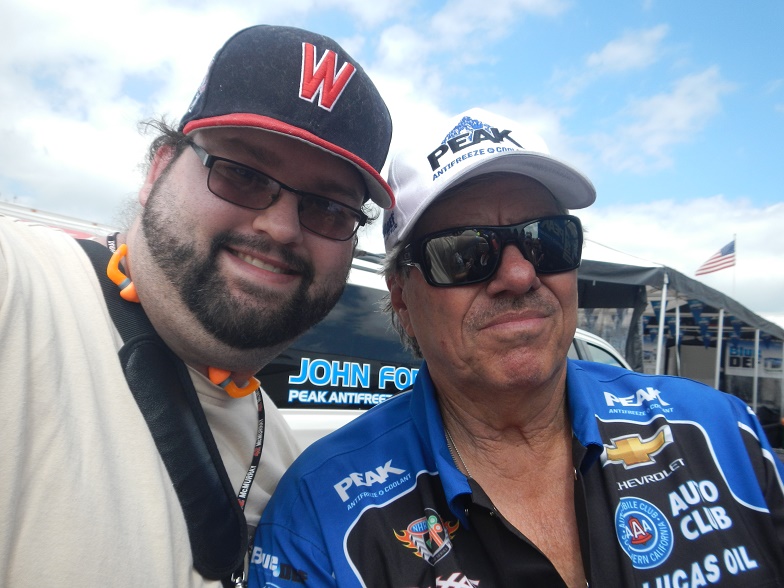
Sunday’s weather was much better. After the first two rounds, I wandered around the pits getting hero cards, and autographs. I got pictures with, and autographs from, Driver Suit Blog favorite Vieri “V” Gaines, JR Todd, Courtney Force, and John Force. I filmed one of Antron Brown’s engine tests,
filmed some slow motion video,
and got to see Solid Rock, a 1971 Ford Mustang funny car.In the end, Tony Schumacher, Tommy Johnson Jr, Allen Johnson, and Hector Arana Jr. won their classes, I got a sunburn, and had a great time, and I can’t wait to go back next year.
In 1995, Mark Martin had a great season. He had 4 wins, 13 top 5’s and 22 top 10’s. This press kit, complete with season information on Mark Martin and Roush Racing’s season and career, is in great condition.
What do Dale Earnhardt Jr., the Chicago Cubs, the Cleveland Browns, religion, and the lottery have in common? At first, it might seem like nothing. None of those things might seem to have anything in common with each other, but it isn’t the things themselves, it’s the hope of the people who support them.
The Chicago Cubs have gone 107 years without winning a World Series. The Cleveland Browns have never been to a Super Bowl. Dale Earnhardt Jr. has never won a Sprint Cup Championship, but all three are united by the undying hope of their fans. Human beings all have hope, but human beings need something to hope for, and something to inspire hope. For many, religion is that outlet. For others, it is their sports teams. For many, the hope that they could win millions in the lottery is that beacon of hope.
The history of the lottery in the United States dates back to the 1600’s, while Europe was colonizing North America. Many colonies saw gambling as harmless fun, but as English investors waned to profit from the New World, this changed quickly. As time went on, each of the 13 original colonies had a lottery system in place to help fund the colonies. It became a civic duty to play the lottery. Recessions, scandals, and corruption had almost eliminated the lottery in the United States by 1868.
In 1934, Puerto Rico, then a US colony, started a legal lottery. It would take 30 years, but in 1964, New Hampshire started a lottery. Since then, 44 of 50 states, as well as Puerto Rico, Washington DC, and the US Virgin Islands have lotteries. Alabama, Mississippi, and Utah don’t have lotteries due to religious objections. Nevada has the gambling industry, and they don’t want competition, and Alaska and Hawaii, not being mainland states, aren’t worried about losing tickets out of state.
The lottery takes several forms. Scratch off tickets, first introduced in the 1970’s, are a very popular method of playing the lottery. There are many different kinds of games, with different rules. Pick 3, pick 4, main drawing, and Powerball have their origin in “numbers games.” Numbers games were popular in poorer areas of the country, especially urban areas. The game works by drawing balls that had numbers to pick the winner. A similar game was popular in South Florida and Cuba called “Bolita” or “little ball” was where betters would bet on which number would be pulled out of a bag containing 100 numbered balls.
All the pre 1934 lotteries had one major drawback that kept them from being as accepted as it is today. They were easily rigged, and people lost money on the racketeering that took place around them. Today, the equipment, the drawing, the tickets, and every other aspect is heavily supervised and regulated so that this kind of cheating is not possible.
Anyone who thinks that lottery balls are ping pong balls has another guess coming. Lottery balls are specifically purpose designed. Made by Beitel Lottery Equipment, or Smartplay International, the balls are kept very secure at all times. According to Lotto Life, they are kept in safes, with 24 hour surveillance equipment focused on all aspects of the drawing. It isn’t known which of the machines, and which set of the lotto balls would be used until 90 minutes before the drawing.
After their life in the machine is over, what happens to the multi-colored balls that so many have placed their hope in? In many cases, they are kept by the lottery. In very rare instances, they are sold to the general public, like this example from the first Colorado Lottery.
The Colorado Lottery started on January 24, 1989, the first Colorado Lottery Drawing took place. It took place on Saturdays, and 42 numbers were drawn. In total, there are 1,405,006,117,752,879,898,543,142,606,244,511,569,936,384,000,000,000 different combination. This ball was one of at least two sets used. It was made by the Beitel Lottery Products company in Trenton New Jersey, and their logo is still embedded in the ball. To protect the secrecy of the makeup of the balls, it has been encased in Lucite. It has a plaque stating it was from “Set B” and was used from January 24, 1989 to March 4, 1995, just over 6 years of use. These were given to former employees, media members, and players.
Hope binds us all, we all have hope, and we all need something to hope for. Without hope, we truly have nothing. No matter where it comes from, it binds us all. So whatever hope means to you, I wish you the best.
By the way, if you, like me, are curious as to how they encase something like this in Lucite, this video should help explain it.
[Editor’s Note: I’m on vacation for July, and I will not update the tracker or paint scheme grades until August. In the meantime, I’ve got articles ready to go on Fridays. DGF]
By David G. Firestone
In January, I discussed NASCAR race winner napkin rings. These were brass rings that were given to crew members at banquets after the season. I had only seen Bobby Labonte, and Jeff Burton, but I came across a couple of Dale Jarrett rings recently. Dale Jarrett is a former NASCAR Sprint Cup Champion, having won in 1999. He won 3 Daytona 500’s, in 1993, 1996, and 2000. He won a total of 32 Sprint Cup and 11 Xfinity Series races.
In 1993, he won the Daytona 500, the race came down to the white flag as Dale Jarrett passed Dale Earnhardt in what became known as “The Dale and Dale Show.” With his father Ned in the broadcast booth calling the race, Dale Jarrett won the race, his second career victory. His first, incidentally, came at Michigan in 1991, while driving by the Wood Brothers. This ring was made for the banquet. It shows some wear on the inside. The top is a traditional design, one side has a picture of Dale Jarrett, his signature and #18. The other side has a picture of the car sandwiched in between INTERSTATE BATTERIES RACING and JOE GIBBS RACE TEAM. The inside shows some wear in the form of spots.
In 1994, he won his third race, the Mello Yello 500 at Charlotte Motor Speedway. He won after an engine failure claimed Geoff Bodine and a late crash destroyed the cars of Ricky Rudd and Jeff Gordon. This ring, almost identical in design to the Daytona 500 ring was prepared for the banquet. The only difference is that the #18 in the center of the top of the ring is in yellow, as the race was sponsored by Mello Yello. The small spots on the Daytona 500 ring are present here as well.
I’m still on vacation, but I’ve got something fun prepared for next week…stay tuned!
[Editor’s Note: I’m on vacation for July, and I will not update the tracker or paint scheme grades until August. In the meantime, I’ve got articles ready to go on Fridays. DGF]
By David G. Firestone
Cory McClenathan has raced in top fuel since 1991. Within that time, he has 34 wins, in 71 final round appearances. In 2015, he is making a comeback after disappearing from the sport for the last two seasons. Cory raced for Joe Gibbs Racing for many years, but now is racing for Chris Dakin and Dexter Tuttle.
I recently purchased a fan pack with two hero cards, one from 1999, which he has autographed, and one from 2011-2012 when he was racing for Rapisarda Racing, an Australian-based team. These are standard items. As is this press kit from 1999, which has driver, and team stats and news, and sponsor information from MBNA, who used to be a huge racing sponsor.The highlight of the collection are these tire shades. Unlike Formula 1, these are meant to protect the tires from the shade. Why is this important? Well tires are 36 inches tall by 17 inches wide. These races often take place in bright sunlight on hot days. If there was no shades, tire pressures could be very uneven, and as a direct result, the tire wouldn’t race as well, and there could be safety issued. These are designed and marketed by Jeg’s, who in addition to being a major seller of racing parts to many professional and amateur teams, is also a sponsor and team owner. These are designed for top fuel dragsters. Funny cars have a square piece that covers the wheel on the body.
This pair is unused and in great condition, and has CORY MCClLENATHAN printed on the side. They appear to be made out of insulated plastic. These are interesting items, and they come up for sale every now and again.
 By David G. Firestone
 They were sponsored by Stock Building Supply, which has a number of stores in 13 states. I’m gonna show both suits at the same time, to show how similar they are. The suit is made by Deist, though isn’t SFI certified. The collar has a Velcro-shut design with a DEIST logo on it, with a warranty tag underneath.


 The shoulders,
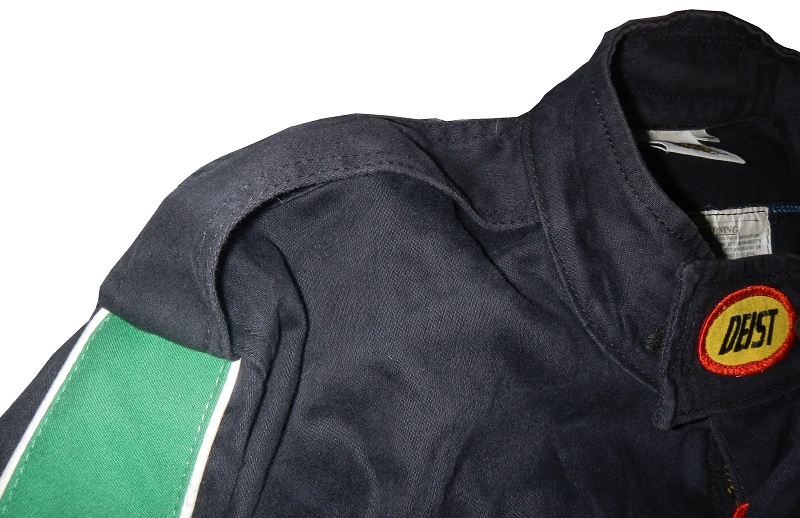

 belt,
belt, 
 and legs
 have no designs on them. The front has a STOCK BUILDING SUPPLY logo on it.
 The sleeves have green and white stripes, and DEIST logos embroidered into them.


 The only difference between the two suits is that one has CHIP written on the top of the right sleeve.


 The back of the neck has a DEIST tag.


 The back torso has a STOCK BUILDING SUPPLY logo and a DEIST SAFETY logo embroidered into it.
 This duality helped protect whoever Chip is, and it’s a good thing that neither suit suffered fire damage, and Chip wasn’t at any risk. Nomex has been the standard since 1967, and I see no signs of that changing in the foreseeable future.




 DGF2099-Main Page