I prefer driver suits, but I look for other forms of racing memorabilia as well. Every once in a while, I will come across something that I’ve never seen before. In this case, I came across a pair of lead crystal wine glasses from the Rolex 24.
Most racing fans only think of wine when it is being sprayed around in victory lane, or being given out as a trophy. However, wine is becoming ever more present at auto racing events for fan consumption, as it has in all other sports. Most NASCAR fans, myself included, stick to beer or soda, but in NASCAR and many other racing events, Formula 1 for example, fans will sip wine while watching the action. Every so often, a vineyard will sponsor a car, usually at Sonoma.
Further proof that wine is becoming a standard in auto racing is that Mario Andretti, Richard Childress, Jeff Gordon, Kevin Buckler, and Randy Lewis all own wineries or vineyards. Benny Parsons owned one before he passed away. Many other athletes own them as well, including Wayne Gretzky, Valeri Bure, Mike Ditka, Peggy Fleming, Dan Marino, Joe Montana, Mickey Morandini, and Charles Woodson. In addition to his successful iced tea/lemonade drink, Arnold Palmer has his own line of wines. Wine really is mainstream, and is popular in auto racing.
Most tracks will sell event branded pint glasses, but I came across these wine glasses from The 2015 Rolex 24 at Daytona. These lead crystal glasses are about nine inches tall, and have the Rolex 24 logo printed on the side with some very nice etchings on the Rolex logo. These are high quality wine glasses. Lead crystal is used on wine glasses because of the strength, clarity, ease of etching, and, interestingly, the tone made during a toast.
Ok, now with that out of the way, next week, we go back to what I love…Driver Suits!
I don’t normally tie in a My Thoughts On with the Friday Feature, but this week I’m going to. I’m not going to spoil the Friday Feature, so don’t worry. But I’ve been following this NASCAR Merchandise tent story, and I’m kind of shocked that it took NASCAR as long as it did to start using the tent. The large tent with all the drivers represented is an idea that should have been implemented years ago, but wasn’t. From what I have heard it is a great thing, but like most things in sports, it will be a work in progress.
I do give NASCAR credit for signing a deal with Fanatics. Fanatics is a merchandise company that operates retail outlets across the country, and uses their website to sell a whole array of items. They do offer some race-used memorabilia, but the race used memorabilia hobby always has and will be dominated by individual sellers, who collect and research items.
When I go to The Route 66 Nationals in Joliet, the NHRA has their own merchandise tent, referred to as “The Nitro Mall” and the teams have their own haulers set up at various points at the track. You can buy most anything driver branded, but I love to buy race-used parts, which are in plentiful supply.
Sports merchandise as a whole is a huge business. That is why teams will change uniforms every few years, especially NCAA uniforms. But I’m beginning to wonder if we have hit, or will soon hit peak merchandise. I get that fans want team branded merchandise, but how much is too much? For example, the latest thing I’ve seen is team branded phone chargers. You spend $25 to get a cord and dock with your team’s logo on it.
It’s different in auto racing because much of the merchandise is designed by the sponsor. Sponsors get cuts from merchandise sales, so they will be involved in the design process. I can’t help but wonder how much of a company’s budget, take Lowe’s for example, is spent on this process. The top sellers in merchandise all have sponsors with deep pockets, and huge advertising budgets. I would love to see the amount spent by the company on racing merchandise each season.
I’m willing to bet we will see an implosion of the sports merchandise market soon. I just can’t see the current merchandise level being maintained for much longer. Something has to give, and I think it will give soon. It will never go away, but it can’t hold on for much longer.
I collect all kinds of memorabilia, not just from auto racing, but from many kinds of sports. One thing that I collect that most people don’t really realize is an aspect of the sports memorabilia market is what is referred to as “stadium memorabilia.” Stadium memorabilia is memorabilia that comes from stadiums as opposed to players or drivers. It has gained new heights since the demolition of Yankee Stadium, Texas Stadium, and Steiner Sports selling memorabilia from the stadium.
This phenomena has spread to NASCAR. With the reconfiguration of Daytona, a slew of memorabilia from the track is now up for sale on eBay and NASCAR.com. Stadium memorabilia comes in several forms. These include seats, signs, scoreboard parts, and playing surfaces, amongst other things. I like to focus on playing surfaces. I have a number of different samples of artificial turf, some baseball infield dirt, and track pieces. This example came from Daytona after the repave in 2011. The entire 2.5 mile surface was removed and the track repaved. The old track was cut into pieces and sold to fans. This is an example of one of those pieces. It is 3 inches by 2 inches, about a third of an inch thick, and has a small plaque on it commemorating that it came from the track.
No track is as well-known as Indianapolis. Affectionately known as “The Brickyard” because of the yard of original bricks that make up the start/finish line. The line has had several different paint jobs over the years. This plaque has a piece of an original brick, and part of the start/finish line. The pieces of brick, and start/finish line are 1 ½ inch square, and the whole plaque is six inches by 1 foot.
This next piece is a mosaic of parts from the Pocono Start/Finish line. Like Daytona, the track was repaved in 2011, but the last repave took place in 1995, whereas Daytona hadn’t been repaved since 1978. The display is made up of six different pieces, each 2 inches square. Three pieces of white, three are black. They are set up to look like a checkered flag, and each piece is an inch and a half thick. It is mounted on a display from Jostens and has a NASCAR hologram.
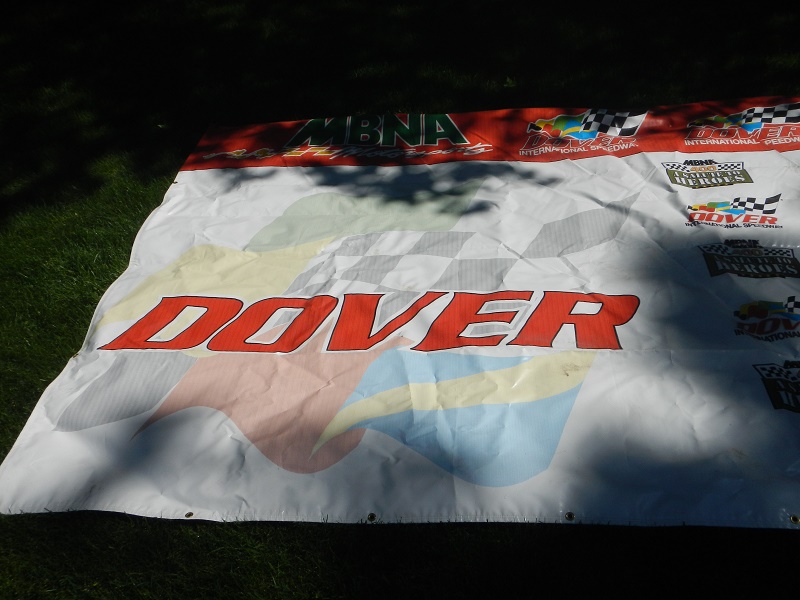
Moving away from racing surface pieces, we move to this piece, which is a banner from the 2004 MBNA America 400 “A Salute To Heroes.” The race took place on June 6, 2004, exactly 60 years after the D-Day invasion. Racing, especially NASCAR holds our military personnel and veterans in the high esteem they richly deserve, and the theme of this race was honoring our veterans. The race had an even more somber note. Ronald Reagan has passed away the previous day. This backdrop, which measures 8 feet tall by 26 feet long was used during the pre-race ceremonies, which included commemoration ceremonies, driver introductions, the invocation, and national anthem. I was able to video match it to the telecast. I normally add a white background to these photos, but I didn’t do that. I wanted to show the size of the banner, and so I had to lay it out on the front lawn, and photograph it from my office window.
This last item isn’t stadium used per se, but it falls in line with the banner above. AJ Foyt Enterprises fielded cars in IndyCar, NASCAR, CART, and USAC. While their IndyCar programs were successful, their NASCAR program wasn’t. From 2000 to 2002, Foyt’s #14 was sponsored by Conseco. For that sponsorship, this backdrop was created. It’s about a 1/3 the length of the Dover banner, but the same height. It has a series of NASCAR and Conseco logos.
That’s the Friday Feature this week, but next week, I’ve got an interesting little quirk in auto racing memorabilia…stay tuned.
This week, we’re going to do things a little differently. I came across this post from Bartley Motorsports in Rocksprings, Texas, and they were so good in explaining the SFI raiting for driver suits that I had to repost it. I take no credit fir this post, it all goes to Bartley Motosports. Thanks to Patrica Bartley for letting me use this!
What is “SFI” and why does it matter to me, as a racer? The SFI Foundation is a non-profit that administers standards for specialty automotive and racing equipment. For the purpose of this article, we’ll focus on “spec 3″ of the ratings as they relate to fire protection materials, driver suits and driver accessories.
3.2 is specifically a technical bulletin on Fire Protection Material while 3.2A is very prescriptive in the requirements to meet ratings such as 3.2A/1, 3.2A/3, 3.2A/5 having to do with “TPP” or Thermal Protective Performance or, how long until you reach a 2nd degree burn. As a realist, I hope we can all agree these are guidelines and not guarantees. One can imagine many circumstances that would influence the effectiveness of a given article and it’s ability to protect against flame. Of note, the 3.2A/10, 3.2A/15, 3.2A/20 ratings for driver suits currently require recertification every 5 years.
3.3 deals with accessories such as arm restraints, footwear, gloves, helmet supports and underclothing to name a few.
How do you know if an article is SFI approved and what it’s rating is? Glad you asked that. Every SFI approved item must carry a tag (normally affixed in a conspicuous location) that has a specific standard layout and will not only show SFI’s logo but it will call out the specification that it meets. It is interesting to note that different manufacturers use different materials to achieve the same ratings. Do your homework before you buy to be sure you are spending those dollars wisely. In addition, always follow the manufacturer’s cleaning instructions as you could easily alter the properties of your gear’s material and have disasterous results if the time came to rely on it. This is not something to take lightly.
To give you an idea of the relationship of the SFI rating, to TPP, to ‘time to burn’ we offer the following:
Race sactioning bodies will specify, in their rules, the minimum requirements to compete at various levels. For most highly competitive / high speed events you should give serious consideration to what your own expectations are as they relate to your safety. Ask yourself if you are prepared for the worst. Stop and think about “what if…”.
It wasn’t long ago we were passing through technical inspection and were told “you don’t need that [safety item] in this class” to which I quickly answered “I will if we flip the car”, which drew an affirming nod from the inspector. Only you can be responsible for you and you must be prepared to deal with the consequences of your decisions. We always exceed the requirements because we consider the “what ifs”. One more comment on that note – I’d rather exceed requirements as I PASS tech, than to fall short and be sitting out the event or scrambling to address the deficiency at the last minute.
When you are planning a first-time purchase or it is time to replace/upgrade, just think as you would when packing a suitcase:
1. Underwear (bottoms)
2. Undershirt (top)
3. Socks
4. Suit (two-piece top/bottom or one-piece driver suit)
5. Shoes
6. Gloves
7. Head protection (head sock (balaclava) and helmet)
6. “other” as required – helmet support, arm restraints, head/neck restraints, harnesses…there is a lot going on as it relates to your safety in competition. READ THE RULES!
Check out our website for pictures, information and pricing of safety equipment.
Thanks again to Patrica Bartley and Bartley Motosports for letting me use this! Next week, we examine an area of the racing memorabilia market many fans are shocked even exists.
Admittedly, I don’t watch a lot of motorcycle racing, out of pro stock motorcycle. In the US, we don’t have the access to MotoGP that we do for Formula 1, NASCAR, IndyCar, and the NHRA. When I get the chance to watch it, I love it for a number of reasons. I like watching a form of motorsports where I have no favorite rider, and the racing is really good.
Leather has a long history in sports. Most game balls, gloves, shoes, and some on-field equipment are made of leather, and many older uniforms, especially helmets were made of leather. Nowhere is leather more critical to the safety of the wearer than motorcycle racing. I’ve discussed it in my NHRA Uniform article, but the reality is that at high speeds, the leather will protect the rider from having his skin ripped off.
What I found interesting is that while professional riders exclusively wear leather, the weekend warriors can pick from a number of different of different fabrics, some of which you might not expect. Take this BMW City II motorcycle suit for example:
Made of 100% Nylon, this red, green, and white suit was made in the 1990’s by Dainese. The suit is multi-layered with several layers of fabric, and has pads on the shoulders, elbows, and knees. There is no padding on the back. It shows no wear at all, and is in great condition. The cuffs and collar are designed to cover as much skin as possible, but unlike a Nomex suit, this is to prevent road rash. This suit is also notable for the biggest belt I have ever seen. It is over 6 inches wide!
How well this would protect the rider at street speeds is unknown. It looks like that if you were at a stoplight, the suit would protect quite well. At 55 MPH, it might provide some protection from injury, and at 100 MPH, it would provide no protection at all. The padding area would provide more support than the cloth area. It does feel heavy duty, but I don’t think that it would provide as much protection as a leather suit.
I’ve been trying to find a MotoGP suit, or a similar suit, but they aren’t available. I bought this one because it is uniquely designed, and it does look pretty good. I hope to get a race-used suit soon.
That covers it for this week, tune in next week when I cover SFI ratings again.
[Editor’s Note: I’m on vacation for July, and I will not update the tracker or paint scheme grades until August. In the meantime, I’ve got articles ready to go on Fridays. DGF]
By David G. Firestone
Nomex is a great material for driver suits. It will protect the driver in the event of a fire, with no health issues, unlike asbestos. It is much more comfortable to wear than chemical dipped cotton, and much more durable. It does however have one major drawback. Should the material get burned, and discolored, the whole suit becomes useless. The discolored area of the suit will not protect the driver from fire.
The damage from fire can’t be fixed. This is why there are multiple suits issued to drivers Contrary to what a lot of people believe, cleaning a Nomex suit won’t reduce the fire protection, in fact it will help. This is why when photo-matching, drivers can often be seen in the same basic design, with some very slight differences. Fire protection is key for drivers and crew members alike.
These are two of the exact same suit, issued to a crew member named Chip. They were sponsored by Stock Building Supply, which has a number of stores in 13 states. I’m gonna show both suits at the same time, to show how similar they are. The suit is made by Deist, though isn’t SFI certified. The collar has a Velcro-shut design with a DEIST logo on it, with a warranty tag underneath. The shoulders, belt, and legs have no designs on them. The front has a STOCK BUILDING SUPPLY logo on it. The sleeves have green and white stripes, and DEIST logos embroidered into them. The only difference between the two suits is that one has CHIP written on the top of the right sleeve. The back of the neck has a DEIST tag.The back torso has a STOCK BUILDING SUPPLY logo and a DEIST SAFETY logo embroidered into it. This duality helped protect whoever Chip is, and it’s a good thing that neither suit suffered fire damage, and Chip wasn’t at any risk. Nomex has been the standard since 1967, and I see no signs of that changing in the foreseeable future.
Every year, I take a month-long vacation in the summer, which coincides with the NHRA Lucas Oil Route 66 Nationals. I love drag racing, and the Route 66 Nationals is the NHRA’s stop on the Mello Yello Drag Racing Series tour. I go with friends from work, and every year, we have a great time.
Mother Nature was not in the kindest of moods on Saturday. Friday Night Qualifying went off without a hitch. I did get to watch the Jeg’s All-Stars race their elimination races. After the Jeg’s All Stars on Saturday, it began to rain. The rain continued to fall for several hours, during which time, I wandered around the pits. I got to meet Driver Suit Blog favorites Tony Schumacher and Ron Capps. Every year, I get the chance to ask Tony Schumacher a question, and the video below is of how that went.
I got a #1 qualifier interview cap from The Thunder Valley Nationals on eBay, and I got it signed by Schumacher, Capps, Tommy Johnson Jr., Fast Jack Beckman, Erica Enders-Stevens, JR Todd, Alexis DeJoria, and John Force. The story behind these interview hats is interesting. Mello Yello gives these hats out to drivers at events, and there are a series of different colors. For qualifying and round winners who don’t wear a sponsor hat after getting out of a car for an interview, they are given either a gray, orange, or black hat. They are all of the same design. For the driver who qualifies #1, they are given a green hat, with a #1 Qualifier patch with their respective class. The drivers who win the event get a yellow cap, with a winner patch to wear, similar in design to the #1 qualifier hat. The drivers who win the championship get a white hat. Drivers wear these hats during interviews, except for John Force who prefers to wear his own hat for an interview after he qualifies #1 or wins.
Jack Beckman personalized my Infinite Hero Challenge Coin, and gave me a very heart felt thank you. I also got one of Cruz Pedregon’s valve springs from his engine, and a burnt hose cover. This is a perfect example of why Nomex is the go-to material for driver suits. This Nomex hose cover went through a serious fire, and was burnt. Nomex isn’t fireproof, it’s fire retardant, which means it will burn, but much slower than most fabrics. It will burn, but will protect whatever it is covering from fire damage for a brief time. The easy way to see if the material has been compromised is if the fabric is discolored. Notice the areas of light on the black fabric, that means that area of the fabric has been compromised. Driver suits, when burned, will show the same discoloration. Should the driver wear the suit, and suffer a similar fire, the suit won’t protect them, and serious burns can and will occur. It may seem like a waste, but countless drivers are alive and well today because of this property of Nomex.
After the rain subsided, and the track was dried, I got to watch round 3 of qualifying, which was supposed to happen at 1 pm, but took place at about 4 pm. It had a lot of good rounds, including TJ Zizzo’s explosion. We decided to go home after round 3, and as we were leaving, we saw the storm clouds were beckoning. Round 4, which started after we left was canceled due to another rainstorm.
Sunday’s weather was much better. After the first two rounds, I wandered around the pits getting hero cards, and autographs. I got pictures with, and autographs from, Driver Suit Blog favorite Vieri “V” Gaines, JR Todd, Courtney Force, and John Force. I filmed one of Antron Brown’s engine tests,
filmed some slow motion video,
and got to see Solid Rock, a 1971 Ford Mustang funny car.In the end, Tony Schumacher, Tommy Johnson Jr, Allen Johnson, and Hector Arana Jr. won their classes, I got a sunburn, and had a great time, and I can’t wait to go back next year.
[Editor’s Note: I’m on vacation for July, and I will not update the tracker or paint scheme grades until August. In the meantime, I’ve got articles ready to go on Fridays. DGF]
By David G. Firestone
Cory McClenathan has raced in top fuel since 1991. Within that time, he has 34 wins, in 71 final round appearances. In 2015, he is making a comeback after disappearing from the sport for the last two seasons. Cory raced for Joe Gibbs Racing for many years, but now is racing for Chris Dakin and Dexter Tuttle.
I recently purchased a fan pack with two hero cards, one from 1999, which he has autographed, and one from 2011-2012 when he was racing for Rapisarda Racing, an Australian-based team. These are standard items. As is this press kit from 1999, which has driver, and team stats and news, and sponsor information from MBNA, who used to be a huge racing sponsor.The highlight of the collection are these tire shades. Unlike Formula 1, these are meant to protect the tires from the shade. Why is this important? Well tires are 36 inches tall by 17 inches wide. These races often take place in bright sunlight on hot days. If there was no shades, tire pressures could be very uneven, and as a direct result, the tire wouldn’t race as well, and there could be safety issued. These are designed and marketed by Jeg’s, who in addition to being a major seller of racing parts to many professional and amateur teams, is also a sponsor and team owner. These are designed for top fuel dragsters. Funny cars have a square piece that covers the wheel on the body.
This pair is unused and in great condition, and has CORY MCClLENATHAN printed on the side. They appear to be made out of insulated plastic. These are interesting items, and they come up for sale every now and again.
Recently, I came across some helmets this last year from a company called BrandArt. I’d never heard of the company before, and I looked them up. I thought at first that they were a memorabilia company, but it turns out they are an “Global Sourcing and Licensor Co-Branding Services in North America and Asia.” Looking at some of their helmets on eBay, their helmets range from accurate versions of helmets, as sold on Lionel’s website, to more plain versions. I’ve been saying we need more of these, and now BrandArt is leading the charge.
I got one of these helmets for Christmas. This Ricky Stenhouse Best Buy helmet.
Let me say, right off the bat, this helmet is very well made. If there wasn’t a strap inside the helmet warning you it is for decoration, you would swear that it was a protective helmet. The quality is part of what makes these helmets good. The design on this helmet is good too. This plain helmet with the sponsor and bare design works well for getting autographs at the track or sponsor events. I also like the driver name on the visor stripe. The font they chose is really good. I don’t normally talk about fonts, but this one is really good. This makes a really good display item too. It would work well in an office, or rec room. It’s also perfectly designed to fit on a bookshelf.
The second helmet I got is this Carl Edwards Aflac helmet. When Carl made the jump from Roush Fenway to Joe Gibbs, Subway went with Carl, but Aflac chose not to stay. This Aflac helmet works well because black is a good background color. The green doesn’t work, blue can work sometimes, but not always, but black works well as a background color. This is another instance of a helmet that would be good to collect autographs on.
These are an older version of the helmet. Newer replica helmets have a more elongated shape, and are much more faithful in design to their on-track counterparts. BrandArt is hitting it out the park with these replica helmets, and I will get some more soon!
Editor’s Note, Next week, I’ll be starting my month long vacation. I will have Friday Features, but I won’t update the tracker or paint scheme grades.
Last week, I covered the first incarnation of Sports Cover Up full size replica helmets. Well after that set was released, the design was completely redesigned. The softer plastic was replaced with a more rigid, harder plastic. Also, the visor has been redesigned, so it can be moved up or down. The finish is much shiner too. To sum it up, the quality is much better. The bottom is also a rigid plastic stand, which helps display the helmet better.
The first example is a Bill Elliott McDonald’s helmet from, I’m guessing 1999. I think it’s from 1999 as there isn’t a 50th Anniversary logo anywhere on the helmet. NASCAR put that logo on EVERYTHING in 1998, and the lack of it makes me think that this came from 1999. Anyway, the helmet feels much more well made than the 1997 helmet. It isn’t impossible that Elliott wore this design during 1998 or 1999, but I have yet to see it.
Mark Martin’s accurate design makes a return with this helmet. Interestingly, unlike the Bill Elloitt model, the intake nozzle is accurate. In NASCAR, and other forms of stock car racing, air is blown into the helmet via a filtering system to keep the driver cool. Not only does this helmet have a nozzle, it is pretty accurate.
Outside of these helmets, I can’t find anything else from this company. They look good, and I would have to guess that they made more memorabilia, not just for NASCAR but for other sports teams as well. If anyone can help me out with information, shoot me an email. I really want to know about this company. We’ll discuss a more modern version of these helmets next week.